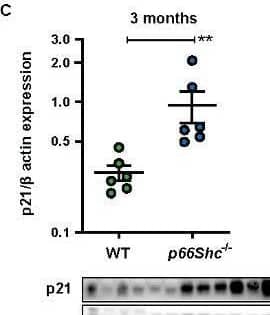
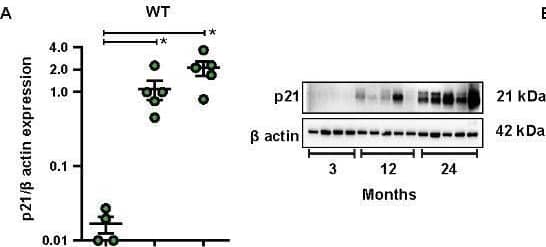
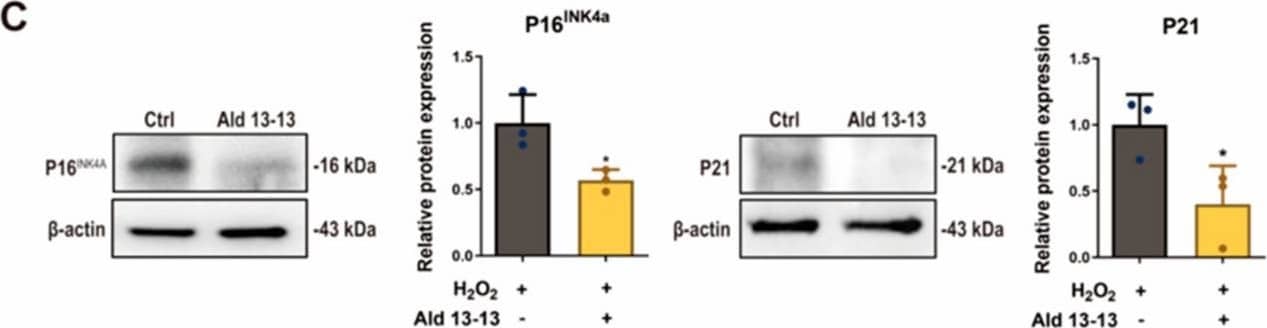
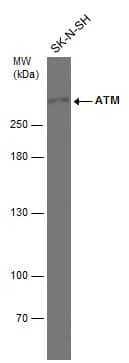
| Immunogen | A synthetic peptide, which represented a portion of human Nijimegen breakage syndrome 1 between amino acid residues 625 and 675 encoded in part by exons 12 and 13 (LocusLink ID 4683). |
| Localization | Nuclear |
| Isotype | IgG |
| Clonality | Polyclonal |
| Host | Rabbit |
| Gene | NBN |
| Purity | Immunogen affinity purified |
| Innovator's Reward | Test in a species/application not listed above to receive a full credit towards a future purchase. |
| Dilutions |
|
||||
| Theoretical MW | 85 kDa. Disclaimer note: The observed molecular weight of the protein may vary from the listed predicted molecular weight due to post translational modifications, post translation cleavages, relative charges, and other experimental factors. |
||||
| Control |
|
||||
| Publications |
|
| Storage | Store at 4C. Do not freeze. |
| Buffer | Tris-Citrate/Phosphate (pH 7.0 - 8.0) |
| Preservative | 0.09% Sodium Azide |
| Concentration | 1.0 mg/ml |
| Purity | Immunogen affinity purified |







Secondary Antibodies |
Isotype Controls |
Research Areas for Nbs1 Antibody (NB100-277)Find related products by research area.
|
|
The MRE11 Complex and DNA Damage Response The maintenance of genome stability depends on the DNA damage response (DDR) which is a complex signaling network including cell cycle checkpoints, DNA repair and damage tolerance pathways. The DDR complex has the ability to sense DNA damage and tra... Read full blog post. |
|
NBS1: The DNA Repair Trigger NBS1 (Nijmegen breakage syndrome protein 1) is a component of the MRN complex (Mre11-Rad50-Nbs1) that plays important role in detecting DNA double strand breaks (DSBs) and triggering the downstream cascade. DSBs can be caused by ionizing radiation, ch... Read full blog post. |
|
NBS1: DNA Repair Trigger NBS1 (Nijmegen breakage syndrome protein 1) is a component of the MRN complex (Mre11-Rad50-Nbs1) that plays important role in detecting DNA double strand breaks (DSBs) and triggering the downstream cascade. DSBs can be caused by ionizing radiation, ch... Read full blog post. |
The concentration calculator allows you to quickly calculate the volume, mass or concentration of your vial. Simply enter your mass, volume, or concentration values for your reagent and the calculator will determine the rest.









![Western Blot BRCA2 Antibody (234403) [Unconjugated]](https://images.novusbio.com/images/antibody/BRCA2_MAB2476_Western_Blot_6033.jpg)
![Immunohistochemistry BRCA2 Antibody (234403) [Unconjugated]](https://images.novusbio.com/images/antibody/mab2476_human-brca2-mab-clone-234403-immunohistochemistry-10520211657.jpg)

![Immunocytochemistry/ Immunofluorescence CFTR Antibody (24-1) [Unconjugated] - C-terminus](https://images.novusbio.com/images/mab25031_human-cftr-c-terminus-mab-clone-24-1-4120241251381.jpg)
![Immunohistochemistry CFTR Antibody (24-1) [Unconjugated] - C-terminus](https://images.novusbio.com/images/antibody/CFTR_MAB25031_Immunohistochemistry_6973.jpg)
![Western Blot CFTR Antibody (24-1) [Unconjugated] - C-terminus](https://images.novusbio.com/images/mab25031_human-cftr-c-terminus-mab-clone-24-1-41202412512653.jpg)