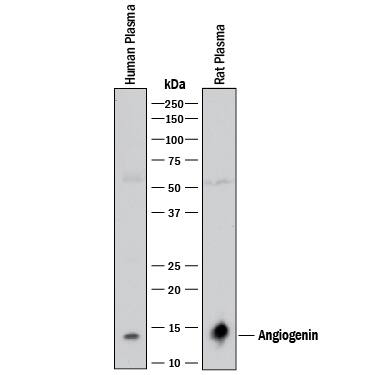
 HAF017). A specific band was detected for Angiogenin at approximately 14 kDa (as indicated). This experiment was conducted under reducing conditions and using Immunoblot Buffer Group 1." title="Western blot shows human plasma and rat plasma. PVDF membrane was probed with 0.5 µg/mL of Goat Anti-Human/Rat Angiogenin Antigen Affinity-purified Polyclonal Antibody (Catalog # AF265) followed by HRP-conjugated Anti-Goat IgG Secondary Antibody (Catalog # HAF017). A specific band was detected for Angiogenin at approximately 14 kDa (as indicated). This experiment was conducted under reducing conditions and using Immunoblot Buffer Group 1." />
| Reactivity | Hu, RtSpecies Glossary |
| Applications | WB, Simple Western, IHC |
| Clonality | Polyclonal |
| Host | Goat |
| Conjugate | Unconjugated |
| Concentration | LYOPH |
| Immunogen | E. coli-derived recombinant human Angiogenin Gln25-Pro147 Accession # Q53X86 |
| Specificity | Detects human Angiogenin in direct ELISAs and Western blots. |
| Source | N/A |
| Isotype | IgG |
| Clonality | Polyclonal |
| Host | Goat |
| Gene | ANG |
| Purity Statement | Antigen Affinity-purified |
| Innovator's Reward | Test in a species/application not listed above to receive a full credit towards a future purchase. |
| Dilutions |
|
|
| Publications |
|
| Storage | Use a manual defrost freezer and avoid repeated freeze-thaw cycles.
|
| Buffer | Lyophilized from a 0.2 μm filtered solution in PBS with Trehalose. *Small pack size (SP) is supplied either lyophilized or as a 0.2 µm filtered solution in PBS. |
| Preservative | No Preservative |
| Concentration | LYOPH |
| Reconstitution Instructions | Reconstitute at 0.2 mg/mL in sterile PBS. |
Angiogenin was initially purified from serum-free media conditioned by growth of a human adenocarcinoma cell line HT-29 based on its ability to initiate vascularization in the chicken embryo chorioallantoic membrane. A number of other tumor, as well as normal, cell lines can also secrete Angiogenin. In addition, Angiogenin is present in normal human plasma at levels as high as 60‑120 ng/mL. Unlike other angiogenic factors such as FGF, Angiogenin is neither mitogenic nor chemotactic for vascular endothelial cells in vitro. However, Angiogenin can stimulate capillary and umbilical vein endothelial cells to produce diacylglycerol and secrete prostacyclin by phospholipase activation. Angiogenin, absorbed on plastic, can also support endothelial and fibroblast cell adhesion and spreading.
Surprisingly, Angiogenin has been found to be a member of the ribonuclease superfamily with approximately 35% sequence similarity at the amino acid level with pancreatic RNase. Angiogenin exhibits ribonucleolytic activity that is distinctly different than that of pancreatic RNase A. The ribonucleolytic activity of Angiogenin toward most RNase A substrates is much lower than that of RNase A. Nevertheless, the ribonucleolytic activity of Angiogenin is essential to its angiogenic activity since inhibition of the Angiogenin RNase activity will also abolish angiogenesis activity. Similar to several members of the RNase superfamily, Angiogenin is a cytotoxic agent that can abolish cellular protein synthesis. It has been demonstrated that Angiogenin-dependent protein synthesis inhibition can be attributed to the function of Angiogenin as a cytotoxic tRNA-specific RNAase.
A cell-surface Angiogenin binding protein has been purified and characterized. Tryptic peptide mapping and sequence analysis indicate that this binding protein is a member of the actin family.
![Immunohistochemistry ACE/CD143 Antibody [Unconjugated]](https://images.novusbio.com/images/antibody/ACE_AF1513_Immunohistochemistry_6703.jpg)
![Western Blot ACE/CD143 Antibody [Unconjugated]](https://images.novusbio.com/images/antibody/ACE_AF1513_Flow_Cytometry_20028.jpg)
![Simple Western ACE/CD143 Antibody [Unconjugated]](https://images.novusbio.com/images/antibody/ACE_AF1513_Simple_Western_20109.jpg)



Secondary Antibodies |
Isotype Controls |
The concentration calculator allows you to quickly calculate the volume, mass or concentration of your vial. Simply enter your mass, volume, or concentration values for your reagent and the calculator will determine the rest.


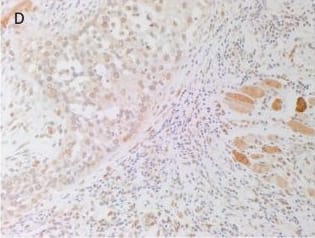
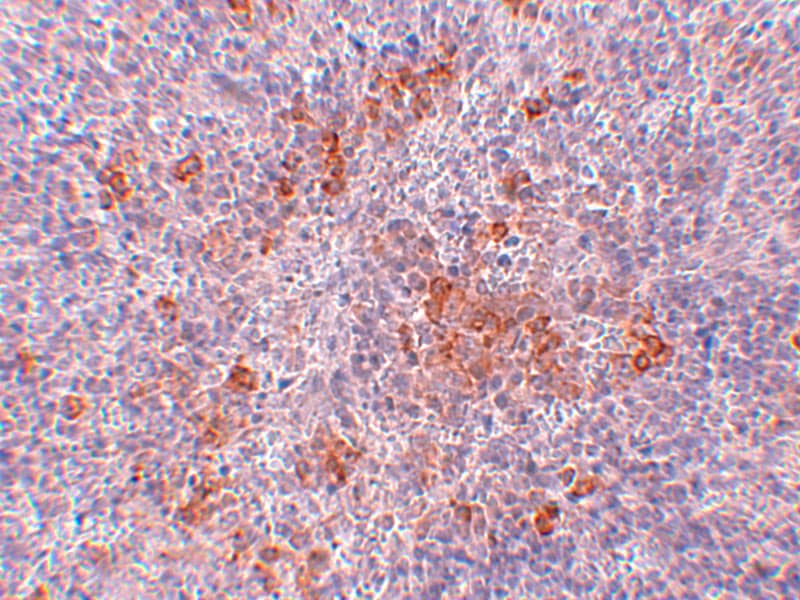
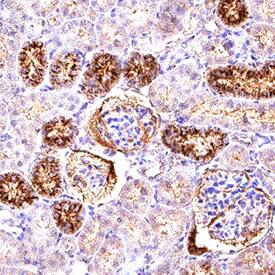 VC004). Before incubation with the primary antibody, tissue was subjected to heat-induced epitope retrieval using Antigen Retrieval Reagent-Basic (
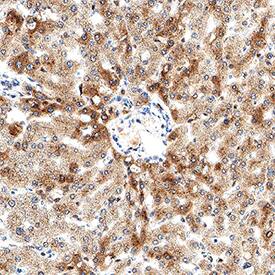 VC004). Before incubation with the primary antibody, tissue was subjected to heat-induced epitope retrieval using Antigen Retrieval Reagent-Basic (
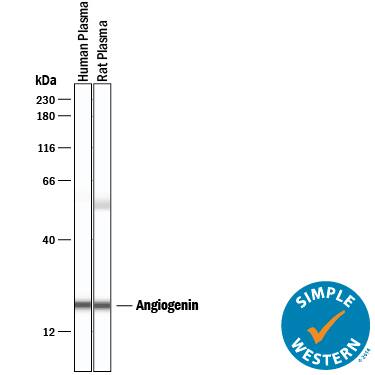 HAF109). This experiment was conducted under reducing conditions and using the 12-230 kDa separation system." title="Simple Western lane view shows human plasma and rat plasma, loaded at 0.2 mg/mL. A specific band was detected for Angiogenin at approximately 20 kDa (as indicated) using 5 µg/mL of Goat Anti-Human/Rat Angiogenin Antigen Affinity-purified Polyclonal Antibody (Catalog # AF265) followed by 1:50 dilution of HRP-conjugated Anti-Goat IgG Secondary Antibody (Catalog #
  265-AN) was serially diluted and captured by Mouse Anti-Human Angiogenin Monoclonal Antibody (Catalog #


![Immunocytochemistry/ Immunofluorescence Renin Antibody [Unconjugated] - 1](https://images.novusbio.com/images/af4277_mouse-renin-1-affinity-purified-polyclonal-ab-41202412394940.jpg)
![Immunohistochemistry Renin Antibody [Unconjugated] - 1](https://images.novusbio.com/images/antibody/Renin_AF4277_Immunohistochemistry_17351.jpg)
![ELISA Renin Antibody [Unconjugated] - 1](https://images.novusbio.com/images/af4277_mouse-renin-1-affinity-purified-polyclonal-ab-elisa-639201778625485467.jpg)




![N/A VEGF [HRP]](https://images.novusbio.com/images/elisa/VEGF_DVE00_ELISA_208.jpg)
![N/A VEGF [HRP]](https://images.novusbio.com/images/elisa/DATA_VEGF_DVE00_ELISA_871.jpg)
![N/A VEGF [HRP]](https://images.novusbio.com/images/elisa/DATA_VEGF_DVE00_ELISA_872.jpg)


![Western Blot ERK2 Antibody [Unconjugated]](https://images.novusbio.com/images/antibody/ERK2_AF1230_Western_Blot_5097.jpg)
![Knockout Validated ERK2 Antibody [Unconjugated]](https://images.novusbio.com/images/antibody/ERK2_AF1230_Knockout_Validated_22864.jpg)
![Immunohistochemistry ERK2 Antibody [Unconjugated]](https://images.novusbio.com/images/antibody/ERK2_AF1230_Immunohistochemistry_20696.jpg)
![Angiopoietin-1 [Unconjugated]](/sites/all/modules/enterprise-tech/et_datasheets/images/novus_guarantee.png "Angiopoietin-1 [Unconjugated]")
![SDS-Page TNF-alpha [Unconjugated]](https://images.novusbio.com/images/protein/TNF-alpha_210-TA_256.jpg)
![Bioactivity TNF-alpha [Unconjugated]](https://images.novusbio.com/images/protein/TNFalpha_210TA_1658.jpg)
![SEC-MALS TNF-alpha [Unconjugated]](https://images.novusbio.com/images/210-ta_recombinant-human-tnf-alpha-protein-sec-mals-35202312244..jpg)
![N/A Angiopoietin-2 [HRP]](https://images.novusbio.com/images/elisa/Angiopoietin-2_DANG20_ELISA_30.jpg)
![N/A Angiopoietin-2 [HRP]](https://images.novusbio.com/images/elisa/DATA_Angiopoietin2_DANG20_ELISA_574.jpg)