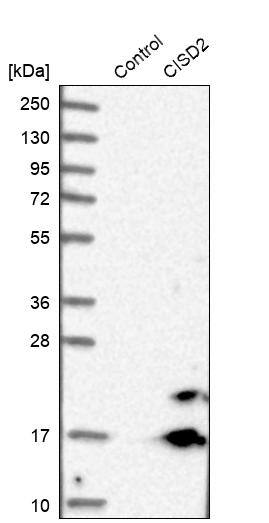
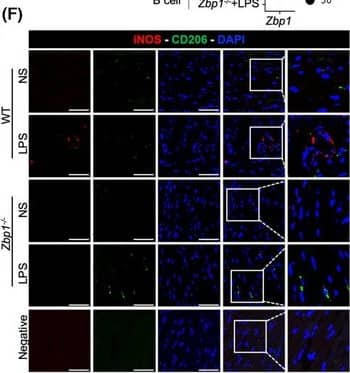
STING/TMEM173 Knockout HeLa Cell Lysate

Images


Product Details

Summary
Product Discontinued
View other related STING/TMEM173 Lysates

Order Details


    • Catalog Number
      NBP2-66102
    • Availability
      Product Discontinued

    Can't find what you are looking for? Use our Antibody Concierge Service & we will help you locate your antibody!

    Or feel free to contact us for alternative products.

STING/TMEM173 Knockout HeLa Cell Lysate Summary

Preparation
Method
Knockout achieved by using CRISPR/Cas9,-1 bp deletion in exon3 and 2 bp insertion in exon3 and Insertion of the selection cassette in exon3
Gene
STING1

Applications/Dilutions

Dilutions
  • Western Blot
Application Notes
You will receive 1 vial (100ug) of knockout cell lysate and 1 vial (100ug) of Parental cell lysate. Lysate can be diluted with 1X SDS sample buffer and will be stable at -20 degrees C for 12 months. Minimize freeze-thaw cycles.

Packaging, Storage & Formulations

Storage
Store at -20C short term. Aliquot and store at -80C long term. Avoid freeze-thaw cycles.
Buffer
0.1 mg cell homogenate lyophilized in RIPA buffer made with double-knockout cell lines.
Concentration
LYOPH
Reconstitution Instructions
To use as WB negative control, spin down briefly and resuspend in 100 uL 1xSDS sample buffer (2% SDS, 60 mM Tris-HCl pH 6.8, 10% Glycerol, 0.02% Bromophenol blue, 60 mM beta-mercaptoethanol). Boil the lysate for 3 - 5 minutes before loading it onto gel.

Lysate Details for Array

Type
Knockout HeLa Cell

Notes

Powered by EDIGENE.
Validation of antibody specificity is critical and verification of antibody performance against knockout samples is one way to guarantee that an antibody recognizes a specific target. Novus' KO cell lysate can be used as a negative control for western blots and to confirm the specificity of antibodies.

Alternate Names for STING/TMEM173 Knockout HeLa Cell Lysate

  • endoplasmic reticulum IFN stimulator
  • Endoplasmic reticulum interferon stimulator
  • ERIS
  • FLJ38577
  • hMITA
  • hSTING
  • Mediator of IRF3 activation
  • MITA
  • mitochondrial mediator of IRF3 activation
  • MPYS
  • NET23
  • N-terminal methionine-proline-tyrosine-serine plasma membrane tetraspanner
  • SAVI
  • Stimulator of interferon genes protein
  • stimulator of interferon protein
  • STING
  • STING-beta
  • TMEM173
  • transmembrane protein 173

Background

STING (stimulator of interferon genes) is encoded by the TMEM173 gene and is an adaptor molecule involved in the activation of innate immune responses to PAMPS (pathogen-associated molecular patterns) and DAMPS (damage-associated molecular patterns). STING specifically recognizes cytosolic DNA products derived from pathogens (e.g., cytomegalovirus, vaccinia virus, Listeria monocytogenes) or dead cells (1, 2). In the STING pathway, dsDNA derived from pathogens or damaged cells serves as a substrate for the enzyme cGAS (cyclic GMP-AMP synthase) which produces the second messenger cyclic GMP-AMP (cGAMP) from ATP and GTP (3, 4). Under steady-state conditions STING (theoretical molecular weight 42 kDa), a protein localizes to the ER membrane. Upon activation by dsDNA derived second messenger (cGAMP), STING translocates to the Golgi apparatus as a homodimer. Once STING has trafficked to the perinuclear region, it activates TANK binding kinase 1 (TBK1), interferon regulatory factor 3 (IRF3) and NF-kB leading to the production of cytokines (e.g., type I interferon) (2, 4). Mutations in the TMEM173 gene affecting STING expression are associated with the development of the auto-inflammatory disease SAVI (STING-associated vasculopathy with onset in infancy) (2). A novel SAVI dominant mutation in the TMEM173 human gene (V155M) leads to increased localization of STING to the Golgi and perinuclear region, indicative of an activated state (1). Hallmarks of SAVI, a rare inflammatory disease, include severe vasculitis in extremities and lung inflammation (7).

References

1. Patel, S., & Jin, L. (2019). TMEM173 variants and potential importance to human biology and disease. Genes and Immunity. https://doi.org/10.1038/s41435-018-0029-9

2. Jounai, N., Kobiyama, K., Takeshita, F., & Ishii, K. J. (2013). Recognition of damage-associated molecular patterns related to nucleic acids during inflammation and vaccination. Frontiers in Cellular and Infection Microbiology. https://doi.org/10.3389/fcimb.2012.00168

3. Xiao, T. S., & Fitzgerald, K. A. (2013). The cGAS-STING Pathway for DNA Sensing. Molecular Cell. https://doi.org/10.1016/j.molcel.2013.07.004

4. Kato, K., Omura, H., Ishitani, R., & Nureki, O. (2017). Cyclic GMP-AMP as an Endogenous Second Messenger in Innate Immune Signaling by Cytosolic DNA. Annual Review of Biochemistry. https://doi.org/10.1146/annurev-biochem-061516-044813

5. Crowl, J. T., Gray, E. E., Pestal, K., Volkman, H. E., & Stetson, D. B. (2017). Intracellular Nucleic Acid Detection in Autoimmunity. Annual Review of Immunology. https://doi.org/10.1146/annurev-immunol-051116-052331

Limitations

This product is for research use only and is not approved for use in humans or in clinical diagnosis. Lysates are guaranteed for 6 months from date of receipt.

Customers Who Viewed This Item Also Viewed...

NB100-56705
Species: Bv, Ca, Hu, Mu, Rt
Applications: ICC/IF, IHC,  IHC-P, IP, KO, Simple Western, WB
NBP2-67741
Species: Hu, Mu, Rt
Applications: Flow, ICC/IF, IHC,  IHC-P, WB
NB100-80859
Species: Hu, Mu, Rt
Applications: ELISA, ICC/IF, IHC,  IHC-P, WB
8499-IF
Species: Hu
Applications: BA
NBP1-84809
Species: Hu
Applications: ICC/IF, IHC,  IHC-P, WB
NB100-56583
Species: Hu, Rb, Rt
Applications: Flow, IHC,  IHC-P, KO, Simple Western, WB
NBP2-24729
Species: Ca, Eq, Hu, Pm, Mu, Pm, Rt
Applications: B/N, CyTOF-ready, DB, ELISA, Flow-IC, Flow, Func, ICC/IF, IHC,  IHC-P, IP, In vitro, KD, Simple Western, WB
NBP2-47415
Species: Hu
Applications: ICC/IF, IHC,  IHC-P, WB
NBP2-27354
Species: Hu
Applications: WB
NB120-13810
Species: Mu, Po, Rt
Applications: IB, ICC/IF, IHC,  IHC-P, IP, KD, Simple Western, WB
NBP1-76854
Species: Hu, Mu, Rt
Applications: ELISA, ICC/IF, IHC,  IHC-P, KD, WB
NBP2-21037
Species: Hu
Applications: IHC,  IHC-P, WB
NBP2-31361
Species: Hu
Applications: IHC,  IHC-P, WB
NBP1-81988
Species: Hu
Applications: IHC,  IHC-P
NBP2-24875
Species: Ca, Hu, Mu
Applications: BA, B/N, Flow-IC, Flow, ICC/IF, IHC,  IHC-P, WB
NBP1-86976
Species: Hu
Applications: IHC,  IHC-P
NBP1-84265
Species: Hu
Applications: IHC,  IHC-P

Publications for STING/TMEM173 Lysate (NBP2-66102) (0)

There are no publications for STING/TMEM173 Lysate (NBP2-66102).
By submitting your publication information earn gift cards and discounts for future purchases.

Reviews for STING/TMEM173 Lysate (NBP2-66102) (0)

There are no reviews for STING/TMEM173 Lysate (NBP2-66102). By submitting a review you will receive an Amazon e-Gift Card or Novus Product Discount.
  • Review with no image -- $10/€7/£6/$10 CAD/¥70 Yuan/¥1110 Yen
  • Review with an image -- $25/€18/£15/$25 CAD/¥150 Yuan/¥2500 Yen

Product General Protocols

Find general support by application which include: protocols, troubleshooting, illustrated assays, videos and webinars.

Video Protocols

WB Video Protocol

FAQs for STING/TMEM173 Lysate (NBP2-66102) (0)

There are no specific FAQs related to this product. Read our general customer & technical service FAQs.

Additional STING/TMEM173 Products

Research Areas for STING/TMEM173 Lysate (NBP2-66102)

Find related products by research area.

Blogs on STING/TMEM173.

STING in Innate Immunity and Cancer: What’s the Buzz About?
STING (STimulator of INterferon Genes protein) acts as a sensor of cytosolic DNA. Bacteria/Virus or self-derived DNA in the cytosol activates the STING pathway and promotes the production of type I interferons (IFN-alpha and IFN-beta). STING also ...  Read full blog post.

Contact Information

Product PDFs

Calculators

Concentration Calculator

The concentration calculator allows you to quickly calculate the volume, mass or concentration of your vial. Simply enter your mass, volume, or concentration values for your reagent and the calculator will determine the rest.

=
÷

Review this Product

Be the first to review our STING/TMEM173 Knockout HeLa Cell Lysate and receive a gift card or discount.

Bioinformatics

Gene Symbol STING1