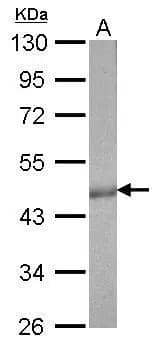
PGC1 alpha Overexpression Lysate

Images


Product Details

Summary
Product Discontinued
View other related PGC1 alpha Lysates

Order Details


    • Catalog Number
      NBL1-14636
    • Availability
      Product Discontinued

    Can't find what you are looking for? Use our Antibody Concierge Service & we will help you locate your antibody!

    Or feel free to contact us for alternative products.

PGC1 alpha Overexpression Lysate Summary

Immunogen
The PGC1 alpha Overexpression Lysate was created in HEK293T cells, using plasmid ID RC212244 and based on accession number NM_013261. The protein contains a C-terminal DDK tag.
Gene
PPARGC1A

Applications/Dilutions

Dilutions
  • Western Blot
Application Notes
This product is intended for use as a positive control in Western Blot.

You will receive 1 vial of lysate (100ug), 1 vial of empty vector negative control (100ug), and 1 vial of 2xSDS sample buffer (250ul).
Theoretical MW
91 kDa.
Disclaimer note: The observed molecular weight of the protein may vary from the listed predicted molecular weight due to post translational modifications, post translation cleavages, relative charges, and other experimental factors.

Packaging, Storage & Formulations

Storage
Store at -80C. Avoid freeze-thaw cycles.
Buffer
RIPA buffer

Lysate Details for Array

Type
Overexpression

Notes

HEK293T cells in 10-cm dishes were transiently transfected with a non-lipid polymer transfection reagent specially designed and manufactured for large volume DNA transfection. Transfected cells were cultured for 48hrs before collection. The cells were lysed in modified RIPA buffer (25mM Tris-HCl pH7.6, 150mM NaCl, 1% NP-40, 1mM EDTA, 1xProteinase inhibitor cocktail mix, 1mM PMSF and 1mM Na3VO4, and then centrifuged to clarify the lysate. Protein concentration was measured by BCA protein assay kit.This product is manufactured by and sold under license from OriGene Technologies and its use is limited solely for research purposes.

Alternate Names for PGC1 alpha Overexpression Lysate

  • LEM6
  • Ligand effect modulator 6
  • ligand effect modulator-6
  • L-PGC-1alpha
  • peroxisome proliferative activated receptor, gamma, coactivator 1, alpha
  • peroxisome proliferator-activated receptor gamma coactivator 1 alpha transcript variant B4-3ext
  • peroxisome proliferator-activated receptor gamma coactivator 1 alpha transcript variant B4-8a
  • peroxisome proliferator-activated receptor gamma coactivator 1 alpha transcript variant B5-NT
  • peroxisome proliferator-activated receptor gamma coactivator 1-alpha
  • peroxisome proliferator-activated receptor gamma, coactivator 1 alpha
  • PGC1 alpha
  • PGC1
  • PGC-1(alpha)
  • PGC1A
  • PGC-1-alpha
  • PGC1APGC-1(alpha)
  • PGC1peroxisome proliferative activated receptor, gamma, coactivator 1
  • PGC-1v
  • PPAR gamma coactivator variant form
  • PPAR gamma coactivator-1
  • PPARgamma coactivator 1alpha
  • PPAR-gamma coactivator 1-alpha
  • PPARGC1
  • PPARGC1A
  • PPARGC-1-alpha

Background

Peroxisome proliferator-activated receptor-gamma coactivator 1-alpha (PGC-1alpha), PPAR-gamma coactivator 1-alpha, PPARGC-1-alpha (theoretical molecular weight 91 kDa) belongs to a family of transcription coactivators which includes two other proteins; PGC-1beta and PGC-1-related coactivators. PGC1 alpha interacts with various transcription factors (e.g., FOXO1, PPAR-(alpha, delta and gamma), LXR and FXR), promoting the transactivation of their specific target genes (1). As a transcription coactivator, PGC1 alpha is found in the nucleus where it interacts with transcriptional activators and chromatin modifiers such as p300/CBP and SRC-1 to induce targeted gene expression (1, 2). Transcription factors which interact with PGC1 alpha are involved in several functions related to cellular energy homeostasis including mitochondrial biogenesis, glucose and fatty acid metabolism, and skeletal muscle remodeling. Upstream regulators of PGC1 alpha activity include proteins that play a central role as energy sensors including SIRT1 and AMPK which, through different mechanisms, induce PGC1 alpha activity (3).

PGC1 alpha is highly expressed in skeletal muscle, cardiac muscle, and brown adipose tissue, all tissues with high oxidative capacity (1, 2). PGC1 alpha is also induced by energy taxing physiological states, for example increased physical activity, reduced body temperature, and reduced food intake (3). Because of its role in pathways controlling cellular energy expenditure, PGC1 alpha dysfunction has been associated with pathophysiological conditions such as type 2 diabetes and the metabolic syndrome (3).

References

1.Liang, H., & Ward, W. F. (2006). PGC-1alpha: A key regulator of energy metabolism. American Journal of Physiology - Advances in Physiology Education. https://doi.org/10.1152/advan.00052.2006

2.Arany, Z., He, H., Lin, J., Hoyer, K., Handschin, C., Toka, O., ... Spiegelman, B. M. (2005). Transcriptional coactivator PGC-1alpha controls the energy state and contractile function of cardiac muscle. Cell Metabolism. https://doi.org/10.1016/j.cmet.2005.03.002

3.Canto, C., & Auwerx, J. (2009). PGC-1alpha, SIRT1 and AMPK, an energy sensing network that controls energy expenditure. Current Opinion in Lipidology. https://doi.org/10.1097/MOL.0b013e328328d0a4

Limitations

This product is for research use only and is not approved for use in humans or in clinical diagnosis. Lysates are guaranteed for 6 months from date of receipt.

Customers Who Viewed This Item Also Viewed...

NBP2-22106
Species: Hu, Mu, Rt
Applications: IHC,  IHC-P, IP, WB
MAB1417
Species: Bv, Hu, Mu
Applications: ICC, IHC
NB300-537
Species: Bv, Hu, Mu, Rb, Rt
Applications: ChIP, Flow, GS, ICC/IF, IHC,  IHC-P, IP, KD, Simple Western, WB
NBP1-51641
Species: Hu, Mu, Pm, Rb, Rt
Applications: ELISA, Flow-IC, Flow, ICC/IF, IHC-FrFl, IHC,  IHC-P, WB
NBP1-71648
Species: Hu, Mu(-)
Applications: ICC/IF, IHC,  IHC-P, Simple Western, WB
NBP1-89125
Species: Hu, Mu
Applications: ChIP-EXO-SEQ, ICC/IF, IHC,  IHC-P, KD, WB
NBP2-22127
Species: Hu, Mu, Pm, Rt
Applications: ELISA, Flow, ICC/IF, IHC,  IHC-P, Simple Western, WB
AF2850
Species: Hu, Mu, Rt
Applications: ICC, IHC, Simple Western, WB
AF2854
Species: Hu, Mu, Rt
Applications: IHC, WB
NBP1-47254
Species: Hu, Mu
Applications: ICC/IF, IHC,  IHC-P, WB
NBP1-49533
Species: Hu, Mu, Pl, Rt
Applications: Flow-IC, Flow, ICC/IF, IHC,  IHC-P, KD, WB
NBP1-91011
Species: Hu
Applications: IHC, IHC-Fr,  IHC-P, WB
NBP2-93792
Species: Hu, Mu, Rt
Applications: ICC/IF, IHC,  IHC-P, WB
NBP2-43648
Species: Hu, Mu, Rt, Ze
Applications: ICC/IF, IHC,  IHC-P, WB
NBP2-31376
Species: Hu, Mu, Rt
Applications: Flow, ICC/IF, IHC,  IHC-P, Simple Western, WB
AF887
Species: Hu, Mu, Rt
Applications: CyTOF-ready, IHC, ICFlow, Simple Western, WB
NB100-59742
Species: Hu, Mu, Rt
Applications: ICC/IF, IHC, PEP-ELISA, WB
NBL1-14636
Species: Hu
Applications: WB

Publications for PGC1 alpha Lysate (NBL1-14636) (0)

There are no publications for PGC1 alpha Lysate (NBL1-14636).
By submitting your publication information earn gift cards and discounts for future purchases.

Reviews for PGC1 alpha Lysate (NBL1-14636) (0)

There are no reviews for PGC1 alpha Lysate (NBL1-14636). By submitting a review you will receive an Amazon e-Gift Card or Novus Product Discount.
  • Review with no image -- $10/€7/£6/$10 CAD/¥70 Yuan/¥1110 Yen
  • Review with an image -- $25/€18/£15/$25 CAD/¥150 Yuan/¥2500 Yen

Product General Protocols

Find general support by application which include: protocols, troubleshooting, illustrated assays, videos and webinars.

Video Protocols

WB Video Protocol

FAQs for PGC1 alpha Lysate (NBL1-14636). (Showing 1 - 1 of 1 FAQ).

  1. Please differentiate to me between PPAR and PGC clearly. I am confused with the difference between these two
    • Thank you very much for contacting Novus Biologicals technical support team and sharing your query on the differences between PGC-1 alpha and PPAR. These are two different proteins encoded by their respective genes and serves different functions. PGC-1 alpha (PGC1A or PPAR gamma coactivator 1-alpha) is a transcriptional co-activator for steroid receptors and nuclear receptors, and it regulates diverse aspects of cellular physiology. It up-regulates the transcriptional activity of PPAR-gamma /thyroid hormone receptor on the uncoupling protein promoter; regulates the key mitochondrial genes involved in adaptive thermogenesis; implicates in the metabolic reprogramming in response to nutrients availability through the coordination of the expression of a wide array of genes involved in the regulation of glucose and fatty acid metabolism. Among our PGC-1 alpha antibodies, NBP1-04676 is our best selling product with nice customer feedback and citations in at least 13 research publications. PPAR (PPAR alpha) on the other hand is a ligand-activated transcription factor which gets activated by the endogenous ligand 1-palmitoyl-2-oleoyl-sn-glycerol-3-phosphocholine, and oleylethanolamide (a naturally occurring lipid that regulates satiety), and acts as a key regulator of lipid metabolism. It also acts as a receptor for peroxisome proliferators such as hypolipidemic drugs and fatty acids. It regulates the peroxisomal beta-oxidation pathway of fatty acids, and also functions as transcription activator for the ACOX1 and P450 genes. We have a variety of PPAR alpha antibodies. I hope you will find this information helpful but please let me know if I can support you with anything else from my end. Thank you very much for choosing Novus Biologicals as your quality reagent supplier and we wish you the best with your research projects.

Additional PGC1 alpha Products

Research Areas for PGC1 alpha Lysate (NBL1-14636)

Find related products by research area.

Blogs on PGC1 alpha.

Tired T cells: Hypoxia Drives T cell Exhaustion in the Tumor Microenvironment
By Hunter MartinezThe paradigm shifting view of the immune system being leveraged to target cancer has led to numerous therapeutic breakthroughs. One major cell group responsible for this revelation is a T cell. ...  Read full blog post.

Contact Information

Product PDFs

Calculators

Concentration Calculator

The concentration calculator allows you to quickly calculate the volume, mass or concentration of your vial. Simply enter your mass, volume, or concentration values for your reagent and the calculator will determine the rest.

=
÷

Review this Product

Be the first to review our PGC1 alpha Overexpression Lysate and receive a gift card or discount.

Bioinformatics

Gene Symbol PPARGC1A