| Immunogen | Partial recombinant human S100B protein (amino acids 2-92) [UniProt P04271] |
| Predicted Species | Mouse (99%), Porcine (97%), Bovine (97%), Rabbit (100%), Sheep (99%), Primate (100%), Equine (100%). Backed by our 100% Guarantee. |
| Isotype | IgG2b Kappa |
| Clonality | Monoclonal |
| Host | Mouse |
| Gene | S100B |
| Purity | Protein G purified |
| Innovator's Reward | Test in a species/application not listed above to receive a full credit towards a future purchase. |
| Dilutions |
|
|
| Reviewed Applications |
|
| Storage | Store at 4C in the dark. |
| Buffer | 50mM Sodium Borate |
| Preservative | 0.05% Sodium Azide |
| Purity | Protein G purified |





![Flow Cytometry CD117/c-kit Antibody [Unconjugated]](https://images.novusbio.com/images/af1356_human-mouse-cd117-c-kit-affinity-purified-polyclonal-ab-81202555532.jpg)
![Immunohistochemistry CD117/c-kit Antibody [Unconjugated]](https://images.novusbio.com/images/antibody/af1356_human-mouse-cd117-c-kit-affinity-purified-polyclonal-ab-immunohistochemistry-812202575731.png)
![Immunocytochemistry/ Immunofluorescence CD117/c-kit Antibody [Unconjugated]](https://images.novusbio.com/images/af1356_human-mouse-cd117-c-kit-affinity-purified-polyclonal-ab-41202410481199.jpg)


| Images | Ratings | Applications | Species | Date | Details | ||||||||||
|---|---|---|---|---|---|---|---|---|---|---|---|---|---|---|---|
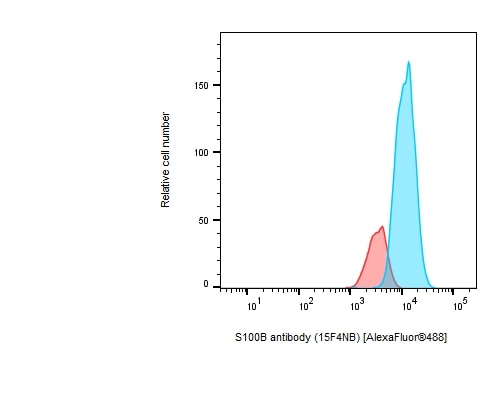
Enlarge |
reviewed by:
Sherida de Leeuw |
Flow | Human | 08/02/2018 |
Summary
Comments
|
Secondary Antibodies |
Isotype Controls |
Research Areas for S100B Antibody (NBP2-45224AF488)Find related products by research area.
|
|
Successful Transplantation of Friedreich Ataxia Induced Pluripotent Stem Cell (iPSC)-Derived Sensory Neurons in Dorsal Root Ganglia of Adult Rodents Jamshed Arslan, Pharm D, PhD The dorsal root ganglia (DRG) are a collection of cell bodies of sensory nerves carrying sensory information – including nociception, mechanoreception and proprioception – from periphera... Read full blog post. |
|
Role of GFAP in astrocytes: Lessons from induced pluripotent stem cells in Alexander disease patients By Michalina Hanzel, PhDAlexander disease is a progressive and fatal neurological disease with phenotypes ranging from myelination abnormalities, gait ataxia and megalencephaly to predisposition to seizures. It is an ... Read full blog post. |
The concentration calculator allows you to quickly calculate the volume, mass or concentration of your vial. Simply enter your mass, volume, or concentration values for your reagent and the calculator will determine the rest.
| Gene Symbol | S100B |


![Immunohistochemistry Desmin Antibody [Unconjugated]](https://images.novusbio.com/images/antibody/Desmin_AF3844_Immunohistochemistry_10689.jpg)
![Immunohistochemistry Desmin Antibody [Unconjugated]](https://images.novusbio.com/images/antibody/Desmin_AF3844_Immunohistochemistry_6808.jpg)
![Immunocytochemistry/ Immunofluorescence Desmin Antibody [Unconjugated]](https://images.novusbio.com/images/af3844_human-mouse-desmin-affinity-purified-polyclonal-ab-41202410331920.jpg)
![Immunocytochemistry S100A8 Antibody [Unconjugated]](https://images.novusbio.com/images/antibody/S100A8_AF3059_Immunocytochemistry_6489.jpg)
![Immunocytochemistry S100A9 Antibody [Unconjugated]](https://images.novusbio.com/images/antibody/S100A9_AF2065_Immunocytochemistry__Immunofluorescence_22492.jpg)
![Immunohistochemistry S100A9 Antibody [Unconjugated]](https://images.novusbio.com/images/af2065_goat-s100a9-pab-alexa-fluor-594-immunohistochemistry-12122025852812.jpg)


![N/A AGER [HRP]](https://images.novusbio.com/images/elisa/DATA_RAGE_DRG00_ELISA_806.jpg)
![N/A AGER [HRP]](https://images.novusbio.com/images/elisa/DATA_RAGE_DRG00_ELISA_807.jpg)
![N/A AGER [HRP]](https://images.novusbio.com/images/elisa/RAGE_DRG00_ELISA_171.jpg)


