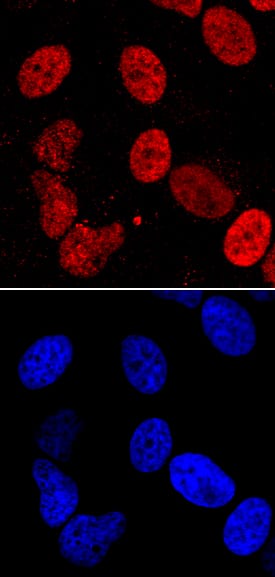
| Reactivity | HuSpecies Glossary |
| Applications | Bioactivity |
| Format | Carrier-Free |
| Details of Functionality | Measured by its ability to enhance neurite outgrowth of E16-E18 rat embryonic cortical neurons. Able to significantly enhance neurite outgrowth and neuronal survival when immobilized at 0.5-2 μg/mL on a nitrocellulose-coated microplate. |
| Source | E. coli-derived human LEDGF protein Met1-Asn530 |
| Accession # | |
| N-terminal Sequence | Met1 |
| Protein/Peptide Type | Recombinant Proteins |
| Gene | PSIP1 |
| Purity | >95%, by SDS-PAGE under reducing conditions and visualized by silver stain |
| Endotoxin Note | <1.0 EU per 1 μg of the protein by the LAL method. |
| Dilutions |
|
|
| Theoretical MW | 60.1 kDa. Disclaimer note: The observed molecular weight of the protein may vary from the listed predicted molecular weight due to post translational modifications, post translation cleavages, relative charges, and other experimental factors. |
|
| SDS-PAGE | 75 kDa, reducing conditions |
|
| Publications |
|
| Storage | Use a manual defrost freezer and avoid repeated freeze-thaw cycles.
|
| Buffer | Lyophilized from a 0.2 μm filtered solution in PBS and DTT. |
| Purity | >95%, by SDS-PAGE under reducing conditions and visualized by silver stain |
| Reconstitution Instructions | Reconstitute at 200 μg/mL in sterile PBS. |
Lens epithelium-derived growth factor (LEDGF; also PC4 and SFRS1-interacting protein, transcriptional coactivator p75/p53, and dense fine speckles 70 kDa protein) is a ubiquitously expressed, 75 kDa member of the hepatoma-derived growth factor (HDGF) family of proteins (1). Human LEDGF is 530 amino acids (aa) in length (SwissProt # O75475). LEDGF contains a PWWP domain (aa 1 - 64), a nuclear localization signal (aa 146 - 156), two coiled-coil regions (aa 306 - 334 and 371 - 395), and four helical regions (aa 347 - 362, 370 - 381, 394 - 403, and 410 - 425). In addition, there are multiple serine and threonine residues that are sites of potential phosphorylation. The protein is highly charged, with lysine, arginine, glutamate, and aspartate comprising 39% of the total residues (1). Two splicing variants produce a second isoform known as p53. p53 has an 8 aa substitution corresponding to aa 326 - 333 of LEDGF, and a deletion of the final 197 aa found in LEDGF. Human LEDGF shares 92% aa sequence identity with mouse and rat LEDGF. LEDGF functions as a transcriptional coactivator that is involved in neuroepithelial stem cell differentiation and neurogenesis (2). It is also a survival factor that is inducible by oxidative stress and protects cells from various stresses by upregulating stress-response genes (3 - 4). For example, TNF-alpha elevates the expression of LEDGF, which increases the expression of endogenous gamma -GHS-HS, a catalytic subunit of the regulating enzyme for GSH biosynthesis that constitutes a protective mechanism in limiting oxidative stress induced by inflammatory cytokines (3). LEDGF is also a major autoantigen in atopic dermatitis and other inflammatory conditions involving dysregulated apoptosis (5 - 7). Anti-LEDGF autoantibodies have been shown to have cytotoxic activity, suggesting their involvement in pathogenesis (6). In apoptotic cells, caspases cleave this protein at three sites within functionally important domains, abolishing the survival function of LEDGF and generating variants of the protein that enhance apoptosis (6). LEDGF has also been shown to interact with lentiviral integrase (IN) proteins, including HIV-1 IN, which determine their nuclear localization and tight association with nuclear DNA (8). This prevents proteosomal degradation of these proteins (8).


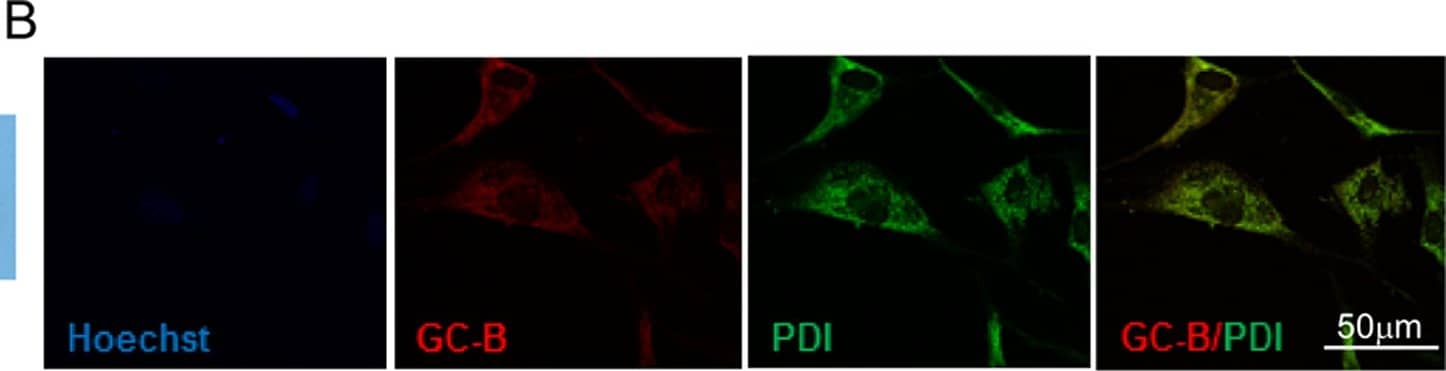


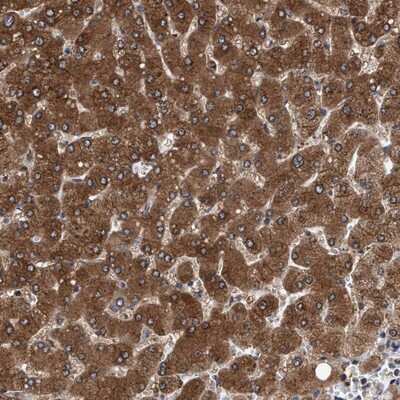
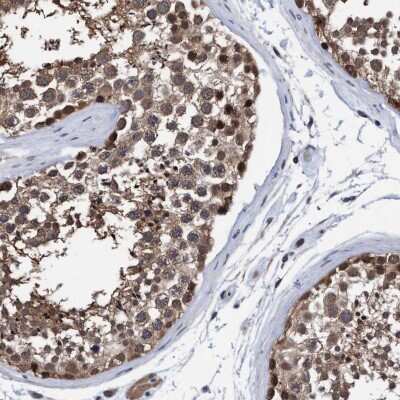



The concentration calculator allows you to quickly calculate the volume, mass or concentration of your vial. Simply enter your mass, volume, or concentration values for your reagent and the calculator will determine the rest.


![SDS-Page TNF-alpha [Unconjugated]](https://images.novusbio.com/images/protein/TNF-alpha_210-TA_256.jpg)
![Bioactivity TNF-alpha [Unconjugated]](https://images.novusbio.com/images/protein/TNFalpha_210TA_1658.jpg)
![SEC-MALS TNF-alpha [Unconjugated]](https://images.novusbio.com/images/210-ta_recombinant-human-tnf-alpha-protein-sec-mals-35202312244..jpg)
![Immunohistochemistry NGFR/TNFRSF16/p75NTR Antibody [Unconjugated]](https://images.novusbio.com/images/af1157_mouse-ngf-r-tnfrsf16-affinity-purified-polyclonal-ab-immunohistochemistry-121220259193821.jpg)
![Immunohistochemistry NGFR/TNFRSF16/p75NTR Antibody [Unconjugated]](https://images.novusbio.com/images/antibody/NGF_R_AF1157_Immunohistochemistry_6685.jpg)
![Immunohistochemistry NGFR/TNFRSF16/p75NTR Antibody [Unconjugated]](https://images.novusbio.com/images/af1157_mouse-ngf-r-tnfrsf16-affinity-purified-polyclonal-ab-immunohistochemistry-12122025974221.jpg)
![N/A BDNF [HRP]](https://images.novusbio.com/images/elisa/BDNF_DBD00_ELISA_36.jpg)
![N/A BDNF [HRP]](https://images.novusbio.com/images/elisa/DATA_BDNF_DBD00_ELISA_587.jpg)
![N/A BDNF [HRP]](https://images.novusbio.com/images/elisa/DATA_BDNF_DBD00_ELISA_588.jpg)
![N/A TNF RI/TNFRSF1A [HRP]](https://images.novusbio.com/images/elisa/DATA_TNF_RI_DRT100_ELISA_816.jpg)
![N/A TNF RI/TNFRSF1A [HRP]](https://images.novusbio.com/images/elisa/DATA_TNF_RI_DRT100_ELISA_815.jpg)
![N/A TNF RI/TNFRSF1A [HRP]](https://images.novusbio.com/images/elisa/TNF_RI_DRT100_ELISA_175.jpg)


![Immunohistochemistry TrkA Antibody [Unconjugated]](https://images.novusbio.com/images/antibody/TrkA_AF1056_Immunohistochemistry_6672.jpg)
![Immunohistochemistry TrkA Antibody [Unconjugated]](https://images.novusbio.com/images/af1056_rat-trka-affinity-purified-polyclonal-ab-44202415425059.jpg)
![Immunohistochemistry TrkA Antibody [Unconjugated]](https://images.novusbio.com/images/af1056_rat-trka-affinity-purified-polyclonal-ab-8220249503264.jpg)
![N/A CD25/IL-2R alpha [HRP]](https://images.novusbio.com/images/elisa/IL-2_R_alpha_DR2A00_ELISA_167.jpg)
![N/A CD25/IL-2R alpha [HRP]](https://images.novusbio.com/images/elisa/DATA_CD25_DR2A00_ELISA_800.jpg)
![Simple Western Fascin Antibody (833223) [Unconjugated]](https://images.novusbio.com/images/antibody/Fascin_MAB7745_Simple_Western_16531.jpg)
![Knockout Validated Fascin Antibody (833223) [Unconjugated]](https://images.novusbio.com/images/antibody/Fascin_MAB7745_Knockout_Validated_23042.jpg)
![Western Blot Fascin Antibody (833223) [Unconjugated]](https://images.novusbio.com/images/antibody/Fascin_MAB7745_Western_Blot_12959.jpg)
![Western Blot PI 3-Kinase p55 gamma Antibody (668619) [Unconjugated]](https://images.novusbio.com/images/antibody/PI_3-Kinase_p55_gamma_MAB6638_Western_Blot_10569.jpg)


![Bioactivity IL-2 [Unconjugated]](https://images.novusbio.com/images/202-il_recombinant-human-il-2-protein-bioactivity-174202314946.jpg)
![Bioactivity beta-NGF [Unconjugated]](https://images.novusbio.com/images/protein/beta-NGF_256-GF_322.jpg)
![SDS-Page beta-NGF [Unconjugated]](https://images.novusbio.com/images/protein/beta-NGF_256-GF_321.jpg)