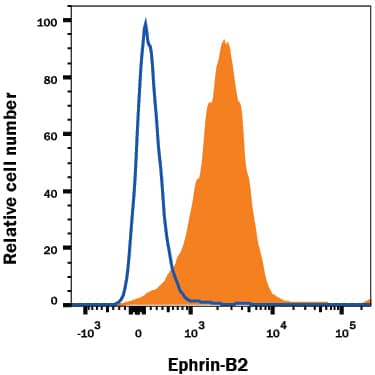
BAF108, open histogram) followed by Streptavidin-Allophycocyanin (Catalog # F0050). To facilitate intracellular staining, cells were fixed with Flow Cytometry Fixation Buffer (Catalog # FC004) and permeabilized with Flow Cytometry Permeabilization/Wash Buffer I (Catalog # FC005). View our protocol for Staining Intracellular Molecules." title="MG-63 cells were stained with Goat Anti-Human SPARC Biotinylated Antigen Affinity-purified Polyclonal Antibody (Catalog # BAF941, filled histogram) or isotype control antibody (Catalog # BAF108, open histogram) followed by Streptavidin-Allophycocyanin (Catalog # F0050). To facilitate intracellular staining, cells were fixed with Flow Cytometry Fixation Buffer (Catalog # FC004) and permeabilized with Flow Cytometry Permeabilization/Wash Buffer I (Catalog # FC005). View our protocol for Staining Intracellular Molecules." />
| Reactivity | HuSpecies Glossary |
| Applications | WB, Flow |
| Clonality | Polyclonal |
| Host | Goat |
| Conjugate | Biotin |
| Concentration | LYOPH |
| Immunogen | Mouse myeloma cell line NS0-derived recombinant human SPARC/Osteonectin Ala18-Ile303 Accession # P09486 |
| Specificity | Detects human SPARC in Western blots. In Western blots, less than 1% cross-reactivity with recombinant mouse SPARC is observed. |
| Source | N/A |
| Isotype | IgG |
| Clonality | Polyclonal |
| Host | Goat |
| Gene | SPARC |
| Purity Statement | Antigen Affinity-purified |
| Innovator's Reward | Test in a species/application not listed above to receive a full credit towards a future purchase. |
| Dilutions |
|
|
| Readout System | ||
| Publications |
|
| Storage | Use a manual defrost freezer and avoid repeated freeze-thaw cycles.
|
| Buffer | Lyophilized from a 0.2 μm filtered solution in PBS with BSA as a carrier protein. |
| Preservative | No Preservative |
| Concentration | LYOPH |
| Reconstitution Instructions | Reconstitute at 0.2 mg/mL in sterile PBS. |
SPARC, an acronym for “secreted protein, acidic and rich in cysteine”, is also known as osteonectin or BM-40 (1-5). It is the founding member of a family of secreted matricellular proteins with similar domain structure. The 286 amino acid (aa), 43 kDa protein contains an N-terminal acidic region that binds calcium, a follistatin domain that contains Kazal-like sequences, and a C-terminal extracellular calcium (EC) binding domain with two EF-hand motifs (1-5). Crystal structure modeling shows that residues implicated in cell binding, inhibition of cell spreading, and disassembly of focal adhesions cluster on one face of SPARC, while a collagen binding epitope and an N-glycosylation site are opposite this face (6). SPARC is produced by fibroblasts, capillary endothelial cells, platelets and macrophages, especially in areas of tissue morphogenesis and remodeling (3, 7). SPARC shows context-specific effects, but generally inhibits adhesion, spreading and proliferation, and promotes collagen matrix formation (3-5). For endothelial cells, SPARC disrupts focal adhesions and binds and sequesters PDGF and VEGF (3-5). SPARC is abundantly expressed in bone, where it promotes osteoblast differentiation and inhibits adipogenesis (5, 8). SPARC is potentially cleaved by metalloproteinases, producing an angiogenic peptide that includes the copper-binding sequence KGHK (7). Paradoxically, SPARC is highly expressed in many tumor types undergoing an endothelial to mesenchymal transistion; its expression, however, mainly decreases the likelihood of metastasis and confers sensitivity to chemotherapy and radiation (4, 9-11). Stabilin-1, which is expressed on alternately activated macrophages, is the first SPARC receptor to be identified. It binds the SPARC EC domain and mediates endocytosis for degradation (12). Mature human SPARC shows 92%, 92%, 97%, 99%, 96%, and 85% aa identity with mouse, rat, canine, bovine, porcine, and chick SPARC, respectively.
![Western Blot Osteopontin/OPN Antibody [Unconjugated]](https://images.novusbio.com/images/af808_mouse-osteopontin-opn-affinity-purified-polyclonal-ab-western-blot-121220259133019.jpg)
![Western Blot Osteopontin/OPN Antibody [Unconjugated]](https://images.novusbio.com/images/af808_mouse-osteopontin-opn-affinity-purified-polyclonal-ab-western-blot-12122025932150.jpg)
![Western Blot Osteopontin/OPN Antibody [Unconjugated]](https://images.novusbio.com/images/af808_mouse-osteopontin-opn-affinity-purified-polyclonal-ab-western-blot-121220259224819.jpg)




![SPARC Antibody [Biotin]](/sites/all/modules/enterprise-tech/et_datasheets/images/novus_guarantee.png "SPARC Antibody [Biotin]")
Secondary Antibodies |
Isotype Controls |
|
Caspase 8 - a key mediator of apoptosis Programmed cell death via apoptosis is a key controlled physiological process instigated by the cell death receptor family, their ligands, and the caspase cysteine protease family. All caspases exist in a precursor form that contains a prodomain, a... Read full blog post. |
|
GAPDH: More than a housekeeping gene GAPDH is a 146kD tetramer glycolytic pathway metabolic enzyme composed of four 30-40 kDa subunits. It is responsible for reversibly phosphorylating its substrate glyceraldehyde 3-phosphate within the glycolytic pathway. Apart from its role in gl... Read full blog post. |
|
GAPDH (Glyceraldehyde 3-Phosphate Dehydrogenase) GAPDH is a 146 kD tetramer glycolytic pathway metabolic enzyme responsible for reversibly phosphorylating glyceraldehyde 3-phosphate. It may have other possible functions in transcriptional activation. GAPDH is highly expressed due to this housekeepin... Read full blog post. |
|
FLICE, FLICE, baby Cell death via apoptosis is a fundamental cellular function triggered by the cell death receptor family and their ligands which signal through downstream adaptor molecules and the caspase protease family. All caspases exist in a precursor form compose... Read full blog post. |
The concentration calculator allows you to quickly calculate the volume, mass or concentration of your vial. Simply enter your mass, volume, or concentration values for your reagent and the calculator will determine the rest.


 941-SP) was serially diluted and captured by Mouse Anti-Human SPARC Monoclonal Antibody (Catalog #

![Bioactivity IBSP/Sialoprotein II [Unconjugated]](https://images.novusbio.com/images/4014-sp_recombinant-human-ibsp-sialoprotein-ii-protein-cf-bioactivity-4420249391..jpg)
![N/A Thrombospondin-1 [HRP]](https://images.novusbio.com/images/elisa/Thrombospondin-1_DTSP10_ELISA_199.jpg)
![N/A Thrombospondin-1 [HRP]](https://images.novusbio.com/images/dtsp10_human-thrombospondin-1-quantikine-elisa-kit-23120261145.jpg)


![N/A VEGF [HRP]](https://images.novusbio.com/images/elisa/VEGF_DVE00_ELISA_208.jpg)
![N/A VEGF [HRP]](https://images.novusbio.com/images/elisa/DATA_VEGF_DVE00_ELISA_871.jpg)
![N/A VEGF [HRP]](https://images.novusbio.com/images/elisa/DATA_VEGF_DVE00_ELISA_872.jpg)
![N/A MMP-2 [HRP]](https://images.novusbio.com/images/elisa/DATA_MMP2_MMP200_ELISA_1003.jpg)
![N/A MMP-2 [HRP]](https://images.novusbio.com/images/elisa/MMP2_MMP200_ELISA_474.jpg)
![N/A SLPI [HRP]](https://images.novusbio.com/images/elisa/SLPI_DPI00_ELISA_160.jpg)
![N/A SLPI [HRP]](https://images.novusbio.com/images/elisa/DATA_SLPI_DPI00_ELISA_792.jpg)
![Western Blot RUNX2/CBFA1 Antibody (232902) [Unconjugated]](https://images.novusbio.com/images/mab2006_human-runx2-cbfa1-mab-clone-232902-western-blot-1212202597422.jpg)
![Western Blot RUNX2/CBFA1 Antibody (232902) [Unconjugated]](https://images.novusbio.com/images/mab2006_human-runx2-cbfa1-mab-clone-232902-western-blot-121220259172010.jpg)
![Immunocytochemistry RUNX2/CBFA1 Antibody (232902) [Unconjugated]](https://images.novusbio.com/images/antibody/RUNX2_MAB2006_Immunocytochemistry_13309.jpg)
![N/A CCL27/CTACK [HRP]](https://images.novusbio.com/images/elisa/DATA_CCL27_DCC270_ELISA_615.jpg)
![N/A CCL27/CTACK [HRP]](https://images.novusbio.com/images/elisa/CCL27_DCC270_ELISA_54.jpg)