| Reactivity | MuSpecies Glossary |
| Applications | Bioactivity |
| Format | Carrier-Free |
| Details of Functionality | Measured by its binding ability in a functional ELISA. Recombinant
Mouse CD31/PECAM-1 (Catalog # 3628-PC) binds to Recombinant Human Integrin alpha 8 beta 1 with
an ED50 of 0.060-0.720 μg/mL. |
| Source | Mouse myeloma cell line, NS0-derived mouse CD31/PECAM-1 protein Glu18-Lys590, with a C-terminal 6-His tag |
| Accession # | |
| N-terminal Sequence | Glu18 |
| Protein/Peptide Type | Recombinant Proteins |
| Gene | Pecam1 |
| Purity | >95%, by SDS-PAGE visualized with Silver Staining and quantitative densitometry by Coomassie® Blue Staining |
| Endotoxin Note | <0.01 EU per 1 μg of the protein by the LAL method. |
| Dilutions |
|
|
| Theoretical MW | 65.5 kDa (monomer). Disclaimer note: The observed molecular weight of the protein may vary from the listed predicted molecular weight due to post translational modifications, post translation cleavages, relative charges, and other experimental factors. |
|
| SDS-PAGE | 91-100 kDa, reducing conditions |
|
| Publications |
|
| Storage | Use a manual defrost freezer and avoid repeated freeze-thaw cycles.
|
| Buffer | Lyophilized from a 0.2 μm filtered solution in PBS. |
| Purity | >95%, by SDS-PAGE visualized with Silver Staining and quantitative densitometry by Coomassie® Blue Staining |
| Reconstitution Instructions | Reconstitute at 200 μg/mL in sterile PBS. |
PECAM-1 (platelet-endothelial cell adhesion molecule-1; also known as CD31) is a 130 kDa type I transmembrane glycoprotein adhesion molecule in the immunoglobulin superfamily (1, 2). Expression is restricted to cells involved in circulation, especially endothelial cells, platelets, monocytes, neutrophils and lymphocyte subsets. PECAM-1 is concentrated at cell-cell junctions and is required for transendothelial migration (TEM) (1 - 3). The extracellular domain (ECD) of PECAM-1 has ten potential N-linked glycosylation sites and six C2-type Ig-like domains, the first of which is critical for adhesion and extravasation (3, 4). The cytoplasmic domain contains immunoregulatory tyrosine-based inhibitory and switch motifs (ITIM, ITSM) that mediate both inhibition and activation via phosphotyrosine-mediated engagement of SH2-containing signaling molecules (1, 5). Metalloproteinase-mediated ectodomain shedding occurs during apoptosis (6) but increased serum PECAM-1 ectodomain in HIV and active multiple sclerosis occurs independent of apoptosis (7, 8). In humans, expression of six isoforms with exon deletions in the cytoplasmic domain is tissue- and stage-specific, but full-length PECAM-1 is predominant. A form lacking the ITSM predominates in mouse (9). Mouse PECAM-1 ECD shows 77%, 63%, 63%, 63% and 61% amino acid (aa) identity with rat, human, canine, porcine and bovine PECAM-1, respectively. PECAM-1 participates with other adhesion molecules in some functions, but is the critical molecule for TEM. Homotypic PECAM-1 adhesion in trans, combined with cycling of PECAM-1 to and from surface-connected endothelial cell vesicles, leads leukocytes across endothelial tight junctions (3, 10). Homotypic adhesion and signaling functions also strongly suppress mitochondria-dependent apoptosis (11). In platelets, PECAM-1 is necessary for limiting thrombus formation (12) and promoting integrin-mediated clot retraction and platelet spreading (13), but mechanisms for these phenomena are unclear. PECAM-/- mice are deficient in chemokine-mediated chemotaxis (14).

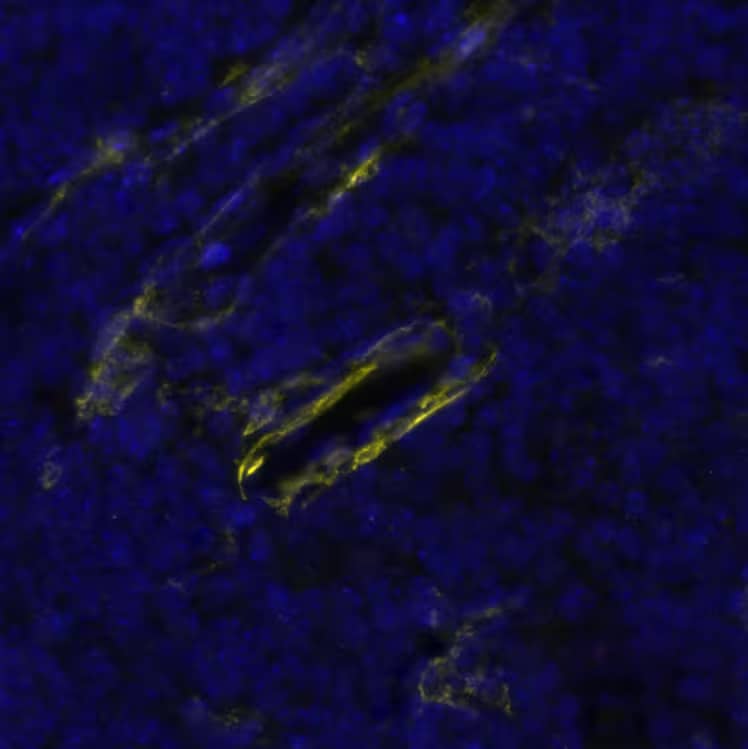


![Flow Cytometry E-Selectin/CD62E Antibody (BBIG-E4) [Unconjugated]](https://images.novusbio.com/images/antibody/bba16_human-e-selectin-cd62e-mab-clone-bbig-e4-flow-cytometry-25102021144214.jpg)
![Immunohistochemistry E-Selectin/CD62E Antibody (BBIG-E4) [Unconjugated]](https://images.novusbio.com/images/antibody/E-Selectin_BBA16_Immunohistochemistry_6938.jpg)
![Western Blot E-Selectin/CD62E Antibody (BBIG-E4) [Unconjugated]](https://images.novusbio.com/images/bba16_human-e-selectin-cd62e-mab-clone-bbig-e4-western-blot-1212202581524.jpg)
![Western Blot Endoglin/CD105 Antibody [Unconjugated]](https://images.novusbio.com/images/antibody/Endoglin_AF1320_Western_Blot_18980.jpg)
![Immunohistochemistry Endoglin/CD105 Antibody [Unconjugated]](https://images.novusbio.com/images/antibody/Endoglin_AF1320_Immunohistochemistry_9922.jpg)
![Immunocytochemistry Endoglin/CD105 Antibody [Unconjugated]](https://images.novusbio.com/images/antibody/Endoglin_AF1320_Immunocytochemistry_12779.jpg)
![Immunohistochemistry VE-Cadherin Antibody [Unconjugated]](https://images.novusbio.com/images/af1002_mouse-ve-cadherin-affinity-purified-polyclonal-ab-81202555729.jpg)
![Western Blot VE-Cadherin Antibody [Unconjugated]](https://images.novusbio.com/images/af1002_mouse-ve-cadherin-affinity-purified-polyclonal-ab-western-blot-12122025920821.jpg)
![Immunohistochemistry VE-Cadherin Antibody [Unconjugated]](https://images.novusbio.com/images/af1002_mouse-ve-cadherin-affinity-purified-polyclonal-ab-8120255552820.jpg)
![Immunohistochemistry VEGFR2/KDR/Flk-1 Antibody [Unconjugated]](https://images.novusbio.com/images/antibody/VEGF_R2_AF644_Immunohistochemistry_6888.jpg)
![Immunohistochemistry VEGFR2/KDR/Flk-1 Antibody [Unconjugated]](https://images.novusbio.com/images/af644_mouse-vegf-r2-flk-1-affinity-purified-polyclonal-ab-4120241048248.jpg)
![In-situ Hybridization VEGFR2/KDR/Flk-1 Antibody [Unconjugated]](https://images.novusbio.com/images/antibody/af644_mouse-vegf-r2-flk-1-affinity-purified-polyclonal-ab-in-situ-hybridization-235202421442..jpg)


|
Read full blog post. |
|
The application of CD31/Pecam-1 (MEC 7.46) in breast cancer research CD31/PECAM-1, or platelet endothelial cell adhesion molecule 1, is a 130-kDa glycoprotein expressed on vascular and hematopoietic cells. Depending on the cell type, CD31/PECAM-1 expression can be largely localized to cell junctions, playing a rol... Read full blog post. |
The concentration calculator allows you to quickly calculate the volume, mass or concentration of your vial. Simply enter your mass, volume, or concentration values for your reagent and the calculator will determine the rest.


![N/A VEGF [HRP]](https://images.novusbio.com/images/elisa/VEGF_DVE00_ELISA_208.jpg)
![N/A VEGF [HRP]](https://images.novusbio.com/images/elisa/DATA_VEGF_DVE00_ELISA_871.jpg)
![N/A VEGF [HRP]](https://images.novusbio.com/images/elisa/DATA_VEGF_DVE00_ELISA_872.jpg)
![Bioactivity CTLA-4 [Unconjugated]](https://images.novusbio.com/images/protein/CTLA4_7268CT_2293.jpg)
![Western Blot ICAM-1/CD54 Antibody [Unconjugated]](https://images.novusbio.com/images/af796_mouse-icam-1-cd54-affinity-purified-polyclonal-ab-41202410481192.jpg)
![Western Blot ICAM-1/CD54 Antibody [Unconjugated]](https://images.novusbio.com/images/af796_mouse-icam-1-cd54-affinity-purified-polyclonal-ab-4120241048112.jpg)
![Western Blot ICAM-1/CD54 Antibody [Unconjugated]](https://images.novusbio.com/images/af796_mouse-icam-1-cd54-affinity-purified-polyclonal-ab-4120241049436.jpg)
![SDS-Page TNF-alpha [Unconjugated]](https://images.novusbio.com/images/protein/TNF-alpha_210-TA_256.jpg)
![Bioactivity TNF-alpha [Unconjugated]](https://images.novusbio.com/images/protein/TNFalpha_210TA_1658.jpg)
![SEC-MALS TNF-alpha [Unconjugated]](https://images.novusbio.com/images/210-ta_recombinant-human-tnf-alpha-protein-sec-mals-35202312244..jpg)
![Immunohistochemistry CD45 Antibody [Unconjugated]](https://images.novusbio.com/images/antibody/CD45_AF114_Immunohistochemistry_23525.jpg)
![Immunocytochemistry CD45 Antibody [Unconjugated]](https://images.novusbio.com/images/antibody/af114_mouse-cd45-affinity-purified-polyclonal-ab-immunocytochemistry-6122021145449.jpg)
![FGF basic/FGF2/bFGF [Unconjugated]](/sites/all/modules/enterprise-tech/et_datasheets/images/novus_guarantee.png "FGF basic/FGF2/bFGF [Unconjugated]")
![N/A IL-6 [HRP]](https://images.novusbio.com/images/elisa/DATA_IL6_M6000_ELISA_936.jpg)
![N/A IL-6 [HRP]](https://images.novusbio.com/images/elisa/IL-6_M6000_ELISA_415.jpg)
![N/A IL-6 [HRP]](https://images.novusbio.com/images/m6000b_mouse-il-6-quantikine-elisa-kit-1752025024034.jpg)


