After August 17, 2026, Novus Biologicals products and services will no longer be available on this website; you will access all products and services on rndsystems.com. Create your R&D Systems online account today.
424-FC) stimulates proliferation in the the NR6R-3T3 mouse fibroblast cell line in a dose-dependent manner (orange line). Proliferation elicited by Recombinant Mouse FGF-8 c Isoform (125 ng/mL) is neutralized (green line) by increasing concentrations of Mouse Anti-Human/Mouse FGF-8 Monoclonal Antibody (Catalog # MAB323). The ND50 is typically 0.25-0.75 µg/mL in the presence of heparin (0.1 µg/mL)." >
424-FC) stimulates proliferation in the the NR6R-3T3 mouse fibroblast cell line in a dose-dependent manner (orange line). Proliferation elicited by Recombinant Mouse FGF-8 c Isoform (125 ng/mL) is neutralized (green line) by increasing concentrations of Mouse Anti-Human/Mouse FGF-8 Monoclonal Antibody (Catalog # MAB323). The ND50 is typically 0.25-0.75 µg/mL in the presence of heparin (0.1 µg/mL)." title="Recombinant Mouse FGF-8 c Isoform (Catalog # 424-FC) stimulates proliferation in the the NR6R-3T3 mouse fibroblast cell line in a dose-dependent manner (orange line). Proliferation elicited by Recombinant Mouse FGF-8 c Isoform (125 ng/mL) is neutralized (green line) by increasing concentrations of Mouse Anti-Human/Mouse FGF-8 Monoclonal Antibody (Catalog # MAB323). The ND50 is typically 0.25-0.75 µg/mL in the presence of heparin (0.1 µg/mL)." />
Recombinant Mouse FGF-8 c Isoform (Catalog # 424-FC) stimulates proliferation in the the NR6R-3T3 mouse fibroblast ...read more
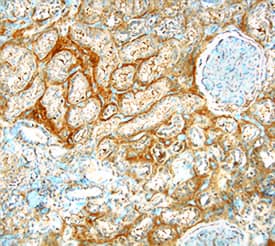
CTS002) and counterstained with hematoxylin (blue). Specific staining was localized to stromal cell cytoplasm. View our protocol for Chromogenic IHC Staining of Paraffin-embedded Tissue Sections." >
CTS002) and counterstained with hematoxylin (blue). Specific staining was localized to stromal cell cytoplasm. View our protocol for Chromogenic IHC Staining of Paraffin-embedded Tissue Sections." title="FGF-8 was detected in immersion fixed paraffin-embedded sections of human prostate using Mouse Anti-Human/Mouse FGF-8 Monoclonal Antibody (Catalog # MAB323) at 25 µg/mL overnight at 4 °C. Tissue was stained using the Anti-Mouse HRP-DAB Cell & Tissue Staining Kit (brown; Catalog # CTS002) and counterstained with hematoxylin (blue). Specific staining was localized to stromal cell cytoplasm. View our protocol for Chromogenic IHC Staining of Paraffin-embedded Tissue Sections." />
FGF-8 was detected in immersion fixed paraffin-embedded sections of human prostate using Mouse Anti-Human/Mouse FGF-8 Monoclonal Antibody (Catalog # MAB323) at 25 µg/mL overnight at 4 °C. Tissue was stained using the ...read more
Bafilomycin A1 (BAF) treatment demonstrates the polarization of ERK activity by FGF8 signal activity along the neuraltube. A-C) BAF amplifies ectopic ERK1/2 activity-related FGF8 induction revealing a clear polarized ...read more
Brefeldin A (BFA) treatment inhibits ERK1/2 activity & modulates differentially Fgf8 negative feed-back regulators. A, B & C) are 12 mM cryostat transversal sections of mouse ONTCs to the isthmic constriction. A & B) ...read more
Phosphorylation patterns of ERK1/2 (dpERK) enzymes in the anterior neural tube.Whole mount in situ hybridization (ISH) of E9.5 mouse embryo (A,B,B’) and corresponding organotypic neural tissue cultures of mouse E9.5 ...read more
E. coli-derived recombinant mouse FGF-8b Gln23-Arg215 Accession # NP_001159834
Specificity
Detects human and mouse FGF-8 in direct ELISAs and Western blots. In direct ELISAs and Western blots, less than 2% cross-reactivity with recombinant human (rh) FGF-5, rhFGF-7, and rhFGF-9 is observed.
Source
N/A
Isotype
IgG1
Clonality
Monoclonal
Host
Mouse
Gene
FGF8
Purity Statement
Protein A or G purified from ascites
Endotoxin Note
<0.10 EU per 1 μg of the antibody by the LAL method.
Innovator's Reward
Test in a species/application not listed above to receive a full credit towards a future purchase.
Use a manual defrost freezer and avoid repeated freeze-thaw cycles.
12 months from date of receipt, -20 to -70 °C as supplied.
1 month, 2 to 8 °C under sterile conditions after reconstitution.
6 months, -20 to -70 °C under sterile conditions after reconstitution.
Buffer
Lyophilized from a 0.2 μm filtered solution in PBS with Trehalose. *Small pack size (SP) is supplied either lyophilized or as a 0.2 µm filtered solution in PBS.
Preservative
No Preservative
Reconstitution Instructions
Reconstitute at 0.5 mg/mL in sterile PBS.
Notes
This product is produced by and ships from R&D Systems, Inc., a Bio-Techne brand.
Alternate Names for FGF-8 Antibody (47109)
AIGF
AIGFKAL6
Androgen-induced growth factor
FGF8
FGF-8
fibroblast growth factor 8 (androgen-induced)
fibroblast growth factor 8
HBGF-8
Heparin-binding growth factor 8
MGC149376
Background
FGF-8
is a member of the fibroblast growth factor family that was originally
discovered as a growth factor essential for the androgen-dependent
growth of mouse mammary carcinoma cells (1-3). Alternate splicing of
mouse FGF-8 mRNA generates eight secreted isoforms, designated a-h, but
only FGF-8a, b, e and f exist in humans (4). FGF-8 contains a 22 amino
acid (aa) signal sequence, an N‑terminal domain that varies according to
the isoform (30 aa for FGF-8b; 20 aa for the shortest, FGF-8a), a
125 aa FGF domain and a 37 aa proline‑rich C‑terminal sequence. The FGF
domain of FGF-8 shares the most aa identity with FGF17 (75%) and FGF-18
(67%), and the three form an FGF subfamily (2). Mouse FGF-8b shares 100%
aa identity with human FGF-8b. FGF-8 is widely expressed
during embryogenesis, and mediates epithelial-mesenchymal transitions.
It plays an organizing and inducing role during gastrulation, and
regulates patterning of the midbrain/hindbrain, eye, ear, limbs and
heart in the embryo (2, 5 - 8). The isoforms may play different roles in
development. FGF-8b shows the strongest receptor affinity and oncogenic
transforming capacity although FGF-8a and FGF-8e are also transforming
and have been found in human prostate, breast or ovarian tumors
(1, 5, 9-12). FGF-8 shows limited expression in the normal adult, but
low levels are found in the reproductive and genitourinary tract,
peripheral leukocytes and bone marrow hematopoietic cells (3, 9, 13).
Reuss, B. and O. von Bohlen und Halbach (2003) Cell Tiss. Res. 313:139.
Tanaka, A. et al. (1992) Proc. Natl. Acad. Sci. USA 89:8928.
Gemel, J. et al. (1996) Genomics 35:253.
Olsen, S.K. et al. (2006) Genes Dev. 20:185.
Crossley, P.H. et al. (1996) Cell, 84:127.
Heikinheimo, M. et al. (1994) Mech. Dev. 48:129.
Sun, X. et al. (1999) Genes Dev. 13:1834.
Ghosh, A.K. et al. (1996) Cell Growth Differ. 7:1425.
Mattila, M.M. et al. (2001) Oncogene 20:2791.
Valve, E. et al. (2000) Int. J. Cancer 88:718.
Valve, E.M. et al. (2001) Lab. Invest. 81:815.
Nezu, M. et al. (2005) Biochem. Biophys. Res. Commun. 335:843.
Limitations
This product is for research use only and is not approved for use in humans or in clinical diagnosis. Primary Antibodies are guaranteed for 1 year from date of receipt.
The concentration calculator allows you to quickly calculate the volume, mass or concentration of your vial. Simply enter your mass, volume, or concentration values for your reagent and the calculator will determine the rest.
=
÷
Review this Product
Be the first to review our FGF-8 Antibody (47109) and receive a gift card or discount.
 424-FC) stimulates proliferation in the the NR6R-3T3 mouse fibroblast cell line in a dose-dependent manner (orange line). Proliferation elicited by Recombinant Mouse FGF-8 c Isoform (125 ng/mL) is neutralized (green line) by increasing concentrations of Mouse Anti-Human/Mouse FGF-8 Monoclonal Antibody (Catalog # MAB323). The ND50 is typically 0.25-0.75 µg/mL in the presence of heparin (0.1 µg/mL)." title="Recombinant Mouse FGF-8 c Isoform (Catalog # 424-FC) stimulates proliferation in the the NR6R-3T3 mouse fibroblast cell line in a dose-dependent manner (orange line). Proliferation elicited by Recombinant Mouse FGF-8 c Isoform (125 ng/mL) is neutralized (green line) by increasing concentrations of Mouse Anti-Human/Mouse FGF-8 Monoclonal Antibody (Catalog # MAB323). The ND50 is typically 0.25-0.75 µg/mL in the presence of heparin (0.1 µg/mL)." />







 CTS002) and counterstained with hematoxylin (blue). Specific staining was localized to stromal cell cytoplasm. View our protocol for

![Phosphorylation patterns of ERK1/2 (dpERK) enzymes in the anterior neural tube.Whole mount in situ hybridization (ISH) of E9.5 mouse embryo (A,B,B’) and corresponding organotypic neural tissue cultures of mouse E9.5 anterior neural tube (A’,B”,C-E”; ONTCs; [42]) where it shows the maintenance of gene expression profiles such us Fgf8, Tcf4 (A,A’) (used to delimit main brain subdivisions such the diencephalon (D; Tcf4 positive) and the mesencephalic anlage (M; negative staining), Pax6 D-D” (delimiting di-mesencephalic boundary and rhombomere 1–2 limits) and En2 E-E”. In B-B”) are photomicrographs of E9.5 mouse embryo with anti-dpERK Immunohistochemistry (IHC) taken from lateral (B) and caudal (B’) sides and the corresponding IHC in ONTCs. (C) double staining procedure: ISH (in blue) for Fgf8 and IHC for dpERK (dark brown) to localize inside the dpERK domain the position of the IsO, marked by the solid red line. (D-E”) photomicrographs of same ONTCs in which first a whole mount ISH for Pax6 (D) or Tcf4/En2 (E) were made and afterwards IHC against dpERK. (D’,E’ respectively). Dashed lines mark the main transversal (in black) and longitudinal (in red) brain subdivisions. These ONTCs were cut into transversal sections to the isthmic constriction (D”,E”) to proof that indeed dpERK expression reaches diencephalic anlage (D”; see asterisk; rostral is left) and has a wider expansion than En2 expression (E”; see asterisk; rostral is left). anr is anterior neural ridge secondary organizer; ba is branchial arch; IsO is isthmic organizer; os is optic stalk; ov is otic vesicle; r is rhombomere; T is telencephalon, D, diencephalon, M, mesencephalon. Scale bars are 0,5 mm except in D”, E” they are 100 µm. Image collected and cropped by CiteAb from the following publication (//pubmed.ncbi.nlm.nih.gov/22792203), licensed under a CC-BY license. Not internally tested by R&D Systems.](http://images.novusbio.com/fullsize/mab323_human-mouse-fgf-8-mab-clone-47109-22820241723615.jpg "Phosphorylation patterns of ERK1/2 (dpERK) enzymes in the anterior neural tube.Whole mount in situ hybridization (ISH) of E9.5 mouse embryo (A,B,B’) and corresponding organotypic neural tissue cultures of mouse E9.5 anterior neural tube (A’,B”,C-E”; ONTCs; [42]) where it shows the maintenance of gene expression profiles such us Fgf8, Tcf4 (A,A’) (used to delimit main brain subdivisions such the diencephalon (D; Tcf4 positive) and the mesencephalic anlage (M; negative staining), Pax6 D-D” (delimiting di-mesencephalic boundary and rhombomere 1–2 limits) and En2 E-E”. In B-B”) are photomicrographs of E9.5 mouse embryo with anti-dpERK Immunohistochemistry (IHC) taken from lateral (B) and caudal (B’) sides and the corresponding IHC in ONTCs. (C) double staining procedure: ISH (in blue) for Fgf8 and IHC for dpERK (dark brown) to localize inside the dpERK domain the position of the IsO, marked by the solid red line. (D-E”) photomicrographs of same ONTCs in which first a whole mount ISH for Pax6 (D) or Tcf4/En2 (E) were made and afterwards IHC against dpERK. (D’,E’ respectively). Dashed lines mark the main transversal (in black) and longitudinal (in red) brain subdivisions. These ONTCs were cut into transversal sections to the isthmic constriction (D”,E”) to proof that indeed dpERK expression reaches diencephalic anlage (D”; see asterisk; rostral is left) and has a wider expansion than En2 expression (E”; see asterisk; rostral is left). anr is anterior neural ridge secondary organizer; ba is branchial arch; IsO is isthmic organizer; os is optic stalk; ov is otic vesicle; r is rhombomere; T is telencephalon, D, diencephalon, M, mesencephalon. Scale bars are 0,5 mm except in D”, E” they are 100 µm. Image collected and cropped by CiteAb from the following publication (//pubmed.ncbi.nlm.nih.gov/22792203), licensed under a CC-BY license. Not internally tested by R&D Systems.")
![SDS-Page Sonic Hedgehog/Shh [Unconjugated]](https://images.novusbio.com/images/protein/Sonic_Hedgehog_464-SH_341.jpg)
![Cell Culture Sonic Hedgehog/Shh [Unconjugated]](https://images.novusbio.com/images/464-sh_recombinant-mouse-sonic-hedgehog-shh-c25ii-n-terminus-cell-culture-105202415719..jpg)
![SEC-MALS Sonic Hedgehog/Shh [Unconjugated]](https://images.novusbio.com/images/464-sh_recombinant-mouse-sonic-hedgehog-shh-c25ii-n-terminus-sec-mals-642023224324.jpg)
![SDS-Page BMP-4 [Unconjugated]](https://images.novusbio.com/images/protein/BMP-4_314-BP_100.jpg)
![Bioactivity BMP-4 [Unconjugated]](https://images.novusbio.com/images/314-bp_recombinant-human-bmp-4-protein-1882021123744.jpg)
![Bioactivity FGF-4 [Unconjugated]](https://images.novusbio.com/images/protein/FGF-4_235-F4_483.jpg)
![SDS-Page FGF-4 [Unconjugated]](https://images.novusbio.com/images/protein/FGF-4_235-F4_472.jpg)
![SDS-Page FGF-10 [Unconjugated]](https://images.novusbio.com/images/protein/FGF-10_345-FG_557.jpg)
![Bioactivity FGF-10 [Unconjugated]](https://images.novusbio.com/images/345-fg_recombinant-human-fgf-10-protein-bioactivity-2520239220..jpg)
![Bioactivity FGF-10 [Unconjugated]](https://images.novusbio.com/images/protein/FGF-10_345-FG_559.jpg)


![Simple Western Otx2 Antibody [Unconjugated]](https://images.novusbio.com/images/antibody/Otx2_AF1979_Simple_Western_20223.jpg)
![Flow Cytometry Otx2 Antibody [Unconjugated]](https://images.novusbio.com/images/af1979_human-otx2-affinity-purified-polyclonal-ab-812025555287.jpg)
![Immunohistochemistry Otx2 Antibody [Unconjugated]](https://images.novusbio.com/images/af1979_human-otx2-affinity-purified-polyclonal-ab-812025557215.jpg)
![Immunohistochemistry Pax2 Antibody [Unconjugated]](https://images.novusbio.com/images/af3364_human-pax2-affinity-purified-polyclonal-ab-22820241721190.jpg)
![Immunohistochemistry Pax2 Antibody [Unconjugated]](https://images.novusbio.com/images/af3364_human-pax2-affinity-purified-polyclonal-ab-2282024172114.jpg)
![Immunohistochemistry Pax2 Antibody [Unconjugated]](https://images.novusbio.com/images/af3364_human-pax2-affinity-purified-polyclonal-ab-8120255531611.jpg)
![Bioactivity BMP-2 [Unconjugated]](https://images.novusbio.com/images/protein/355-bm_recombinant-human-mouse-rat-bmp-2-protein-bioactivity-181120209742.jpg)


![Immunohistochemistry MSX1 Antibody [Unconjugated]](https://images.novusbio.com/images/af5045_human-mouse-msx1-affinity-purified-polyclonal-ab-immunohistochemistry-121220259315415.jpg)
![Immunohistochemistry MSX1 Antibody [Unconjugated]](https://images.novusbio.com/images/af5045_human-mouse-msx1-affinity-purified-polyclonal-ab-immunohistochemistry-121220259325912.jpg)
![Western Blot MSX1 Antibody [Unconjugated]](https://images.novusbio.com/images/antibody/MSX1_AF5045_Western_Blot_5607.jpg)
![Neutralization FGF acidic/FGF1 Antibody [Unconjugated]](https://images.novusbio.com/images/antibody/FGF_acidic_AF232_Block_Neutralize_8822.jpg)
![Immunohistochemistry FGF acidic/FGF1 Antibody [Unconjugated]](https://images.novusbio.com/images/antibody/FGF_acidic_AF232_Immunohistochemistry_17183.jpg)
![Western Blot FGF acidic/FGF1 Antibody [Unconjugated]](https://images.novusbio.com/images/antibody/FGF_acidic_AF232_Western_Blot_18640.jpg)





![SDS-Page: Mouse IgG1 Isotype Control (MG1) [NBP1-97005] - Lane 1: , Non-reduced. M: Opal Pre-stained Ladder. Lane 2: , Reduced. Load: 1.0 ug per lane. Predicted/Observed: 120 kDa Non-reduced, 55 and 25 Reduced.](https://images.novusbio.com/images/Mouse-IgG1-Isotype-Control-MG1-SDS-Page-NBP1-97005-img0002.jpg "SDS-Page: Mouse IgG1 Isotype Control (MG1) [NBP1-97005] - Lane 1: , Non-reduced. M: Opal Pre-stained Ladder. Lane 2: , Reduced. Load: 1.0 ug per lane. Predicted/Observed: 120 kDa Non-reduced, 55 and 25 Reduced.")

