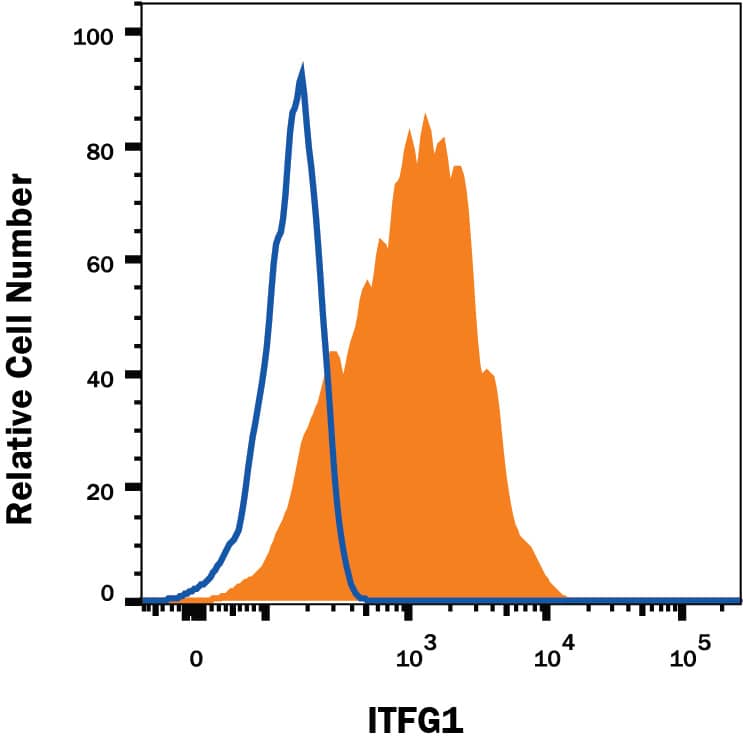
MAB0041, open histogram) followed by anti-Mouse IgG PE-conjugated Secondary Antibody (F0102B). View our protocol for Staining Membrane-associated Proteins." title="Human peripheral blood platelets were stained with Mouse Anti-Human CD9 Monoclonal Antibody (Catalog # MAB1880, filled histogram) or isotype control antibody (Catalog # MAB0041, open histogram) followed by anti-Mouse IgG PE-conjugated Secondary Antibody (F0102B). View our protocol for Staining Membrane-associated Proteins." />
| Reactivity | HuSpecies Glossary |
| Applications | Flow, CyTOF-ready |
| Clone | 209306 |
| Clonality | Monoclonal |
| Host | Mouse |
| Conjugate | Unconjugated |
| Concentration | LYOPH |
| Immunogen | NS0 mouse myeloma cell line transfected with human CD9 Met1-Val228 Accession # P21926 |
| Specificity | Detects human CD9 in direct ELISAs. |
| Source | N/A |
| Isotype | IgG2b |
| Clonality | Monoclonal |
| Host | Mouse |
| Gene | CD9 |
| Purity Statement | Protein A or G purified from hybridoma culture supernatant |
| Innovator's Reward | Test in a species/application not listed above to receive a full credit towards a future purchase. |
| Dilutions |
|
|
| Publications |
|
| Storage | Use a manual defrost freezer and avoid repeated freeze-thaw cycles.
|
| Buffer | Lyophilized from a 0.2 μm filtered solution in PBS and NaCl with Trehalose. See Certificate of Analysis for details. *Small pack size (-SP) is supplied either lyophilized or as a 0.2 µm filtered solution in PBS. |
| Preservative | No Preservative |
| Concentration | LYOPH |
| Reconstitution Instructions | Reconstitute at 0.5 mg/mL in sterile PBS. For liquid material, refer to CoA for concentration. |
CD9, also known as motility-related protein-1 (MRP-1), is a tetraspan family glycoprotein expressed by a variety of hematopoietic and epithelial cells. It forms homotypic associations as well as heterotypic associations with other tetraspan proteins, some integrins and MHC class II proteins. CD9 has been shown to modulate cellular adhesion, migration and proliferation.






![Immunoprecipitation CD44 Antibody (2C5) [Unconjugated] - s Pan Specific](https://images.novusbio.com/images/antibody/bba10_human-cd44s-pan-specific-mab-clone-2c5-immunoprecipitation-2852025105258..png)
![Knockout Validated CD44 Antibody (2C5) [Unconjugated] - s Pan Specific](https://images.novusbio.com/images/antibody/bba10_human-cd44s-pan-specific-mab-clone-2c5-knockout-validated-285202510529..png)
![Western Blot CD44 Antibody (2C5) [Unconjugated] - s Pan Specific](https://images.novusbio.com/images/antibody/CD44_BBA10_Western_Blot_21459.jpg)



Secondary Antibodies |
Isotype Controls |
|
Glypican 3 as a biomarker for gastro-esophageal adenocarcinoma By Jamshed Arslan, Pharm. D., PhD. Gastroesophageal adenocarcinoma originates from the glandular epithelium of the esophagus, gastroesophageal junction and stomach. The incidence of gastroesophageal adenocarcinoma is ... Read full blog post. |
|
Tools for Isolation, Quantification and Analysis of Exosomes Exosomes are spherical to cup-shaped bilayered membrane enclosed nanosize vesicles (30-100 nm) which have the ability to shuttle active cargoes between cells. Johnstone et al. 1987 pioneered in documenting the generation of exosomes in differentiat... Read full blog post. |
The concentration calculator allows you to quickly calculate the volume, mass or concentration of your vial. Simply enter your mass, volume, or concentration values for your reagent and the calculator will determine the rest.


![Bioactivity CTLA-4 [Unconjugated]](https://images.novusbio.com/images/protein/CTLA4_7268CT_2293.jpg)
![Flow Cytometry Integrin beta 1/CD29 Antibody (P5D2) [Unconjugated]](https://images.novusbio.com/images/antibody/Integrin_beta_1_MAB17781_Flow_Cytometry_17077.jpg)
![Flow Cytometry Integrin beta 1/CD29 Antibody (P5D2) [Unconjugated]](https://images.novusbio.com/images/antibody/Integrin_beta_1_MAB17781_Flow_Cytometry_23861.jpg)
![Immunohistochemistry Neprilysin/CD10 Antibody [Unconjugated]](https://images.novusbio.com/images/antibody/Neprilysin_AF1126_Immunohistochemistry_6679.jpg)
![Immunohistochemistry Neprilysin/CD10 Antibody [Unconjugated]](https://images.novusbio.com/images/antibody/af1126_mouse-neprilysin-affinity-purified-polyclonal-ab-immunohistochemistry-7520268331.png)
![N/A Neprilysin/CD10 Antibody [Unconjugated]](https://images.novusbio.com/images/antibody/af1126_mouse-neprilysin-affinity-purified-polyclonal-ab-7520268433.png)
![Bioactivity EGF [Unconjugated]](https://images.novusbio.com/images/protein/EGF_236EG_1570.jpg)
![Cell Culture EGF [Unconjugated]](https://images.novusbio.com/images/236-eg_recombinant-human-egf-protein-cf-25202394526.jpg)
![Cell Culture EGF [Unconjugated]](https://images.novusbio.com/images/236-eg_recombinant-human-egf-protein-cf-bioactivity-25202394053.jpg)



![Western Blot ICAM-1/CD54 Antibody [Unconjugated]](https://images.novusbio.com/images/af796_mouse-icam-1-cd54-affinity-purified-polyclonal-ab-41202410481192.jpg)
![Western Blot ICAM-1/CD54 Antibody [Unconjugated]](https://images.novusbio.com/images/af796_mouse-icam-1-cd54-affinity-purified-polyclonal-ab-4120241048112.jpg)
![Western Blot ICAM-1/CD54 Antibody [Unconjugated]](https://images.novusbio.com/images/af796_mouse-icam-1-cd54-affinity-purified-polyclonal-ab-4120241049436.jpg)
![SDS-Page TNF-alpha [Unconjugated]](https://images.novusbio.com/images/protein/TNF-alpha_210-TA_256.jpg)
![Bioactivity TNF-alpha [Unconjugated]](https://images.novusbio.com/images/protein/TNFalpha_210TA_1658.jpg)
![SEC-MALS TNF-alpha [Unconjugated]](https://images.novusbio.com/images/210-ta_recombinant-human-tnf-alpha-protein-sec-mals-35202312244..jpg)