210-TA), Recombinant Mouse TNF-a aa 80-235 (Catalog # 410-MT), Recombinant Rat TNF-a (Catalog # 510-RT), and Recombinant Human APRIL/TNFSF13 (Catalog # 5860-AP). PVDF Membrane was probed with 1 µg/mL of Mouse Anti-Human TNF-a Monoclonal Antibody (Catalog # MAB610) followed by HRP-conjugated Anti-Mouse IgG Secondary Antibody (Catalog # HAF007). A specific band was detected for TNF-a at approximately 15 kDa (as indicated). This experiment was conducted under reducing conditions and using Immunoblot Buffer Group 3." title="Western blot shows 25 ng of Recombinant Human TNF-a (Catalog # 210-TA), Recombinant Mouse TNF-a aa 80-235 (Catalog # 410-MT), Recombinant Rat TNF-a (Catalog # 510-RT), and Recombinant Human APRIL/TNFSF13 (Catalog # 5860-AP). PVDF Membrane was probed with 1 µg/mL of Mouse Anti-Human TNF-a Monoclonal Antibody (Catalog # MAB610) followed by HRP-conjugated Anti-Mouse IgG Secondary Antibody (Catalog # HAF007). A specific band was detected for TNF-a at approximately 15 kDa (as indicated). This experiment was conducted under reducing conditions and using Immunoblot Buffer Group 3." />
| Reactivity | HuSpecies Glossary |
| Applications | WB, B/N, ELISA(Cap), ICC/IF |
| Clone | 28401 |
| Clonality | Monoclonal |
| Host | Mouse |
| Conjugate | Unconjugated |
| Immunogen | E. coli-derived recombinant human TNF-alpha Gly57-Leu233 (predicted) Accession # P01375 |
| Specificity | Detects human TNF-alpha in ELISAs and Western blots. In sandwich ELISAs, less than 0.05% cross-reactivity with recombinant human TNF‑ beta , recombinant mouse TNF‑ alpha , recombinant rat TNF‑ alpha , and recombinant porcine TNF‑ alpha is observed. |
| Source | N/A |
| Isotype | IgG1 |
| Clonality | Monoclonal |
| Host | Mouse |
| Gene | TNF |
| Purity Statement | Protein A or G purified from hybridoma culture supernatant |
| Endotoxin Note | <0.10 EU per 1 μg of the antibody by the LAL method. |
| Innovator's Reward | Test in a species/application not listed above to receive a full credit towards a future purchase. |
| Dilutions |
|
|
| Application Notes | ELISA Detection: Human TNF-alpha Biotinylated Antibody (Catalog number BAF210) Standard: Recombinant Human TNF-alpha (Catalog number 210-TA) |
|
| Reviewed Applications |
|
|
| Publications |
|
| Storage | Use a manual defrost freezer and avoid repeated freeze-thaw cycles.
|
| Buffer | Lyophilized from a 0.2 μm filtered solution in PBS with Trehalose. *Small pack size (SP) is supplied either lyophilized or as a 0.2 µm filtered solution in PBS. |
| Preservative | No Preservative |
| Reconstitution Instructions | Reconstitute at 0.5 mg/mL in sterile PBS. |




| Images | Ratings | Applications | Species | Date | Details | ||||||||||
|---|---|---|---|---|---|---|---|---|---|---|---|---|---|---|---|
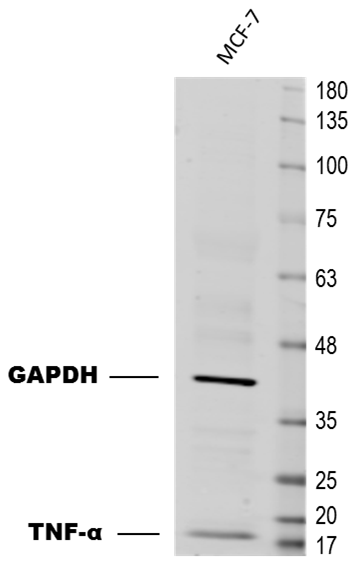
Enlarge |
reviewed by:
Verified Customer |
WB | Human | 04/20/2017 |
Summary
Comments
|
Secondary Antibodies |
Isotype Controls |
|
Unlocking the Potential of Biosimilars in Immuno-Oncology By Jennifer Jones, M.S.Biosimilar Antibodies: Imitation Meets InnovationIn the ever-evolving medical landscape, a new class of pharmaceuticals is emerging as a game-changer, poised to transform the way we approach... Read full blog post. |
|
Tired T cells: Hypoxia Drives T cell Exhaustion in the Tumor Microenvironment By Hunter MartinezThe paradigm shifting view of the immune system being leveraged to target cancer has led to numerous therapeutic breakthroughs. One major cell group responsible for this revelation is a T cell. ... Read full blog post. |
|
Immune Cell Metabolic Flux Influences Type I Diabetes By Hunter MartinezWhat is Immunometabolism?It is well established that abnormal metabolic environments can be a risk factor for disease development. One characteristic example is the role of dyslipidemia (high lev... Read full blog post. |
|
Read full blog post. |
|
Read full blog post. |
|
Read full blog post. |
|
Liver ASK1 activates autophagy to protect against hepatic fat accumulation, non-alcoholic steatohepatitis and fibrosis By Jamshed Arslan, Pharm. D., PhD. The most common chronic liver disorder worldwide is non-alcoholic fatty liver disease (NAFLD). This obesity-linked disorder can manifest as hepatic fat accumulation (steatosis) wit... Read full blog post. |
|
Metabolic Syndrome: Symptoms and associated disease states By Jamshed Arslan, Pharm. D., PhD. What is metabolic syndrome?It was 1988 when, after decades of research, Dr. GM Reaven of the Stanford University, CA, explained the relationship between four diseases:... Read full blog post. |
|
Increased wild type FUS levels in ALS patients lead to a toxic microenvironment and motor neuron neurodegeneration By Michalina Hanzel, PhDFUS mutations in Amyotrophic Lateral SclerosisFused in sarcoma (FUS) is a ribonucleoprotein that continuously shuttles between the nucleus and the cytoplasm to regulate pre-mRNA splicing, mRN... Read full blog post. |
|
You complete me: Natural killer cells need TGF-beta inhibition to effectively combat cancers By Jamshed Arslan Pharm.D. Natural killer (NK) cells are lymphocytes of the innate immune system that were first discovered for their “natural” ability to kill cancer cells. To use NK cells as anti-cancer therapy, t... Read full blog post. |
The concentration calculator allows you to quickly calculate the volume, mass or concentration of your vial. Simply enter your mass, volume, or concentration values for your reagent and the calculator will determine the rest.


 NL007) and counterstained with DAPI (blue). View our protocol for
  210-TA) induces cytotoxicity in the the L-929 mouse fibroblast cell line in a dose-dependent manner (orange line). Cytotoxicity elicited by Recombinant Human TNF-a (0.25 ng/mL) is neutral-ized (green line) by increasing concentrations of Mouse Anti-Human TNF-a Monoclonal Antibody (Catalog # MAB610). The ND50 is typically 0.01-0.04 µg/mL in the presence of the metabolic inhibitor actinomycin D." title="Recombinant Human TNF-a (Catalog #
  DY990). Goat Anti-Human TNF‑ alpha Antigen Affinity-purified Polyclonal Antibody (Catalog #
 ![N/A IL-6 [HRP]](https://images.novusbio.com/images/elisa/DATA_IL6_M6000_ELISA_936.jpg)
![N/A IL-6 [HRP]](https://images.novusbio.com/images/elisa/IL-6_M6000_ELISA_415.jpg)
![N/A IL-6 [HRP]](https://images.novusbio.com/images/m6000b_mouse-il-6-quantikine-elisa-kit-1752025024034.jpg)
![N/A IL-10 [Biotin]](https://images.novusbio.com/images/elisa/DATA_IL10_DY417_ELISA_2014.jpg)
![SEC-MALS IFN-gamma [Unconjugated]](https://images.novusbio.com/images/485-mi_recombinant-mouse-ifn-gamma-protein-sec-mals-1612202583245.jpg)
![Bioactivity IFN-gamma [Unconjugated]](https://images.novusbio.com/images/protein/IFN-gamma_485-MI_455.jpg)
![SDS-Page IFN-gamma [Unconjugated]](https://images.novusbio.com/images/protein/IFN-gamma_485-MI_407.jpg)
![Bioactivity IL-1 beta/IL-1F2 [Unconjugated]](https://images.novusbio.com/images/protein/IL-1_beta_201-LB_306.jpg)
![SDS-Page IL-1 beta/IL-1F2 [Unconjugated]](https://images.novusbio.com/images/protein/IL-1_beta_201-LB_304.jpg)
![SEC-MALS IL-1 beta/IL-1F2 [Unconjugated]](https://images.novusbio.com/images/201-lb_recombinant-human-il-1-beta-il-1f2-protein-sec-mals-123202491556.jpg)
![Bioactivity IL-2 [Unconjugated]](https://images.novusbio.com/images/202-il_recombinant-human-il-2-protein-bioactivity-174202314946.jpg)
![Bioactivity IL-4 [Unconjugated]](https://images.novusbio.com/images/protein/6507-ilcf_recombinant-human-il-4-cho-expressed-protein-cf-bioactivity-272020133214.jpg)
![Bioactivity CTLA-4 [Unconjugated]](https://images.novusbio.com/images/protein/CTLA4_7268CT_2293.jpg)
![N/A C-Reactive Protein/CRP [Biotin]](https://images.novusbio.com/images/elisa/DATA_CReactive_Protein_DY1707_ELISA_1701.jpg)
![N/A CCL2/JE/MCP-1 [HRP]](https://images.novusbio.com/images/elisa/CCL2_DCP00_ELISA_67.jpg)
![N/A CCL2/JE/MCP-1 [HRP]](https://images.novusbio.com/images/elisa/DATA_CCL2_DCP00_ELISA_633.jpg)
![N/A CCL2/JE/MCP-1 [HRP]](https://images.novusbio.com/images/elisa/DATA_CCL2_DCP00_ELISA_634.jpg)
![Bioactivity Lymphotoxin-alpha/TNF-beta [Unconjugated]](https://images.novusbio.com/images/protein/Lymphotoxin-alpha_211-TBB_CF_697.jpg)
![SDS-Page Lymphotoxin-alpha/TNF-beta [Unconjugated]](https://images.novusbio.com/images/protein/Lymphotoxin-alpha_211-TBB_CF_695.jpg)
![N/A TNF RI/TNFRSF1A [HRP]](https://images.novusbio.com/images/elisa/DATA_TNF_RI_DRT100_ELISA_816.jpg)
![N/A TNF RI/TNFRSF1A [HRP]](https://images.novusbio.com/images/elisa/DATA_TNF_RI_DRT100_ELISA_815.jpg)
![N/A TNF RI/TNFRSF1A [HRP]](https://images.novusbio.com/images/elisa/TNF_RI_DRT100_ELISA_175.jpg)
![Western Blot ERK2 Antibody [Unconjugated]](https://images.novusbio.com/images/antibody/ERK2_AF1230_Western_Blot_5097.jpg)
![Knockout Validated ERK2 Antibody [Unconjugated]](https://images.novusbio.com/images/antibody/ERK2_AF1230_Knockout_Validated_22864.jpg)
![Immunohistochemistry ERK2 Antibody [Unconjugated]](https://images.novusbio.com/images/antibody/ERK2_AF1230_Immunohistochemistry_20696.jpg)