| Reactivity | HuSpecies Glossary |
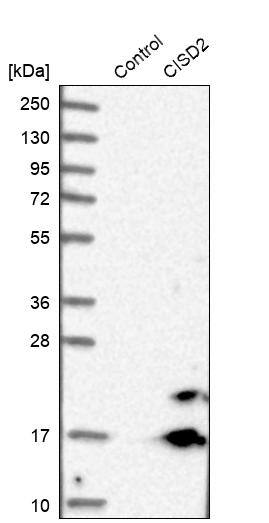
| Applications | WB, KO |
| Clonality | Polyclonal |
| Host | Sheep |
| Conjugate | Alexa Fluor 594 |
| Immunogen | E. coli-derived recombinant human STING/TMEM173 Ala215-Ser379 Accession # Q86WV6 |
| Specificity | Detects human STING/TMEM173 in direct ELISAs and Western blots. |
| Isotype | IgG |
| Clonality | Polyclonal |
| Host | Sheep |
| Gene | STING1 |
| Purity Statement | Antigen Affinity-purified |
| Innovator's Reward | Test in a species/application not listed above to receive a full credit towards a future purchase. |
| Storage | Protect from light. Do not freeze. 12 months from date of receipt, 2 to 8 °C as supplied |
| Buffer | Supplied 0.2 mg/mL in a saline solution containing BSA and Sodium Azide. |
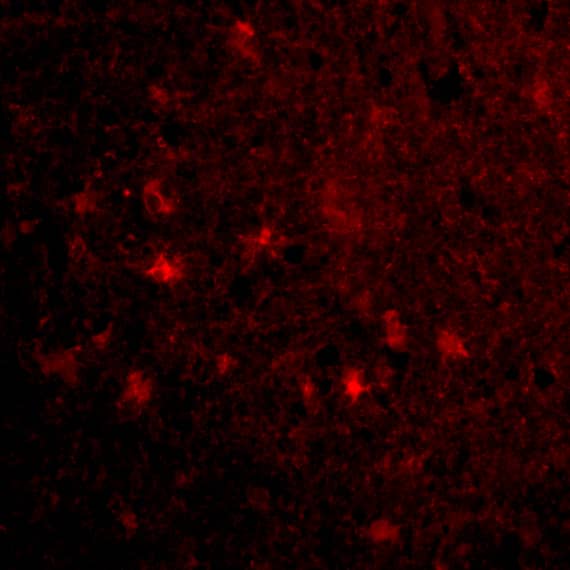
STING (Stimulator of interferon genes; also ERIS, MPYS, MITA and TMEM173) is a 40-42 kDa 4-transmembrane protein that mediates both antiviral and MHC-II antigen recognition responses. STING is found in the ER, mitochondrial outer membrane and plasma membrane. It acts as an adaptor protein for intracellular viral detection molecules, participating in the induction of type I interferon. It also may play a role in the initiation of apoptosis following MHC-II engagement. Cells known to express STING include B cells, dendritic cells, macrophages, and monocytes. Human STING is 379 amino acids (aa) in length. It contains an N-terminal cytoplasmic region (aa 1-20), four transmembrane segments (aa 21-173), and a C-terminal cytoplasmic domain (aa 174-379). Ubiquitination occurs at Lys150, and phosphorylation occurs at Ser358. STING forms 80 kDa homodimers. There are two potential splice forms, one that shows a 25 aa substitution for aa 1-173, and another that possesses an alternative start site at Met215, coupled to a premature truncation following Arg334. Over aa 215-379, human STING shares 76% aa identity with mouse STING.






Secondary Antibodies |
Isotype Controls |
|
STING in Innate Immunity and Cancer: What’s the Buzz About? STING (STimulator of INterferon Genes protein) acts as a sensor of cytosolic DNA. Bacteria/Virus or self-derived DNA in the cytosol activates the STING pathway and promotes the production of type I interferons (IFN-alpha and IFN-beta). STING also ... Read full blog post. |
The concentration calculator allows you to quickly calculate the volume, mass or concentration of your vial. Simply enter your mass, volume, or concentration values for your reagent and the calculator will determine the rest.


![Binding Activity IFN-beta [Unconjugated]](https://images.novusbio.com/images/protein/IFNbeta_8499IF_1038.jpg)



![SDS-Page TNF-alpha [Unconjugated]](https://images.novusbio.com/images/protein/TNF-alpha_210-TA_256.jpg)
![Bioactivity TNF-alpha [Unconjugated]](https://images.novusbio.com/images/protein/TNFalpha_210TA_1658.jpg)
![SEC-MALS TNF-alpha [Unconjugated]](https://images.novusbio.com/images/210-ta_recombinant-human-tnf-alpha-protein-sec-mals-35202312244..jpg)


