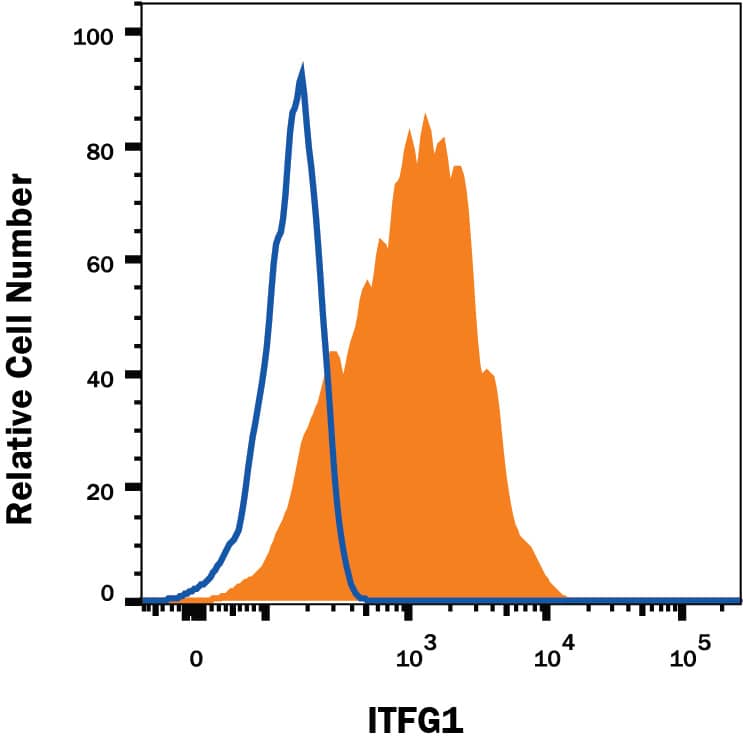
MAB004, open histogram), followed by Allophycocyanin-conjugated Anti-Mouse IgG Secondary Antibody (Catalog # F0101B). To facilitate intracellular staining, cells were fixed and permeabilized with FlowX FoxP3 Fixation & Permeabilization Buffer Kit (Catalog # FC012). View our protocol for Staining Intracellular Molecules." title="Jurkat human acute T cell leukemia cell line was stained with Mouse Anti-Human NLRP6/NALP6 Monoclonal Antibody (Catalog # MAB9145, filled histogram) or isotype control antibody (Catalog # MAB004, open histogram), followed by Allophycocyanin-conjugated Anti-Mouse IgG Secondary Antibody (Catalog # F0101B). To facilitate intracellular staining, cells were fixed and permeabilized with FlowX FoxP3 Fixation & Permeabilization Buffer Kit (Catalog # FC012). View our protocol for Staining Intracellular Molecules." />
| Reactivity | HuSpecies Glossary |
| Applications | Flow, CyTOF-ready |
| Clone | 920631 |
| Clonality | Monoclonal |
| Host | Mouse |
| Conjugate | Unconjugated |
| Immunogen | E.coli-derived recombinant human NLRP6/NALP6 Lys35-Arg193 Accession # P59044 |
| Specificity | Detects human NLRP6/NALP6 in direct ELISAs. |
| Source | N/A |
| Isotype | IgG2b |
| Clonality | Monoclonal |
| Host | Mouse |
| Gene | NLRP6 |
| Purity Statement | Protein A or G purified from hybridoma culture supernatant |
| Innovator's Reward | Test in a species/application not listed above to receive a full credit towards a future purchase. |
| Dilutions |
|
|
| Publications |
|
| Storage | Use a manual defrost freezer and avoid repeated freeze-thaw cycles.
|
| Buffer | Lyophilized from a 0.2 μm filtered solution in PBS with Trehalose. *Small pack size (SP) is supplied either lyophilized or as a 0.2 µm filtered solution in PBS. |
| Preservative | No Preservative |
| Reconstitution Instructions | Reconstitute at 0.5 mg/mL in sterile PBS. |









![NALP6 Antibody (920631) [Unconjugated]](/sites/all/modules/enterprise-tech/et_datasheets/images/novus_guarantee.png "NALP6 Antibody (920631) [Unconjugated]")
Secondary Antibodies |
Isotype Controls |
|
Pyroptosis: Mechanisms mediating cell death and pro-inflammatory cytokine release By Victoria OsinskiPyroptosis is an inflammatory form of programmed cell death characterized by the release of pro-inflammatory cytokines IL-1 beta and IL-18.1,10 It is a process distinct from apoptosis and necrosis (T... Read full blog post. |
|
NALP6 - plays a critical role in suppressing inflammation and tumorigenesis NALP6 belongs to the NLRP family of which function as innate sensors of endogenous and exogenous stress and damage-associated molecular patterns (DAMPs). NLRPs are vital components of the inflammasome which is the cytoplasmic multiprotein complex that... Read full blog post. |
The concentration calculator allows you to quickly calculate the volume, mass or concentration of your vial. Simply enter your mass, volume, or concentration values for your reagent and the calculator will determine the rest.