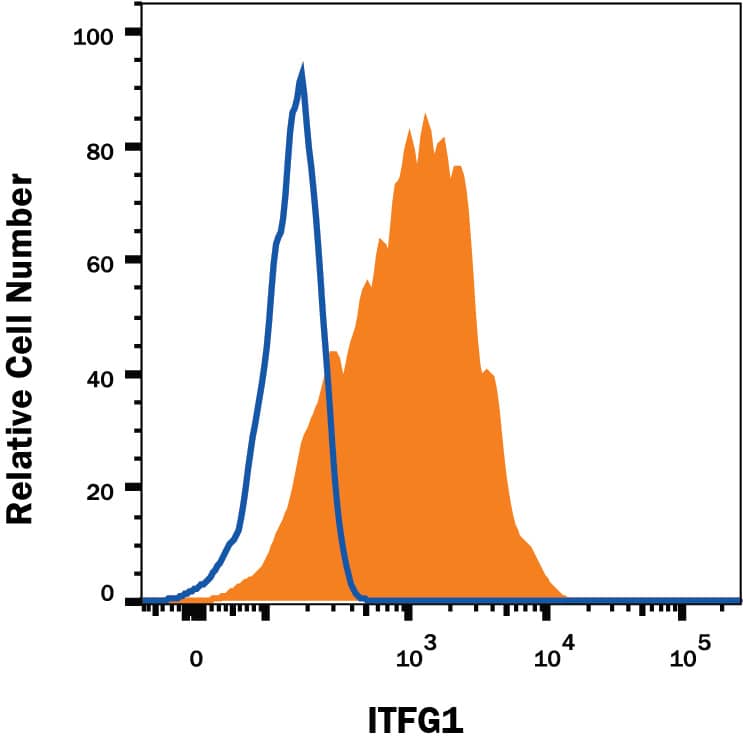
MAB0041, open histogram), followed by Allophycocyanin-conjugated Anti-Mouse IgG Secondary Antibody (Catalog # F0101B). To facilitate intracellular staining, cells were fixed with Flow Cytometry Fixation Buffer (Catalog # FC004) and permeabilized with Flow Cytometry Permeabilization/Wash Buffer I (Catalog # FC005)." title="OVCAR-3 human ovarian carcinoma cell line was stained with Mouse Anti-Human GDF-9 Monoclonal Antibody (Catalog # MAB8266, filled histogram) or isotype control antibody (Catalog # MAB0041, open histogram), followed by Allophycocyanin-conjugated Anti-Mouse IgG Secondary Antibody (Catalog # F0101B). To facilitate intracellular staining, cells were fixed with Flow Cytometry Fixation Buffer (Catalog # FC004) and permeabilized with Flow Cytometry Permeabilization/Wash Buffer I (Catalog # FC005)." />
| Reactivity | HuSpecies Glossary |
| Applications | Flow, CyTOF-ready, ICC/IF |
| Clone | 917319 |
| Clonality | Monoclonal |
| Host | Mouse |
| Conjugate | Unconjugated |
| Immunogen | Human embryonic kidney cell line derived recombinant human GDF-9 Met1-Arg454 Accession # O60383 |
| Specificity | Detects human GDF-9 in direct ELISAs. |
| Source | N/A |
| Isotype | IgG2b |
| Clonality | Monoclonal |
| Host | Mouse |
| Gene | GDF9 |
| Purity Statement | Protein A or G purified from hybridoma culture supernatant |
| Innovator's Reward | Test in a species/application not listed above to receive a full credit towards a future purchase. |
| Storage | Use a manual defrost freezer and avoid repeated freeze-thaw cycles.
|
| Buffer | Lyophilized from a 0.2 μm filtered solution in PBS with Trehalose. *Small pack size (SP) is supplied either lyophilized or as a 0.2 µm filtered solution in PBS. |
| Preservative | No Preservative |
| Reconstitution Instructions | Reconstitute at 0.5 mg/mL in sterile PBS. |
Growth Differentiation Factor-9 (GDF-9) is an oocyte secreted paracrine factor in the TGF-beta superfamily (1, 2). It is synthesized as a prepropeptide and is subsequently processed by proteases into the mature protein (1, 2). Mature human GDF-9 has a predicted molecular weight of 16 kDa and shares 89.6% and 91.9% amino acid sequence identity with the mouse and rat orthologs, respectively. Despite the high homology, mouse GDF-9 is secreted in an active form, while human GDF-9 is latent. A single mutation Gly391Arg increases the affinity between human GDF-9 and its signaling receptors and make it more active (3). It forms both non-covalent homodimers and heterodimers with BMP-15, which is coordinately expressed with GDF-9 in the oocyte. (2, 4, 5). GDF-9 signals through TGF-beta RI/ALK-5 and BMPR-II, while the GDF-9:BMP-15 heterodimer is believed to signal through BMPR-II, ALK 4/5/7, and BMPR-IB/ALK-6 (5-8). SMAD2 and SMAD3 are phosphorylated following activation of receptor complexes by GDF-9 (5, 6). GDF-9 functions as a paracrine factor in the development of primary follicles in the ovary. It is critical for the growth of granulosa and theca cells and for the differentiation and maturation of the oocyte (5, 9-11). GDF-9 is thought to act synergistically with BMP-15 to control development of the oocyte-cumulus cell complex (4-6). In humans, GDF-9:BMP-15 heterodimers have been shown to be more potent regulators of granulosa cell functions compared to GDF-9 homodimers (6). Aberrant GDF-9 expression and activation is associated with a multitude of common human ovarian disorders including premature ovarian failure and polycystic ovary syndrome (10, 12-14). In breast and bladder cancers, GDF-9 is believed to function as a tumor suppressor because its expression levels are inversely correlated with the aggressiveness of the cancer (15, 16). In prostate cancer, however, GDF-9 may enhance tumor progression by promoting tumor cell growth and epithelial-to-mesenchymal transition (17, 18).
![Western Blot Smad3 [p Ser423, p Ser425] Antibody - BSA Free](https://images.novusbio.com/images/Smad3-[p-Ser423--p-Ser425]-Antibody-Western-Blot-NBP1-77836-img0005.jpg)
![Immunocytochemistry/ Immunofluorescence Smad3 [p Ser423, p Ser425] Antibody - BSA Free](https://images.novusbio.com/images/Smad3-[p-Ser423--p-Ser425]-Antibody-Immunocytochemistry-Immunofluorescence-NBP1-77836-img0007.jpg)
![Immunohistochemistry Smad3 [p Ser423, p Ser425] Antibody - BSA Free](https://images.novusbio.com/images/Smad3-[p-Ser423--p-Ser425]-Antibody-Immunohistochemistry-NBP1-77836-img0006.jpg)
![Flow Cytometry CD117/c-kit Antibody [Unconjugated]](https://images.novusbio.com/images/af1356_human-mouse-cd117-c-kit-affinity-purified-polyclonal-ab-81202555532.jpg)
![Immunohistochemistry CD117/c-kit Antibody [Unconjugated]](https://images.novusbio.com/images/antibody/af1356_human-mouse-cd117-c-kit-affinity-purified-polyclonal-ab-immunohistochemistry-812202575731.png)
![Immunocytochemistry/ Immunofluorescence CD117/c-kit Antibody [Unconjugated]](https://images.novusbio.com/images/af1356_human-mouse-cd117-c-kit-affinity-purified-polyclonal-ab-41202410481199.jpg)
Secondary Antibodies |
Isotype Controls |
The concentration calculator allows you to quickly calculate the volume, mass or concentration of your vial. Simply enter your mass, volume, or concentration values for your reagent and the calculator will determine the rest.


 NL007) and counterstained with DAPI (blue). Specific staining was localized to secreted molecule. View our protocol for
 ![BMP-15/GDF-9B [Unconjugated]](/sites/all/modules/enterprise-tech/et_datasheets/images/novus_guarantee.png "BMP-15/GDF-9B [Unconjugated]")


![Immunocytochemistry TGF-beta RI/ALK-5 Antibody [Unconjugated]](https://images.novusbio.com/images/antibody/TGF-beta_RI_AF3025_Immunocytochemistry_9948.jpg)
![Western Blot TGF-beta RI/ALK-5 Antibody [Unconjugated]](https://images.novusbio.com/images/af3025_human-tgf-beta-ri-alk-5-affinity-purified-polyclonal-ab-western-blot-12122025932372.jpg)
![Western Blot TGF-beta RI/ALK-5 Antibody [Unconjugated]](https://images.novusbio.com/images/af3025_human-tgf-beta-ri-alk-5-affinity-purified-polyclonal-ab-41202412402510.jpg)
![SDS-Page BMP-6 [Unconjugated]](https://images.novusbio.com/images/protein/BMP-6_507-BP_374.jpg)
![Bioactivity BMP-6 [Unconjugated]](https://images.novusbio.com/images/protein/BMP-6_507-BP_376.jpg)
![Western Blot Smad2/3 Antibody [Unconjugated]](https://images.novusbio.com/images/antibody/Smad3_AF3797_Western_Blot_5347.jpg)
![Immunohistochemistry Smad2/3 Antibody [Unconjugated]](https://images.novusbio.com/images/antibody/af3797_human-mouse-smad2-3-affinity-purified-polyclonal-ab-immunohistochemistry-3082021153223.jpg)
![Simple Western Smad2/3 Antibody [Unconjugated]](https://images.novusbio.com/images/antibody/Smad2_3_AF3797_Simple_Western_20385.jpg)


![SDS-Page BMP-4 [Unconjugated]](https://images.novusbio.com/images/protein/BMP-4_314-BP_100.jpg)
![Bioactivity BMP-4 [Unconjugated]](https://images.novusbio.com/images/314-bp_recombinant-human-bmp-4-protein-1882021123744.jpg)


![Bioactivity TGF-beta 1 [Unconjugated]](https://images.novusbio.com/images/protein/7754-bhcf_recombinant-human-tgf-beta-1-human-cell-expressed-cf-bioactivity-1811202013946.jpg)
![N/A Follistatin [HRP]](https://images.novusbio.com/images/elisa/DATA_Follistatin_DFN00_ELISA_681.jpg)
![N/A Follistatin [HRP]](https://images.novusbio.com/images/elisa/DATA_Follistatin_DFN00_ELISA_682.jpg)
![N/A Follistatin [HRP]](https://images.novusbio.com/images/elisa/Follistatin_DFN00_ELISA_97.jpg)
![Bioactivity IGF-I/IGF-1 [Unconjugated]](https://images.novusbio.com/images/protein/IGF-I_291-G1_41.jpg)
![Mass Spectrometry IGF-I/IGF-1 [Unconjugated]](https://images.novusbio.com/images/protein/IGF-I_291-G1_42.jpg)
![SEC-MALS IGF-I/IGF-1 [Unconjugated]](https://images.novusbio.com/images/291-g1_recombinant-human-igf-i-igf-1-protein-cf-sec-mals-224202691859.jpg)
![Bioactivity EGF [Unconjugated]](https://images.novusbio.com/images/protein/EGF_236EG_1570.jpg)
![Cell Culture EGF [Unconjugated]](https://images.novusbio.com/images/236-eg_recombinant-human-egf-protein-cf-25202394526.jpg)
![Cell Culture EGF [Unconjugated]](https://images.novusbio.com/images/236-eg_recombinant-human-egf-protein-cf-bioactivity-25202394053.jpg)
![Bioactivity BMP-2 [Unconjugated]](https://images.novusbio.com/images/protein/355-bm_recombinant-human-mouse-rat-bmp-2-protein-bioactivity-181120209742.jpg)