| Reactivity | HuSpecies Glossary |
| Applications | WB, IHC |
| Clonality | Polyclonal |
| Host | Goat |
| Conjugate | Unconjugated |
| Concentration | LYOPH |
| Immunogen | Mouse myeloma cell line NS0-derived recombinant human ROBO3 Leu40-Ser545 Accession # Q96MS0 |
| Specificity | Detects ROBO3 in direct ELISAs and Western blots. In direct ELISAs and Western blots, approximately 60% cross-reactivity with recombinant mouse ROBO3 is observed, 5% cross-reactivity with recombinant human ROBO2 and recombinant rat ROBO1 is observed, and less than 1% cross‑reactivity with recombinant human ROBO4 is observed. |
| Source | N/A |
| Isotype | IgG |
| Clonality | Polyclonal |
| Host | Goat |
| Gene | ROBO3 |
| Purity Statement | Antigen Affinity-purified |
| Innovator's Reward | Test in a species/application not listed above to receive a full credit towards a future purchase. |
| Dilutions |
|
|
| Reviewed Applications |
|
|
| Publications |
|
| Storage | Use a manual defrost freezer and avoid repeated freeze-thaw cycles.
|
| Buffer | Lyophilized from a 0.2 μm filtered solution in PBS with Trehalose. *Small pack size (SP) is supplied either lyophilized or as a 0.2 µm filtered solution in PBS. |
| Preservative | No Preservative |
| Concentration | LYOPH |
| Reconstitution Instructions | Reconstitute at 0.2 mg/mL in sterile PBS. |
Human ROBO3 is a 200 kDa member of the ROBO family of guidance molecules (1‑3). The term ROBO derives from round-about, a description of the circuitous pathway axons take in the absence of a functional ROBO gene (3, 4). Human ROBO3 is a type I transmembrane glycoprotein that is synthesized as a 1386 amino acid (aa) precursor. It contains a 20 aa signal sequence, an 871 aa extracellular domain (ECD), a 21 aa transmembrane segment, and a 474 aa cytoplasmic region (5, 6). The ECD contains five C2-type Ig-like domains (aa 64‑531) and three fibronectin (FN) type III domains (aa 555‑863). The cytoplasmic region contains three of four possible 15‑20 aa long CC (conserved cytoplasmic) motifs that are found in ROBO1 (7, 8). Human ROBO3 has multiple isoforms. An alternate start site generates a 1365 aa A isoform and a 1341 aa B isoform. These two mature forms differ only over the first 26 and 2 amino acids of the N-terminus, respectively. There are multiple point mutations and insertions in the ROBO3 gene. Three result in truncated forms. One is 456 aa in length and ends after the Ig-like domain # 4. A second is 770 aa in length and ends in the third FN domain. A third isoform is truncated after aa 1108 in the cytoplasmic region after CC2. At least one alternate splice form is also reported. It shows a 10 aa substitution between aa 1025‑1034, followed by truncation. Human ROBO3 ECD is 84% and 91% aa identical to the ECD in mouse and canine ROBO3, respectively. Normally, axons originating on one side of the spinal cord are inhibited from crossing to the other side by a SLIT2-ROBO1 interaction at the midline. ROBO3 is permissive for this event. It is unclear how this is accomplished. One possibility is that it binds directly to ROBO1, blocking SLIT activation. A second possibility involves ROBO3 binding to SLIT2 in a nonproductive interaction. However, only ROBO3 Form B is known to bind to SLIT2 (9‑11).


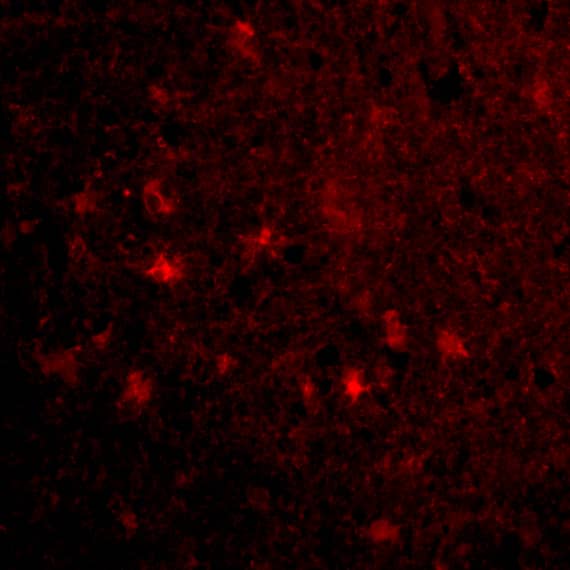


| Images | Ratings | Applications | Species | Date | Details | ||||||||
|---|---|---|---|---|---|---|---|---|---|---|---|---|---|

Enlarge |
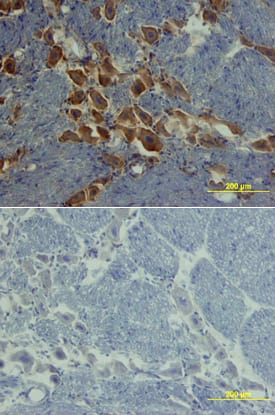
reviewed by:
Ricardo Vieira |
IHC-Fr | Mouse | 05/08/2019 |
Summary
|
Secondary Antibodies |
Isotype Controls |
The concentration calculator allows you to quickly calculate the volume, mass or concentration of your vial. Simply enter your mass, volume, or concentration values for your reagent and the calculator will determine the rest.





![Slit1 [Unconjugated]](/sites/all/modules/enterprise-tech/et_datasheets/images/novus_guarantee.png "Slit1 [Unconjugated]")



![Binding Activity IFN-beta [Unconjugated]](https://images.novusbio.com/images/protein/IFNbeta_8499IF_1038.jpg)