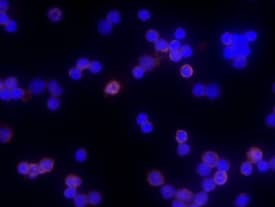
CTS008) and counterstained with hematoxylin (blue). Specific labeling was localized to the cytoplasm of Langerhans cells in the skin epidermis. View our protocol for Chromogenic IHC Staining of Paraffin-embedded Tissue Sections." title="Langerin/CD207 was detected in immersion fixed paraffin-embedded sections of human skin using 15 µg/mL Goat Anti-Human Langerin/CD207 Antigen Affinity-purified Polyclonal Antibody (Catalog # AF2088) overnight at 4 °C. Tissue was stained with the Anti-Goat HRP-DAB Cell & Tissue Staining Kit (brown; Catalog # CTS008) and counterstained with hematoxylin (blue). Specific labeling was localized to the cytoplasm of Langerhans cells in the skin epidermis. View our protocol for Chromogenic IHC Staining of Paraffin-embedded Tissue Sections." />
| Reactivity | HuSpecies Glossary |
| Applications | WB, IHC |
| Clonality | Polyclonal |
| Host | Goat |
| Conjugate | Unconjugated |
| Concentration | LYOPH |
| Immunogen | Mouse myeloma cell line NS0-derived recombinant human Langerin/CD207 Tyr64-Pro328 Accession # Q9UJ71 |
| Specificity | Detects human Langerin/CD207 in direct ELISAs and Western blots. |
| Source | N/A |
| Isotype | IgG |
| Clonality | Polyclonal |
| Host | Goat |
| Gene | CD207 |
| Purity Statement | Antigen Affinity-purified |
| Innovator's Reward | Test in a species/application not listed above to receive a full credit towards a future purchase. |
| Dilutions |
|
|
| Reviewed Applications |
|
|
| Publications |
|
| Storage | Use a manual defrost freezer and avoid repeated freeze-thaw cycles.
|
| Buffer | Lyophilized from a 0.2 μm filtered solution in PBS with Trehalose. *Small pack size (SP) is supplied either lyophilized or as a 0.2 µm filtered solution in PBS. |
| Preservative | No Preservative |
| Concentration | LYOPH |
| Reconstitution Instructions | Reconstitute at 0.2 mg/mL in sterile PBS. |
Langerin (also known as CD207) is a type II transmembrane glycoprotein which is member K of the C-type lectin domain family 4 (1). Langerin is used as a marker for Langerhans cells (LCs) which represent the immature dendritic cells in the epidermis (1, 2). LCs uniquely contain “tennis racket”-shaped endosomal recycling compartment subdomains with pentalamellar membranes termed Birbeck granules (1-3). Langerin is necessary and sufficient for Birbeck granule formation (1). The 328 amino acid (aa) human langerin sequence contains a 43 aa cytoplasmic domain, a 21 aa transmembrane domain and a 264 aa extracellular domain (ECD) that contains a coiled-coil domain and a single C-type lectin domain. Trimerization greatly increases the lectin binding affinity (4). Langerin internalizes endogenous proteins such as type I procollagen. Internalization by LC is thought to lead to suppression of self reactions (4-6). Langerin also mediates endocytosis of non-peptide antigens containing mannose, N-acetyl glucosamine and fucose that are expressed by mycobacteria and fungae (4, 7). Some antigens, such as the M. leprae glycolipid arabinomycolate, are ultimately presented by human LC CD1a in cutaneous-draining lymph nodes (8). Langerin performs a barrier-like function to HIV-1 transmission due to its internalization of virus particles for destruction (9). A rare human polymorphism within the lectin domain, W264R, abolishes both carbohydrate recognition and Birbeck granule formation (10, 11). Genetic deletion of mouse langerin was not shown to have functional consequence other than abolishing Birbeck granule formation (12). Human langerin shares 68%, 62%, 71% aa identity with mouse, rat, and bovine langerin ECD, respectively.



| Images | Ratings | Applications | Species | Date | Details | ||||||
|---|---|---|---|---|---|---|---|---|---|---|---|
|
reviewed by:
Verified Customer |
IF | Human | 01/06/2015 |
Summary
|
Secondary Antibodies |
Isotype Controls |
The concentration calculator allows you to quickly calculate the volume, mass or concentration of your vial. Simply enter your mass, volume, or concentration values for your reagent and the calculator will determine the rest.


![Bioactivity CTLA-4 [Unconjugated]](https://images.novusbio.com/images/protein/CTLA4_7268CT_2293.jpg)


![Flow Cytometry CD1b Antibody (737249) [Unconjugated]](https://images.novusbio.com/images/antibody/CD1b_MAB7446_Flow_Cytometry_12185.jpg)


![Immunohistochemistry DC-SIGN/CD209 Antibody (120507) [Unconjugated]](https://images.novusbio.com/images/mab161_human-dc-sign-cd209-mab-clone-120507-8120255531625.jpg)
![Western Blot DC-SIGN/CD209 Antibody (120507) [Unconjugated]](https://images.novusbio.com/images/mab161_human-dc-sign-cd209-mab-clone-120507-81202555723.jpg)
![Multiplex Immunofluorescence DC-SIGN/CD209 Antibody (120507) [Unconjugated]](https://images.novusbio.com/images/antibody/mab161_human-dc-sign-cd209-mab-clone-120507-multiplex-immunofluorescence-165202622135.png)
![SDS-Page TNF-alpha [Unconjugated]](https://images.novusbio.com/images/protein/TNF-alpha_210-TA_256.jpg)
![Bioactivity TNF-alpha [Unconjugated]](https://images.novusbio.com/images/protein/TNFalpha_210TA_1658.jpg)
![SEC-MALS TNF-alpha [Unconjugated]](https://images.novusbio.com/images/210-ta_recombinant-human-tnf-alpha-protein-sec-mals-35202312244..jpg)
![N/A CD14 [HRP]](https://images.novusbio.com/images/elisa/DATA_CD14_DC140_ELISA_597.jpg)
![N/A CD14 [HRP]](https://images.novusbio.com/images/elisa/CD14_DC140_ELISA_42.jpg)