| Applications | ELISA |
| Conjugate | Biotin |
| Source | N/A |
| Assay Type | Solid Phase Sandwich ELISA |
| Inter-Assay | See PDF Datasheet for details |
| Intra-Assay | See PDF Datasheet for details |
| Spike Recovery | See PDF Datasheet for details |
| Sample Volume | See PDF Datasheet for details |
| Gene | ESR1 |
| Dilutions |
|
|
| Application Notes | No significant interference observed with available related molecules. |
|
| Publications |
|
| Storage | Store the unopened product at 2 - 8 °C. Do not use past expiration date. |
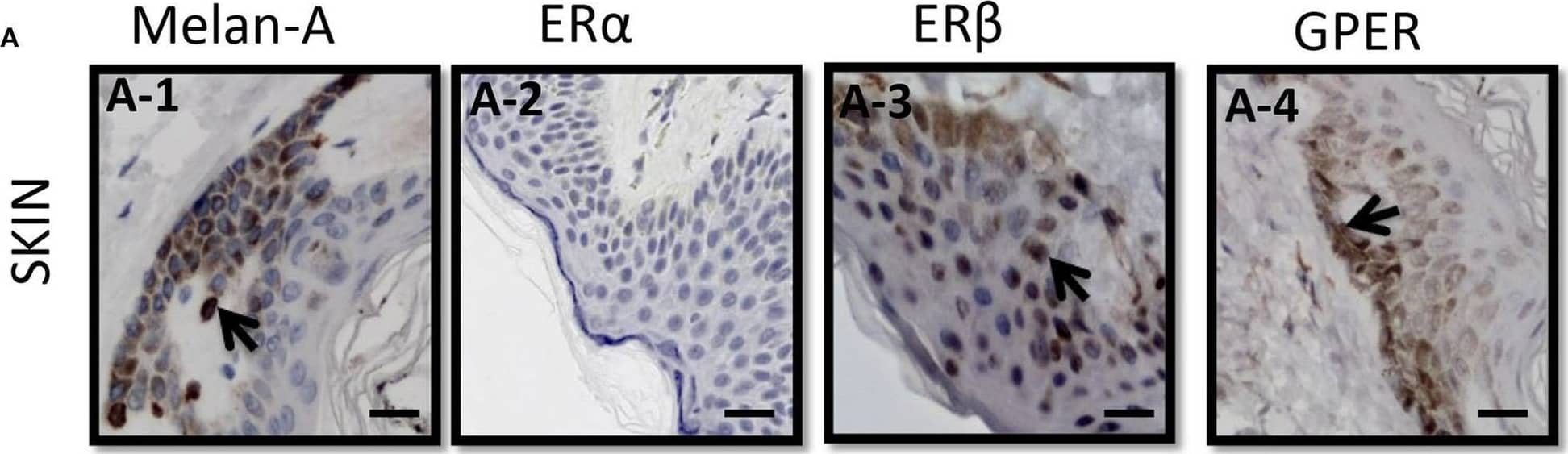
Estrogen receptor alpha (ER alpha, NR3A1) is a member of the steroid receptor family. The natural ligand for ER is the classic estrogenic compound 17 beta-estradiol. ER alpha is expressed in a wide variety of tissues such as bones, uterus, bladder, ovary, prostate, testis, epididymis, kidney, breast, heart, vessel wall, pituitary and hypothalamus. The estrogen receptor has a variety of central physiological roles, including those involved in maintenance of the reproductive, cardiovascular, musculoskeletal and central nervous systems. ER alpha has been shown to form homodimers as well as heterodimers with ER beta. Both ER alpha and ER beta can give rise to numerous isoforms.




![Immunocytochemistry EGFR Antibody [Unconjugated]](https://images.novusbio.com/images/antibody/EGF_R_AF231_Immunocytochemistry__Immunofluorescence_21143.jpg)
![Flow Cytometry EGFR Antibody [Unconjugated]](https://images.novusbio.com/images/antibody/EGF_R_AF231_Flow_Cytometry_20401.jpg)
![Western Blot EGFR Antibody [Unconjugated]](https://images.novusbio.com/images/antibody/EGF_R_AF231_Western_Blot_19925.jpg)





| Gene Symbol | ESR1 |


![N/A C-Reactive Protein/CRP [Biotin]](https://images.novusbio.com/images/elisa/DATA_CReactive_Protein_DY1707_ELISA_1701.jpg)
![Bioactivity ErbB2/Her2 [Unconjugated]](https://images.novusbio.com/images/protein/1129-er_recombinant-human-erbb2-her2-fc-chimera-protein-cf-bioactivity-7122020142841.jpg)
![SDS-Page ErbB2/Her2 [Unconjugated]](https://images.novusbio.com/images/protein/ErbB2_1129-ER_70.jpg)
![Western Blot Androgen R/NR3C4 [p Ser213, p Ser210] Antibody (156C135.2) - BSA Free](https://images.novusbio.com/images/Androgen-R-NR3C4-p-Ser213-p-Ser210-Antibody-156C135-2-Western-Blot-NB100-56603-img0004.jpg)
![SDS-Page TNF-alpha [Unconjugated]](https://images.novusbio.com/images/protein/TNF-alpha_210-TA_256.jpg)
![Bioactivity TNF-alpha [Unconjugated]](https://images.novusbio.com/images/protein/TNFalpha_210TA_1658.jpg)
![SEC-MALS TNF-alpha [Unconjugated]](https://images.novusbio.com/images/210-ta_recombinant-human-tnf-alpha-protein-sec-mals-35202312244..jpg)
![Bioactivity EGF [Unconjugated]](https://images.novusbio.com/images/protein/EGF_236EG_1570.jpg)
![Cell Culture EGF [Unconjugated]](https://images.novusbio.com/images/236-eg_recombinant-human-egf-protein-cf-25202394526.jpg)
![Cell Culture EGF [Unconjugated]](https://images.novusbio.com/images/236-eg_recombinant-human-egf-protein-cf-bioactivity-25202394053.jpg)
![Western Blot: ER alpha/NR3A1 Antibody (33) [NB300-560] - Analysis of recombinant ER alpha.](https://images.novusbio.com/images/ER-alpha-NR3A1-Antibody-33-Western-Blot-NB300-560-img0004.jpg "Western Blot: ER alpha/NR3A1 Antibody (33) [NB300-560] - Analysis of recombinant ER alpha.")