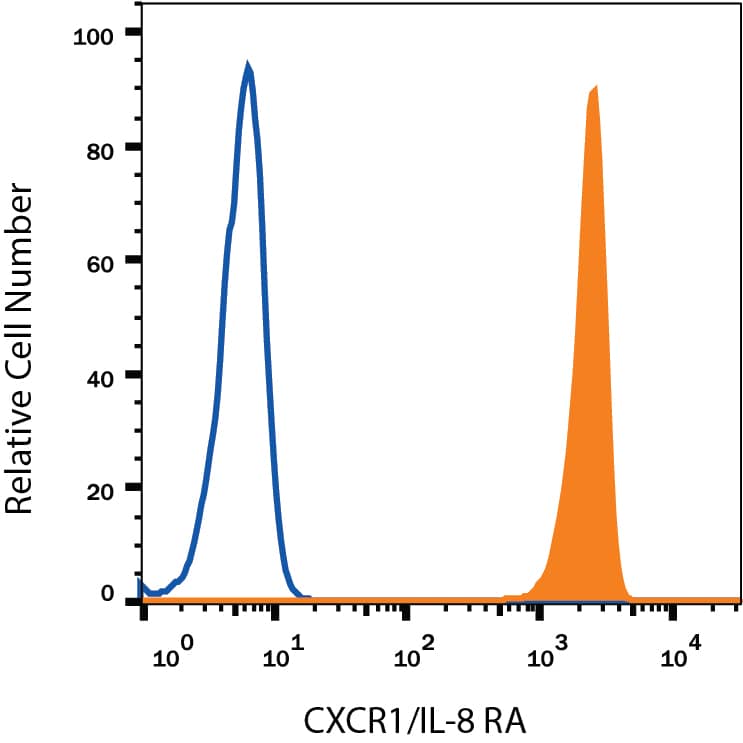
F0101B). Quadrant markers were set based on control antibody staining (Catalog # MAB003)." title="HEK293 human embryonic kidney cell line transfected with either (A) human CEACAM-5/CD66e or (B) human CEACAM-8/CD66b and eGFP was stained with Mouse Anti-Human CEACAM-5/CD66e Monoclonal Antibody (Catalog # MAB41281) followed by Allophycocyanin-conjugated Anti-Mouse IgG Secondary Antibody (Catalog # F0101B). Quadrant markers were set based on control antibody staining (Catalog # MAB003)." />
| Reactivity | HuSpecies Glossary |
| Applications | WB, Flow, IHC, CyTOF-ready |
| Clone | 487609 |
| Clonality | Monoclonal |
| Host | Mouse |
| Conjugate | Unconjugated |
| Concentration | LYOPH |
| Immunogen | Mouse myeloma cell line NS0-derived recombinant human CEACAM‑5/CD66e Lys35-Ala685 Accession # ABM87752 |
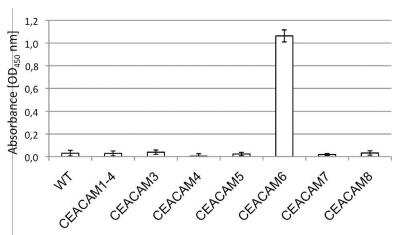
| Specificity | Detects human CEACAM‑5/CD66e in direct ELISAs and Western blots. In direct ELISAs and Western blots, no cross-reactivity with recombinant human CEACAM-1 or -6 is observed. |
| Source | N/A |
| Isotype | IgG2a |
| Clonality | Monoclonal |
| Host | Mouse |
| Gene | CEACAM5 |
| Purity Statement | Protein A or G purified from hybridoma culture supernatant |
| Innovator's Reward | Test in a species/application not listed above to receive a full credit towards a future purchase. |
| Dilutions |
|
|
| Publications |
|
| Storage | Use a manual defrost freezer and avoid repeated freeze-thaw cycles.
|
| Buffer | Lyophilized from a 0.2 μm filtered solution in PBS with Trehalose. *Small pack size (SP) is supplied either lyophilized or as a 0.2 µm filtered solution in PBS. |
| Preservative | No Preservative |
| Concentration | LYOPH |
| Reconstitution Instructions | Reconstitute at 0.5 mg/mL in sterile PBS. |
CEACAM-5, also known as CEA and CD66e, belongs to the large family of CEACAM and pregnancy specific glycoproteins. CEACAM molecules are either transmembrane or GPI-linked, and are differentially expressed between species (1, 2). Orthologs of human CEACAM‑5 have not been described in other species. CEACAM-5, which is expressed primarily by epithelial cells, consists of an N-terminal Ig-like V-set domain followed by six Ig-like C2-set domains and a GPI anchor (2‑4). CEACAM-5 is synthesized as a 180 kDa, variably glycosylated molecule of which approximately 60% is carbohydrate (5). CEACAM-5 functions as a calcium‑independent adhesion molecule through homophilic and heterophilic interactions with CEACAM-1 (6‑8). CEACAM-5 is restricted to the apical face of intestinal epithelial cells in the adult but is more diffuse during embryonic development and in tumors (7). This is consistent with a role in the development and maintenance of epithelial architecture. CEACAM-5 is upregulated in a wide variety of human tumors and is a commonly used cancer marker (9). It promotes tumor cell migration, invasion, adhesion, and metastasis (10). It also contributes to tumor formation by maintaining cellular proliferation in the presence of differentiation stimuli, and by blocking apoptosis following loss of ECM anchorage (anoikis) (11, 12). The GPI anchoring of CEACAM-5 can be released by GPI-PLD, resulting in a soluble molecule that also promotes tumor metastasis (13). Cell surface expression of CEACAM-5 on tumor cells prevents the adhesion of CEACAM-1 expressing NK cells and provides protection from NK‑mediated lysis (6). CEACAM-5 also binds a subset of Neisseria opacity proteins (Opa) and E. coli adhesion proteins (14‑16). These interactions trigger clustering of the lipid raft-localized CEACAM-5 to sites of pathogen contact (15, 16).
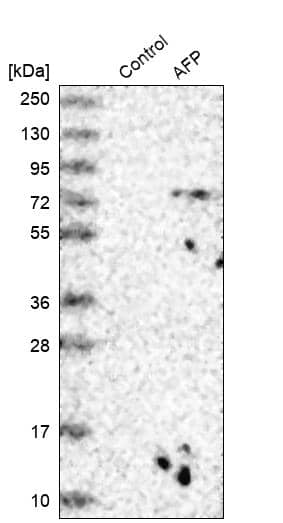
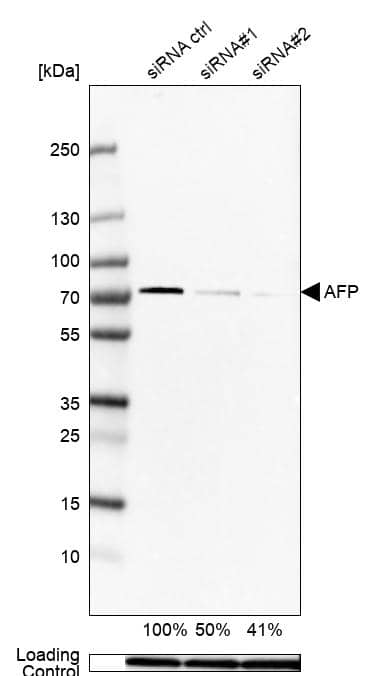
![Western Blot alpha-Fetoprotein/AFP Antibody (189502) [Unconjugated]](https://images.novusbio.com/images/antibody/alphaFetoprotein_MAB1368_Western_Blot_20276.jpg)
![Immunocytochemistry/ Immunofluorescence alpha-Fetoprotein/AFP Antibody (189502) [Unconjugated]](https://images.novusbio.com/images/mab1368_human-mouse-alpha-fetoprotein-mab-clone-189502-41202410325519.jpg)
![Knockout Validated alpha-Fetoprotein/AFP Antibody (189502) [Unconjugated]](https://images.novusbio.com/images/antibody/alphaFetoprotein_MAB1368_Knockout_Validated_21503.jpg)




Secondary Antibodies |
Isotype Controls |
The concentration calculator allows you to quickly calculate the volume, mass or concentration of your vial. Simply enter your mass, volume, or concentration values for your reagent and the calculator will determine the rest.


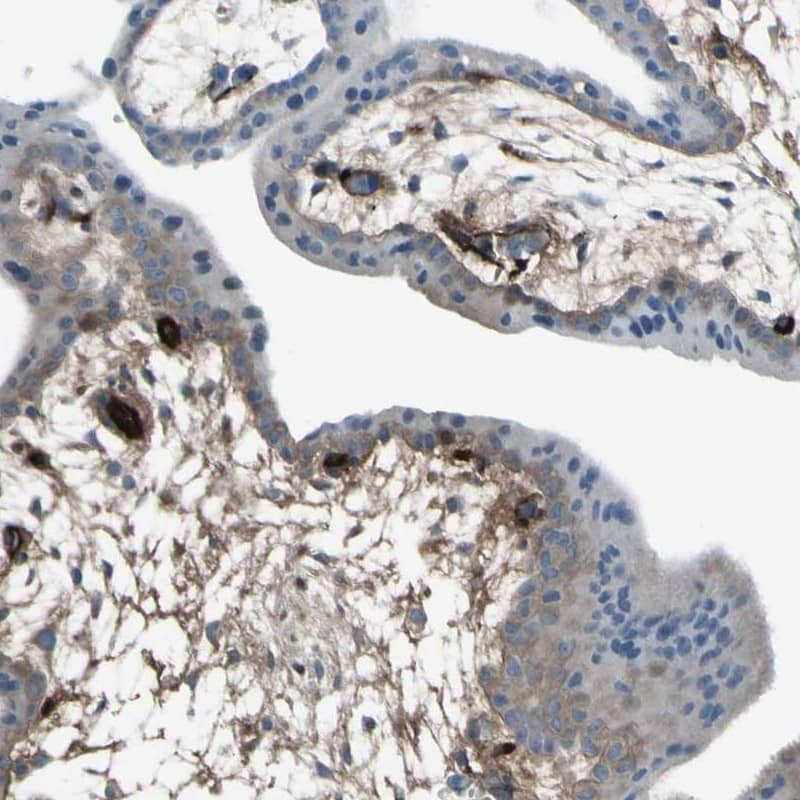
 VC001). Tissue was stained using DAB (brown) and counterstained with hematoxylin (blue). Specific staining was localized to cell membranes. View our protocol for




![CA125/MUC16 [Unconjugated]](/sites/all/modules/enterprise-tech/et_datasheets/images/novus_guarantee.png "CA125/MUC16 [Unconjugated]")


![N/A Kallikrein 3/PSA [HRP]](https://images.novusbio.com/images/elisa/DATA_Kallikrein_3_DKK300_ELISA_730.jpg)
![N/A Kallikrein 3/PSA [HRP]](https://images.novusbio.com/images/elisa/DATA_Kallikrein_3_DKK300_ELISA_729.jpg)
![N/A Kallikrein 3/PSA [HRP]](https://images.novusbio.com/images/elisa/Kallikrein_3_DKK300_ELISA_124.jpg)