5-001-A, open histogram), followed by NorthernLights™ 637-conjugated Anti-Sheep IgG Secondary Antibody (Catalog # NL011)." title="Human whole blood granulocytes were stained with Sheep Anti-Human CEACAM-3/CD66d Antigen Affinity-purified Polyclonal Antibody (Catalog # AF4166, filled histogram) or isotype control antibody (Catalog # 5-001-A, open histogram), followed by NorthernLights™ 637-conjugated Anti-Sheep IgG Secondary Antibody (Catalog # NL011)." />
| Reactivity | HuSpecies Glossary |
| Applications | WB, Flow, CyTOF-ready |
| Clonality | Polyclonal |
| Host | Sheep |
| Conjugate | Unconjugated |
| Concentration | LYOPH |
| Immunogen | Mouse myeloma cell line NS0-derived recombinant human CEACAM‑3/CD66d isoform 1 Lys35-Gly155 Accession # P40198 |
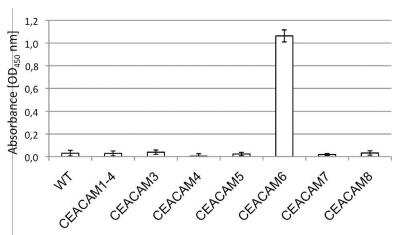
| Specificity | Detects human CEACAM‑3/CD66d in direct ELISAs and Western blots. In direct ELISAs, approximately 10% cross-reactivity with recombinant human (rh) CEACAM-1, rhCEACAM-5, and rhCEACAM-6 is observed and less than 5% cross-reactivity with rhCEACAM-4, rhCEACAM-7, and rhCEACAM-8 is observed. |
| Source | N/A |
| Isotype | IgG |
| Clonality | Polyclonal |
| Host | Sheep |
| Gene | CEACAM3 |
| Purity Statement | Antigen Affinity-purified |
| Innovator's Reward | Test in a species/application not listed above to receive a full credit towards a future purchase. |
| Storage | Use a manual defrost freezer and avoid repeated freeze-thaw cycles.
|
| Buffer | Lyophilized from a 0.2 μm filtered solution in PBS with Trehalose. *Small pack size (SP) is supplied either lyophilized or as a 0.2 µm filtered solution in PBS. |
| Preservative | No Preservative |
| Concentration | LYOPH |
| Reconstitution Instructions | Reconstitute at 0.2 mg/mL in sterile PBS. |
CEACAM-3 (carcinoembryonic antigen-related cell adhesion molecule 3; also CD66d and CGM1) is a 31‑34 kDa member of the CEACAM subfamily of the CEA family of proteins. It is expressed by neutrophils and serves as a microbial receptor for a wide range of microorganisms. Mature human CEACAM-3 is a 218 amino acid (aa) type I transmembrane glycoprotein. Its extracellular domain (aa 35‑155) shows one V-type Ig-like domain (aa 35‑142). There are two alternate splice forms. One shows a 40 aa substitution for the C-terminal 116 amino acids (aa 137‑252), while a second shows a 31 aa substitution for the C-terminal 71 amino acids. No definitive rodent CEACAM-3 has been reported.
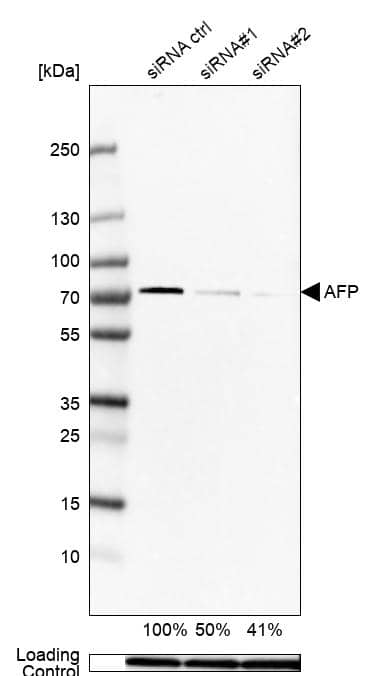
![Western Blot alpha-Fetoprotein/AFP Antibody (189502) [Unconjugated]](https://images.novusbio.com/images/antibody/alphaFetoprotein_MAB1368_Western_Blot_20276.jpg)
![Immunocytochemistry/ Immunofluorescence alpha-Fetoprotein/AFP Antibody (189502) [Unconjugated]](https://images.novusbio.com/images/mab1368_human-mouse-alpha-fetoprotein-mab-clone-189502-41202410325519.jpg)
![Knockout Validated alpha-Fetoprotein/AFP Antibody (189502) [Unconjugated]](https://images.novusbio.com/images/antibody/alphaFetoprotein_MAB1368_Knockout_Validated_21503.jpg)





Secondary Antibodies |
Isotype Controls |
The concentration calculator allows you to quickly calculate the volume, mass or concentration of your vial. Simply enter your mass, volume, or concentration values for your reagent and the calculator will determine the rest.





![N/A Kallikrein 3/PSA [HRP]](https://images.novusbio.com/images/elisa/DATA_Kallikrein_3_DKK300_ELISA_730.jpg)
![N/A Kallikrein 3/PSA [HRP]](https://images.novusbio.com/images/elisa/DATA_Kallikrein_3_DKK300_ELISA_729.jpg)
![N/A Kallikrein 3/PSA [HRP]](https://images.novusbio.com/images/elisa/Kallikrein_3_DKK300_ELISA_124.jpg)


![Bioactivity CTLA-4 [Unconjugated]](https://images.novusbio.com/images/protein/CTLA4_7268CT_2293.jpg)