| Reactivity | Hu, Mu, RtSpecies Glossary |
| Clone | 603813 |
| Clonality | Monoclonal |
| Host | Mouse |
| Conjugate | Alexa Fluor Plus 555 |
| Specificity | Detects human, mouse, and rat ATG5 in Western blots. |
| Isotype | IgG2b |
| Clonality | Monoclonal |
| Host | Mouse |
| Innovator's Reward | Test in a species/application not listed above to receive a full credit towards a future purchase. |
| Storage | Protect from light. Do not freeze. 12 months from date of receipt, 2 to 8 °C as supplied |
| Buffer | Supplied 0.2 mg/mL in a saline solution containing BSA and Sodium Azide. |
ATG5 (Autophagy-related Protein), also known as APG5L and Apoptosis-specific Protein, is a ubiquitous 32 kDa member of the ATG family of proteins. ATG5 exists as a covalent heterodimer with ATG12 through the creation of a Lys-Gly linkage. The ATG5:ATG12 heterodimer associates noncovalently with an ATG16 multimer to generate autophagosomes. Human ATG5 is 275 amino acids in length and contains N- and C-terminal ubiquitin-like domains (aa 15‑105 and 187‑275) separated by a helix-rich linker region that contains a dimerizing Lys at position 130. There are two potential alternate start sites at Met80 and Met173. Over aa 99‑193, human ATG5 is 97% aa identical to mouse ATG5.
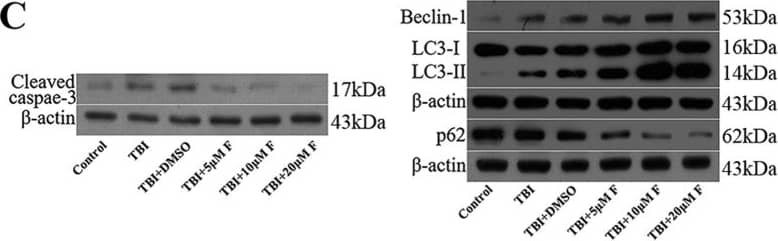
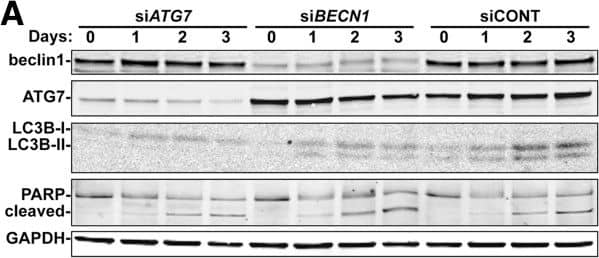


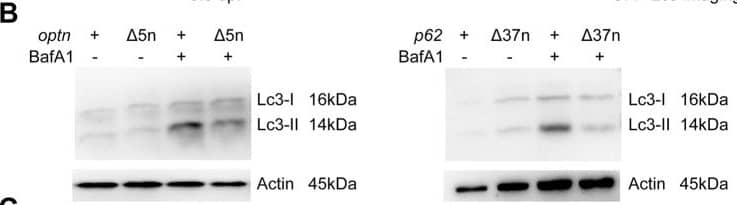
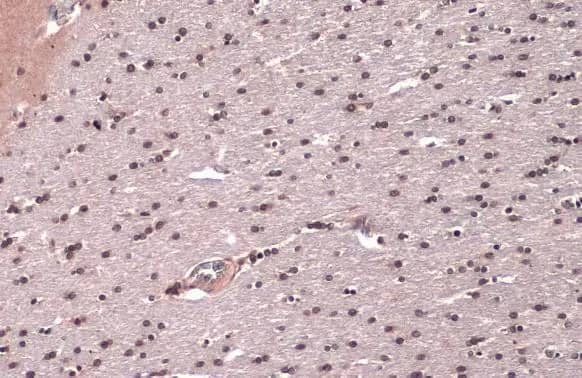
![Immunohistochemistry ATG7 Antibody (683906) [Unconjugated]](https://images.novusbio.com/images/antibody/ATG7_MAB6608_Immunohistochemistry_10631.jpg)
![Simple Western ATG7 Antibody (683906) [Unconjugated]](https://images.novusbio.com/images/antibody/ATG7_MAB6608_Simple_Western_16409.jpg)






![ATG5 Antibody (603813) [Alexa Fluor™ Plus 555]](/sites/all/modules/enterprise-tech/et_datasheets/images/novus_guarantee.png "ATG5 Antibody (603813) [Alexa Fluor™ Plus 555]")
Secondary Antibodies |
Isotype Controls |
|
Liver ASK1 activates autophagy to protect against hepatic fat accumulation, non-alcoholic steatohepatitis and fibrosis By Jamshed Arslan, Pharm. D., PhD. The most common chronic liver disorder worldwide is non-alcoholic fatty liver disease (NAFLD). This obesity-linked disorder can manifest as hepatic fat accumulation (steatosis) wit... Read full blog post. |
|
Read full blog post. |
|
Read full blog post. |
|
Read full blog post. |
|
Animal Models to Study Autophagy By Christina Towers, PhD What is autophagy?Autophagy is the catabolic process that degrades cytoplasmic material via the lysosome. The process of macroautophagy was originally characterized in yeast, where the... Read full blog post. |
|
Losing memory: Toxicity from mutant APP and amyloid beta explain the hippocampal neuronal damage in Alzheimer's disease By Jamshed Arslan Pharm.D. Alzheimer's disease (AD) is an irreversible brain disorder that destroys memory and thinking skills. The telltale signs of AD brains are extracellular deposits of amy... Read full blog post. |
|
Read full blog post. |
|
Autophagy independent roles of the core ATG proteins By Christina Towers, PhD. Autophagy and ATG ProteinsAutophagy is a nutrient recycling process that cells use to fuel metabolism, particularly in response to nutrient deprivation. It is critical for removal of dam... Read full blog post. |
|
Key Targets in Apoptosis, Necroptosis, and Autophagy Cell death/recycling pathways such as apoptosis, necroptosis, and autophagy are an integral part of the growth, development, homeostasis as well as the pathophysiology in the life of living organisms. These signaling pathways are highly regulated and ... Read full blog post. |
|
The role of Parkin and autophagy in retinal pigment epithelial cell (RPE) degradation The root of Parkinson’s disease (PD) points to a poorly regulated electron transport chain leading to mitochondrial damage, where many proteins need to work cohesively to ensure proper function. The two key players of this pathway are PINK1, ... Read full blog post. |
The concentration calculator allows you to quickly calculate the volume, mass or concentration of your vial. Simply enter your mass, volume, or concentration values for your reagent and the calculator will determine the rest.


![Immunohistochemistry Insulin Antibody (182410) [Unconjugated]](https://images.novusbio.com/images/antibody/mab1417_human-bovine-mouse-insulin-mab-clone-182410-immunohistochemistry-308202115145.jpg)
![Immunocytochemistry Insulin Antibody (182410) [Unconjugated]](https://images.novusbio.com/images/antibody/Insulin_MAB1417_Immunocytochemistry_9376.jpg)
![Immunohistochemistry TOR/mTOR [p Ser2448] Antibody - BSA Free](https://images.novusbio.com/images/nb600-607_rabbit-polyclonal-tor-mtor-p-ser2448-antibody-235202318143142.jpg)
![Western Blot TOR/mTOR [p Ser2448] Antibody - BSA Free](https://images.novusbio.com/images/nb600-607_rabbit-polyclonal-tor-mtor-p-ser2448-antibody-31020241535647.jpg)
![Data TOR/mTOR [p Ser2448] Antibody - BSA Free](https://images.novusbio.com/images/TOR-mTOR-[p-Ser2448]-Antibody-N-A-NB600-607-img0008.jpg)


![Immunohistochemistry Caspase-3 Antibody [Unconjugated] - Active](https://images.novusbio.com/images/af835_human-mouse-active-caspase-3-affinity-purified-pab-41202410331943.jpg)
![Western Blot Caspase-3 Antibody [Unconjugated] - Active](https://images.novusbio.com/images/af835_human-mouse-active-caspase-3-affinity-purified-pab-812025554170.jpg)
![Western Blot Caspase-3 Antibody [Unconjugated] - Active](https://images.novusbio.com/images/af835_human-mouse-active-caspase-3-affinity-purified-pab-8120255534731.jpg)


![SDS-Page TNF-alpha [Unconjugated]](https://images.novusbio.com/images/protein/TNF-alpha_210-TA_256.jpg)
![Bioactivity TNF-alpha [Unconjugated]](https://images.novusbio.com/images/protein/TNFalpha_210TA_1658.jpg)
![SEC-MALS TNF-alpha [Unconjugated]](https://images.novusbio.com/images/210-ta_recombinant-human-tnf-alpha-protein-sec-mals-35202312244..jpg)