Snail Antibody

Images


Product Details

Summary
Product Discontinued
View other related Snail Primary Antibodies

Order Details


    • Catalog Number
      NBP1-19529
    • Availability
      Product Discontinued

    Can't find what you are looking for? Use our Antibody Concierge Service & we will help you locate your antibody!

    Or feel free to contact us for alternative products.

Snail Antibody Summary

Immunogen
Synthetic phosphopeptide derived from human SNAI 1 around the phosphorylation site of Serine 246.
Clonality
Polyclonal
Host
Rabbit
Gene
SNAI1
Purity
Immunogen affinity purified
Innovator's Reward
Test in a species/application not listed above to receive a full credit towards a future purchase.

Applications/Dilutions

Dilutions
  • Immunocytochemistry/ Immunofluorescence 1:50-1:200
  • Immunohistochemistry 1:10-1:500
  • Immunohistochemistry-Paraffin 1:50-1:200
  • Western Blot 1:500-1:1000
Application Notes
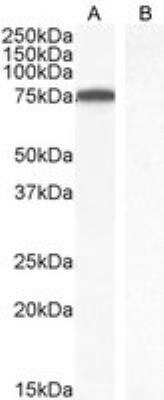
Western blot (WB) analyzes of SNAI 1 (A242) pAb in extracts from HT29 cells.
Immunohistochemistry (IHC) analyzes of SNAI 1 (A242) pAb in paraffin-embedded human lung carcinoma tissue.
Theoretical MW
29 kDa.
Disclaimer note: The observed molecular weight of the protein may vary from the listed predicted molecular weight due to post translational modifications, post translation cleavages, relative charges, and other experimental factors.
Reviewed Applications
Read 4 Reviews rated 4.5
using
NBP1-19529 in the following applications:

Publications
Read Publications using
NBP1-19529 in the following applications:

Packaging, Storage & Formulations

Storage
Store at 4C short term. Aliquot and store at -20C long term. Avoid freeze-thaw cycles.
Buffer
PBS (pH 7.2)
Preservative
0.05% Sodium Azide
Concentration
1.0 mg/ml
Purity
Immunogen affinity purified

Alternate Names for Snail Antibody

  • dJ710H13.1
  • Protein sna
  • Protein snail homolog 1
  • SLUGH2
  • SNA
  • SNAH
  • SNAI1
  • snail 1 homolog
  • snail 1 zinc finger protein
  • snail family zinc finger 1
  • snail homolog 1
  • Snail
  • SNAIL1
  • zinc finger protein SNAI1

Background

Snail, also called SNAIL1 or SNAI1, is a zinc-finger transcription factor belonging to the Snail superfamily and encoded by the SNAI1 gene (1,2). Snail was first discovered in Drosophila and has homologs in many species including vertebrates and humans (1,2). The Snail family members includes Snail (Snail1), Slug (Snail2), and Smuc (Snail3) (1,2). In humans, Snail is expressed in a number of tissues including placenta, brain, and skeletal muscle, but is most highly expressed by the kidneys (1). Snail functions in repression of E-cadherin transcription which is associated with epithelial-mesenchymal transition (EMT) that is especially prominent during embryonic development (1-5). Along with Snail, other related EMT-inducing transcription factors (EMT-TFs) include the Twist and ZEB protein families (3). Snail is synthesized as a protein of 264 amino acids (aa) with an N-terminal SNAG domain, a serine-rich domain (SRD), nuclear export sequences (NES), and four C-terminal zinc-finger binding domains, with a theoretical molecular weight of 29 kDa (1,3). Snail activity is largely regulated through post-translational modifications such as phosphorylation, ubiquitination, and glycosylation, which impacts Snail's localization and stability, amongst other things (1-3, 5).

In addition to its role in embryonic development, Snail-induced EMT is also associated with cancer metastasis (1-5). Snail is expressed in a variety of cancer lines including breast cancer, cervical carcinoma, and colorectal carcinoma, and typically results in increased migration, invasion, and metastasis (1). Accordingly, Snail expression is also correlated with drug resistance and tumor recurrence (1-5). Chemical inhibitors that target Snail have shown some promise in reducing or eliminating Snail-induced EMT, increasing E-cadherin expression, and increasing tumor regression (1).

1. Kaufhold, S., & Bonavida, B. (2014). Central role of Snail1 in the regulation of EMT and resistance in cancer: a target for therapeutic intervention. Journal of Experimental & Clinical Cancer Research. https://doi.org/10.1186/s13046-014-0062-0

2. Wang, Y., Shi, J., Chai, K., Ying, X., & Zhou, B. P. (2013). The Role of Snail in EMT and Tumorigenesis. Current Cancer Drug Targets. https://doi.org/10.2174/15680096113136660102

3. Kang, E., Seo, J., Yoon, H., & Cho, S. (2021). The Post-Translational Regulation of Epithelial-Mesenchymal Transition-Inducing Transcription Factors in Cancer Metastasis. International Journal of Molecular Sciences. https://doi.org/10.3390/ijms22073591

4. Seo, J., Ha, J., Kang, E., & Cho, S. (2021). The role of epithelial-mesenchymal transition-regulating transcription factors in anti-cancer drug resistance. Archives of Pharmacal Research. https://doi.org/10.1007/s12272-021-01321-x

5. Baulida, J., Diaz, V. M., & Herreros, A. G. (2019). Snail1: A Transcriptional Factor Controlled at Multiple Levels. Journal of Clinical Medicine. https://doi.org/10.3390/jcm8060757

Limitations

This product is for research use only and is not approved for use in humans or in clinical diagnosis. Primary Antibodies are guaranteed for 1 year from date of receipt.

Customers Who Viewed This Item Also Viewed...

NBP1-83976
Species: Hu
Applications: ICC/IF, IHC,  IHC-P
NB100-807
Species: Hu
Applications: ICC/IF, PEP-ELISA, WB
AF748
Species: Hu, Mu
Applications: CyTOF-ready, Dual ISH-IHC, Flow, ICC, IHC, Simple Western, WB
NBP2-03886
Species: Hu, Mu, Rt
Applications: Flow, IHC,  IHC-P, WB
NBP2-37364
Species: Hu, Mu
Applications: CyTOF-ready, ELISA, Flow-IC, Flow, ICC/IF, IHC,  IHC-P, KD, WB
NB300-223
Species: Bv, Ca, Ch, Eq, Hu, Mu, Po, Rt
Applications: ICC/IF, IHC, IHC-Fr,  IHC-P, WB
NBP1-05987
Species: Hu, Mu, Rt
Applications: ChIP, GS, ICC/IF, IHC,  IHC-P, IP, KD, MiAr, Simple Western, Single-Cell Western, WB
NBP1-30027
Species: Hu, Mu, Rt
Applications: ICC/IF, IHC,  IHC-P, WB
NBP2-13304
Species: Hu
Applications: ICC/IF, IHC,  IHC-P, WB
NBP1-82991
Species: Hu
Applications: ChIP-EXO-SEQ, IHC,  IHC-P, WB
NBP1-49045
Species: Mu
Applications: Cell Depl, CyTOF-ready, Flow, ICC/IF, IHC, IHC-Fr,  IHC-P, IP, InhibTFunc
NB600-534
Species: Hu, Mu, Po, V-Vi
Applications: ELISA, Flow, ICC/IF, IHC, IHC-Fr,  IHC-P, In vitro, In vivo, RIA, WB
NBP2-62693
Species: Hu
Applications: IHC,  IHC-P
NBP2-75563
Species: Hu, Mu, Rt
Applications: Flow, IHC,  IHC-P, WB
NBP2-92503
Species: Hu, Mu, Rt
Applications: ELISA, ICC/IF, IHC,  IHC-P, WB
NBP2-26245
Species: Hu, Mu
Applications: Flow, In vitro
NBP1-88498
Species: Hu, Mu
Applications: ICC/IF, IHC,  IHC-P, KD, WB
NBP2-92630
Species: Hu, Mu, Rt
Applications: ELISA, ICC/IF, IHC,  IHC-P, WB

Publications for Snail Antibody (NBP1-19529)(11)

We have publications tested in 2 confirmed species: Human, Mouse.

We have publications tested in 4 applications: ICC/IF, IF/IHC, IHC-P, WB.


Filter By Application
ICC/IF
(1)
IF/IHC
(1)
IHC-P
(3)
WB
(5)
All Applications
Filter By Species
Human
(7)
Mouse
(2)
All Species
Showing Publications 1 - 10 of 11. Show All 11 Publications.
Publications using NBP1-19529 Applications Species
Liu T, Zhao X, Zheng X et al. The EMT transcription factor, Twist1, as a novel therapeutic target for pulmonary sarcomatoid carcinomas Int J Oncol 2020-01-29 [PMID: 32124963]
Zhang XY, Gao PT, Yang X et al. Reduced selenium-binding protein 1 correlates with a poor prognosis in intrahepatic cholangiocarcinoma and promotes the cell epithelial-mesenchymal transition Am J Transl Res 2018-11-15 [PMID: 30662608] (WB, Human) WB Human
Wang J, Ye Q, Cao Y et al. Snail determines the therapeutic response to mTOR kinase inhibitors by transcriptional repression of 4E-BP1. Nat Commun 2017-12-20 [PMID: 29263324] (IHC-P, Human) IHC-P Human
Woods LT, Camden JM, El-Sayed FG et al. Increased Expression of TGF-B Signaling Components in a Mouse Model of Fibrosis Induced by Submandibular Gland Duct Ligation. PLoS ONE. 2015-05-09 [PMID: 25955532] (ICC/IF, Mouse) ICC/IF Mouse
Choi YJ, Kim N, Chang H et al. Helicobacter pylori-induced epithelial-mesenchymal transition, a potential role of gastric cancer initiation and an emergence of stem cells. Carcinogenesis. 2015-03-16 [PMID: 25784376] (IHC-P, Human) IHC-P Human
Gu H, Mickler EA, Cummings OW et al. Crosstalk between TGF-beta1 and complement activation augments epithelial injury in pulmonary fibrosis. FASEB J. 2014-06-23 [PMID: 24958208] (WB, Human)

Details:
Figure 8C- Normal primary human small airway epithelial cells (SAECs) were treated with or without TGF-1 (10 ng/ml) and cell lysates were immunoblotted against specific receptors C3aR and C5aR (-actin, loading control).
WB Human
Hardin H, Guo Z, Shan W et al. The Roles of the Epithelial-Mesenchymal Transition Marker PRRX1 and MicroRNA 146b-5p in Papillary Thyroid Carcinoma Progression. Am. J. Pathol. 2014-06-17 [PMID: 24946010] (WB, Human)

Details:
Used for IHC-P of PRRX1 on whole sections of FFPE lymph node tissues /seven Papillary Thyroid Carcinoma (PTCs) and one anaplastic thyroid carcinoma (ATC) TMAs with automated immunostaining procedure/ Lab Vision 360 LV-1 Autostainer system - 1:20 dilution, incubation 1 hr followed by biotinylated goat anti-rabbit IgG for 15 minutes, 4+ streptavidin–horseradish peroxidase treatment for 15 minutes followed by DAB and hematoxylin 1 minute each. PRRX1 staining evaluated based on the presence or absence of nuclear immunoreactivity in thyroid epithelial cells.
WB Human
Huang XY, Zhang C, Cai JB et al. Comprehensive multiple molecular profile of epithelial mesenchymal transition in intrahepatic cholangiocarcinoma patients. PLoS ONE. 2014-05-12 [PMID: 24816558] (IHC-P, WB, Human) IHC-P, WB Human
Li C, Siragy HM. High Glucose Induces Podocyte Injury via Enhanced (Pro)renin Receptor-Wnt-beta-Catenin-Snail Signaling Pathway. PLoS ONE 2014-02-17 [PMID: 24533170] (WB, Mouse) WB Mouse
Sung CO, Choi H, Lee KW, Kim SH. Sarcomatoid carcinoma represents a complete phenotype with various pathways of epithelial mesenchymal transition J Clin Pathol 2013-03-26 [PMID: 23533257]
Show All 11 Publications.

Reviews for Snail Antibody (NBP1-19529) (4) 4.54

Average Rating: 4.5
(Based on 4 reviews)
We have 4 reviews tested in 3 species: Human, Mouse, Other.

Reviews using NBP1-19529:
Filter by Applications
 IHC-P
(1)
IF
(2)
WB
(1)
All Applications
Filter by Species
Human
(1)
Mouse
(2)
Other
(1)
All Species
Images Ratings Applications Species Date Details
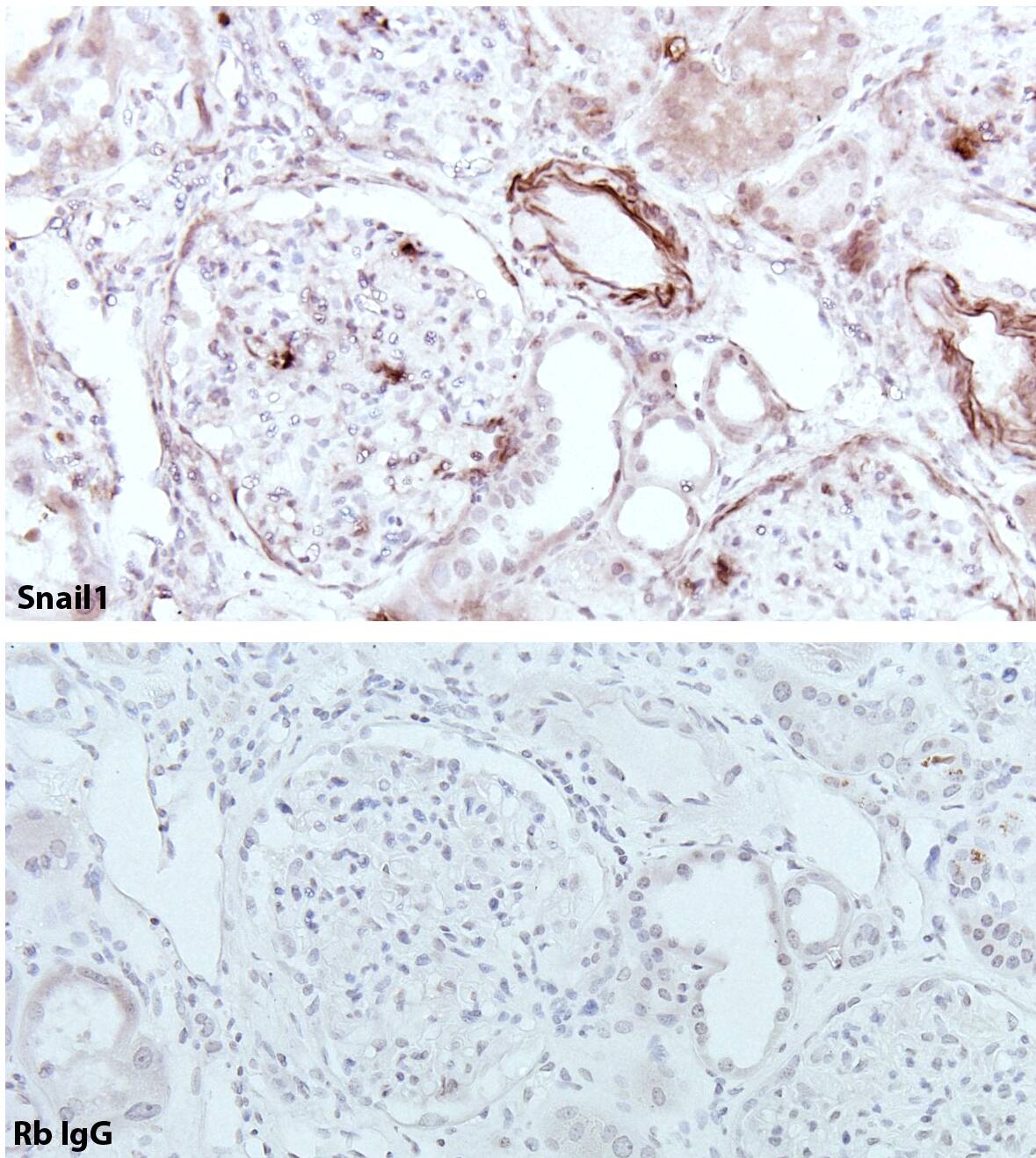
Immunohistochemistry-Paraffin Snail NBP1-19529
Enlarge
5
reviewed by:
Mariya Sweetwyne
 IHC-P Human 01/31/2014
View

Summary

ApplicationImmunohistochemistry-Paraffin
Sample TestedHuman kidney tissue
SpeciesHuman
LotG22121
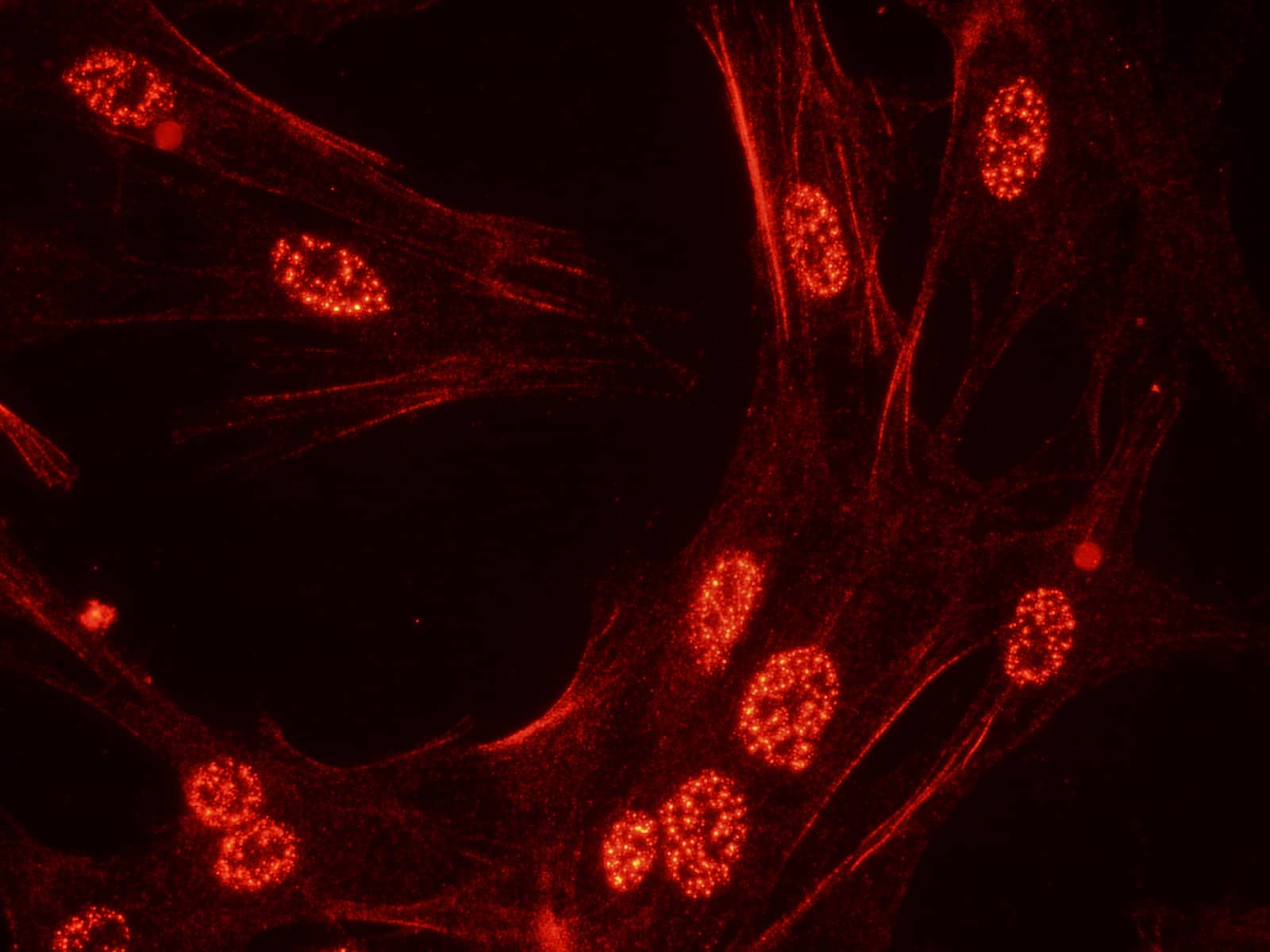
Immunofluorescence Snail NBP1-19529
Enlarge
5
reviewed by:
Mariya Sweetwyne
IF Mouse 01/29/2014
View

Summary

ApplicationImmunofluorescence
Sample TestedPrimary mouse kidney cells grown on glass coverslips.
SpeciesMouse
LotG22121
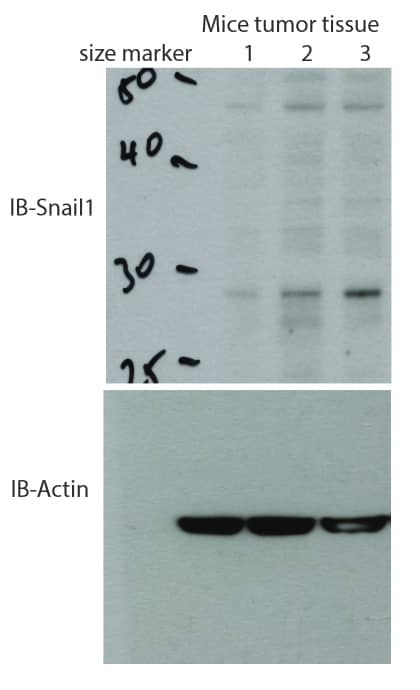
Western Blot Snail NBP1-19529
Enlarge
4
reviewed by:
Shyam Gudey
WB Mouse 01/17/2014
View

Summary

ApplicationWestern Blot
SpeciesMouse
LotG22121
  4
reviewed by:
Shyam Gudey
IF Other 01/10/2014
View

Summary

ApplicationImmunofluorescence
SpeciesOther
LotLot G22121

Product General Protocols

View specific protocols for Snail Antibody (NBP1-19529): Find general support by application which include: protocols, troubleshooting, illustrated assays, videos and webinars.

Video Protocols

WB Video Protocol
ICC/IF Video Protocol

FAQs for Snail Antibody (NBP1-19529). (Showing 1 - 2 of 2 FAQs).

  1. There are many kinds of antibodies you supply against SNAIL. Could you give me your recommendation? Which is the best for the IHC-P experiments the species of my samples to be tested is human.
    • Our SNAIL antibody with catalog # NBP1-19529 has been successfully validated for IHC-P in paraffin-embedded human lung carcinoma tissue and I would highly recommend you to use the same for your samples too. The working dilutions of this antibody for IHC-P ranges from 1:50 - 1:200 and beside IHC, you can use this antibody for Western Blot and Immunofluorescence also.
  2. Our customer wants to know the site of staining of NBP1-19529. Nuclear or cytoplasm or both?
    • SNAIL protein may be found in the Nucleus as well as in the Cytoplasm, and its phosphorylation status controls its cellular localization. Unphosphorylated SNAIL exists in the nucleus, and once phosphorylated (probably on Ser-107, Ser-111, Ser-115 and Ser-119), it gets exported from the nucleus to the cytoplasm wherein, subsequent phosphorylation of the destruction motif and ubiquitination involving BTRC occurs (References: UniProt O95863; PMID 15448698, PMID 15833848, PMID 15836774, PMID 19955572, PMID 22128911, PMID 21577210, PMID 21952048).

Secondary Antibodies


Isotype Controls

Additional Snail Products

Research Areas for Snail Antibody (NBP1-19529)

Find related products by research area.

Blogs on Snail.


  Read full blog post.

Epithelial-Mesenchymal Transition (EMT) Markers
Epithelial-Mesenchymal Transition (EMT) is the trans-differentiation of stationary epithelial cells into motile mesenchymal cells. During EMT, epithelial cells lose their junctions and apical-basal polarity, reorganize their cytoskeleton, undergo a...  Read full blog post.

Understanding the relationship between HIF-1 alpha, Hypoxia and Epithelial-Mesenchymal Transition
Epithelial-mesenchymal transition (EMT) is a natural process by which epithelial cells lose their polarity and intercellular adhesion, and gain the migratory invasive properties of mesenchymal stem cells that can differentiate into a variety of cel...  Read full blog post.

Contact Information

Product PDFs

Calculators

Concentration Calculator

The concentration calculator allows you to quickly calculate the volume, mass or concentration of your vial. Simply enter your mass, volume, or concentration values for your reagent and the calculator will determine the rest.

=
÷

Recent Reviews

4.5
5
2
4
2
3
0
2
0
1
0

Mariya Sweetwyne
01/31/2014
Application:  IHC-P
Species: Human

Mariya Sweetwyne
01/29/2014
Application: IF
Species: Mouse

Shyam Gudey
01/17/2014
Application: WB
Species: Mouse

Bioinformatics

Gene Symbol SNAI1
Entrez
Uniprot