| Reactivity | Hu, MuSpecies Glossary |
| Applications | WB, ICC/IF |
| Clonality | Polyclonal |
| Host | Sheep |
| Conjugate | Alexa Fluor 488 |
| Immunogen | E. coli-derived recombinant human RIAM/APBB1IP Gly2-Ser89 Accession # Q7Z5R6 |
| Specificity | Detects recombinant human RIAM/APBB1IP in direct ELISAs. Detects human and mouse RIAM/APBB1IP in Western blots |
| Isotype | IgG |
| Clonality | Polyclonal |
| Host | Sheep |
| Purity Statement | Antigen Affinity-purified |
| Innovator's Reward | Test in a species/application not listed above to receive a full credit towards a future purchase. |
| Storage | Protect from light. Do not freeze. 12 months from date of receipt, 2 to 8 °C as supplied |
| Buffer | Supplied 0.2 mg/mL in a saline solution containing BSA and Sodium Azide. |
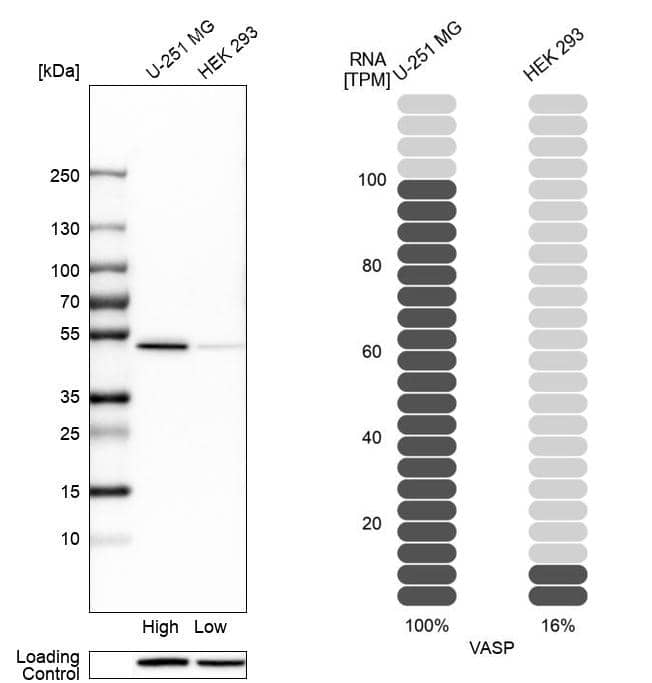
APBB1IP (Amyloid beta A4 precursor protein-binding family B member 1 interacting protein; also PREL-1, Pro-rich protein 73, RARP1 and RIAM) is a member of the MRL family of proteins. Although its predicted MW is 73 kDa, it runs anomalously at 100-110 kDa in SDS-PAGE. It is expressed in megakaryocytes, T cells and fibroblasts. APBB1IP acts as a coordinator for Rap1 GTPase signaling. Rap1 both antagonizes Ras signaling, and is associated with beta 1 and beta 2 integrin-induced cell adhesion and cytoskeleton rearrangement. Within this context, APBB1IP operates as a cytosolic adaptor protein that induces integrin activation by recruiting talin and RAP1 to the cell membrane, and by mediating Profilin and VASP protein polymerizatiuon of actin. Human APBB1IP is 666 amino acids (aa) in length. It contains a poly-Pro sequence (aa 129-148), a Ras-association domain (aa 176-263), a PH domain (aa 310-419), and a large poly-Pro region (aa 503-640). There are multiple potential isoform variants. One contains a deletion of aa 152-177 coupled to a 27 aa substitution for aa 262-666, a second possesses a 21 aa substitution for aa 152‑666, and a third shows a deletion of aa 386-390 coupled to a five aa substitution for aa 417-666. Over aa 2-89, human APBB1IP shares 97% aa sequence identity with mouse APBB1IP.


![RIAM/APBB1IP Antibody [Alexa Fluor® 488]](/sites/all/modules/enterprise-tech/et_datasheets/images/novus_guarantee.png "RIAM/APBB1IP Antibody [Alexa Fluor® 488]")
Secondary Antibodies |
Isotype Controls |
The concentration calculator allows you to quickly calculate the volume, mass or concentration of your vial. Simply enter your mass, volume, or concentration values for your reagent and the calculator will determine the rest.
| Uniprot |
|


![Western Blot Rap1A/B Antibody [Unconjugated]](https://images.novusbio.com/images/antibody/Rap1B_AF3767_Western_Blot_5331.jpg)
![Immunohistochemistry Rap1A/B Antibody [Unconjugated]](https://images.novusbio.com/images/antibody/af3767_human-mouse-rat-rap1a-b-affinity-purified-polyclonal-ab-immunohistochemistry-318202392533..jpg)
![Western Blot Rap1A/B Antibody [Unconjugated]](https://images.novusbio.com/images/antibody/Rap1B_AF3767_Western_Blot_6316.jpg)




![Flow Cytometry Integrin beta 2/CD18 Antibody [Unconjugated]](https://images.novusbio.com/images/antibody/af1730_human-integrin-beta-2-cd18-affinity-purified-polyclonal-ab-flow-cytometry-7220258626..jpg)
![Immunocytochemistry Integrin beta 2/CD18 Antibody [Unconjugated]](https://images.novusbio.com/images/antibody/Integrin_beta_2_AF1730_Immunocytochemistry_6474.jpg)
![Immunocytochemistry Integrin beta 2/CD18 Antibody [Unconjugated]](https://images.novusbio.com/images/antibody/af1730_human-integrin-beta-2-cd18-affinity-purified-polyclonal-ab-immunocytochemistry-1292023225343.jpg)
![Western Blot Integrin alpha L/CD11a Antibody (345913) [Unconjugated]](https://images.novusbio.com/images/antibody/Integrin_alpha_L_MAB3595_Western_Blot_10266.jpg)
![Simple Western Integrin alpha L/CD11a Antibody (345913) [Unconjugated]](https://images.novusbio.com/images/mab3595_human-integrin-alpha-l-cd11a-mab-clone-345913-simple-western-268202215744.jpg)


![Western Blot ERK2 Antibody [Unconjugated]](https://images.novusbio.com/images/antibody/ERK2_AF1230_Western_Blot_5097.jpg)
![Knockout Validated ERK2 Antibody [Unconjugated]](https://images.novusbio.com/images/antibody/ERK2_AF1230_Knockout_Validated_22864.jpg)
![Immunohistochemistry ERK2 Antibody [Unconjugated]](https://images.novusbio.com/images/antibody/ERK2_AF1230_Immunohistochemistry_20696.jpg)
![Western Blot Src [p Tyr419] Antibody [Unconjugated]](https://images.novusbio.com/images/antibody/Src_AF2685_Western_Blot_5209.jpg)
![Immunohistochemistry Src [p Tyr419] Antibody [Unconjugated]](https://images.novusbio.com/images/af2685_human-phospho-src-y419-affinity-purified-polyclonal-ab-412024124022.jpg)
![Immunohistochemistry Src [p Tyr419] Antibody [Unconjugated]](https://images.novusbio.com/images/antibody/Src_AF2685_Immunohistochemistry_9943.jpg)