| Reactivity | HuSpecies Glossary |
| Applications | Bioactivity |
| Format | Carrier-Free |
| Details of Functionality | Bioassay data are not available. |
||||||||||
| Source | E. coli-derived human Ubiquitin+1 protein
The italicized carboxyl terminal sequence is generated by a frameshift in the mRNA. |
||||||||||
| Accession # | |||||||||||
| N-terminal Sequence | Ala |
||||||||||
| Protein/Peptide Type | Recombinant Proteins |
||||||||||
| Gene | UBB |
||||||||||
| Purity | >95%, by SDS-PAGE under reducing conditions and visualized by silver stain |
| Dilutions |
|
|
| Theoretical MW | 13 kDa. Disclaimer note: The observed molecular weight of the protein may vary from the listed predicted molecular weight due to post translational modifications, post translation cleavages, relative charges, and other experimental factors. |
|
| SDS-PAGE | 13 kDa, reducing conditions |
|
| Publications |
|
| Storage | Use a manual defrost freezer and avoid repeated freeze-thaw cycles.
|
| Buffer | Supplied as a 0.2 μm filtered solution in PBS. |
| Purity | >95%, by SDS-PAGE under reducing conditions and visualized by silver stain |
Ubiquitin (Ub) is a 6 - 7 kDa polypeptide whose name derives from the observation that Ubiquitin possesses a highly conserved structure that is found in virtually all plant and animal species (1, 2). Ubiquitin is globular in nature, 76 amino acids (aa) in length, contains multiple lysines plus two C-terminal glycines. In human, there are at least four genes that code for Ubiquitin. Found on human chromosomes 17 (UbB), 2 (UbA-80), 19 (UbA-52) and 12 (UbC), all genes code for a Ubiquitin polymer that undergoes proteolytic processing to generate free, monoubiquitin (3 - 7). In general, about one-half of all Ubiquitin exists in a monomeric form within the cell (8). Ubiquitin can also be added posttranslationally to multiple cell proteins. In conjunction with Ubiquitin ligases E1, 2 and 3, Ubiquitin is covalently attached to amino groups on target molecules via its C-terminal glycines, either at the N-terminus, or on any exposed amino acid that precedes the target's C-terminus (9). Further structural complexity may be added through Ubiquitin binding to Ubiquitin. Depending upon the exact pattern created, cellular proteins possessing UAD (Ub-associated domain) and UIM (Ub-interacting motif) sequences will selectively bind ubiquitinated proteins and incorporate them into multiple signaling pathways or regulatory complexes (10, 11).
The UbB gene codes for a 229 aa precursor. This precursor contains three contiguous head-to-tail, 76 aa Ub sequences that ends with a C-terminal cysteine. A truncated mutation for UbB, termed ubiquitin+1, has now been reported, that shows a 20 aa substitution for the last Gly of the first Ub sequence, generating a 95 aa polypeptide (12). Although a mutation, this molecule is apparently commonly expressed (13). At low levels of expression, it is degraded in a proteosome-dependent manner. At high levels, it overwhelms the proteosome system and accumulates, inhibiting proteosome activity (13). This is suggested to contribute to pathology associated with polyglutamine diseases (14).









The concentration calculator allows you to quickly calculate the volume, mass or concentration of your vial. Simply enter your mass, volume, or concentration values for your reagent and the calculator will determine the rest.


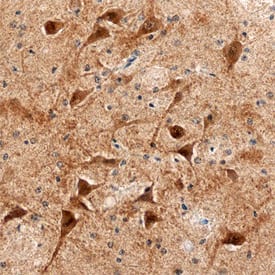
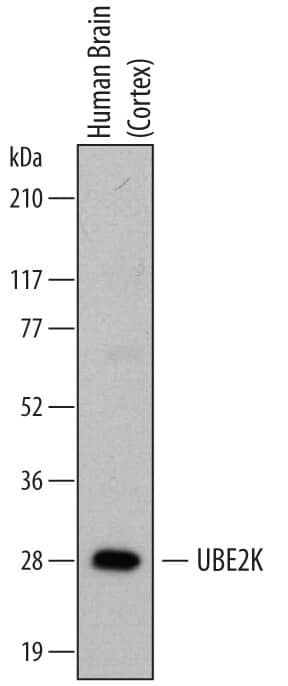

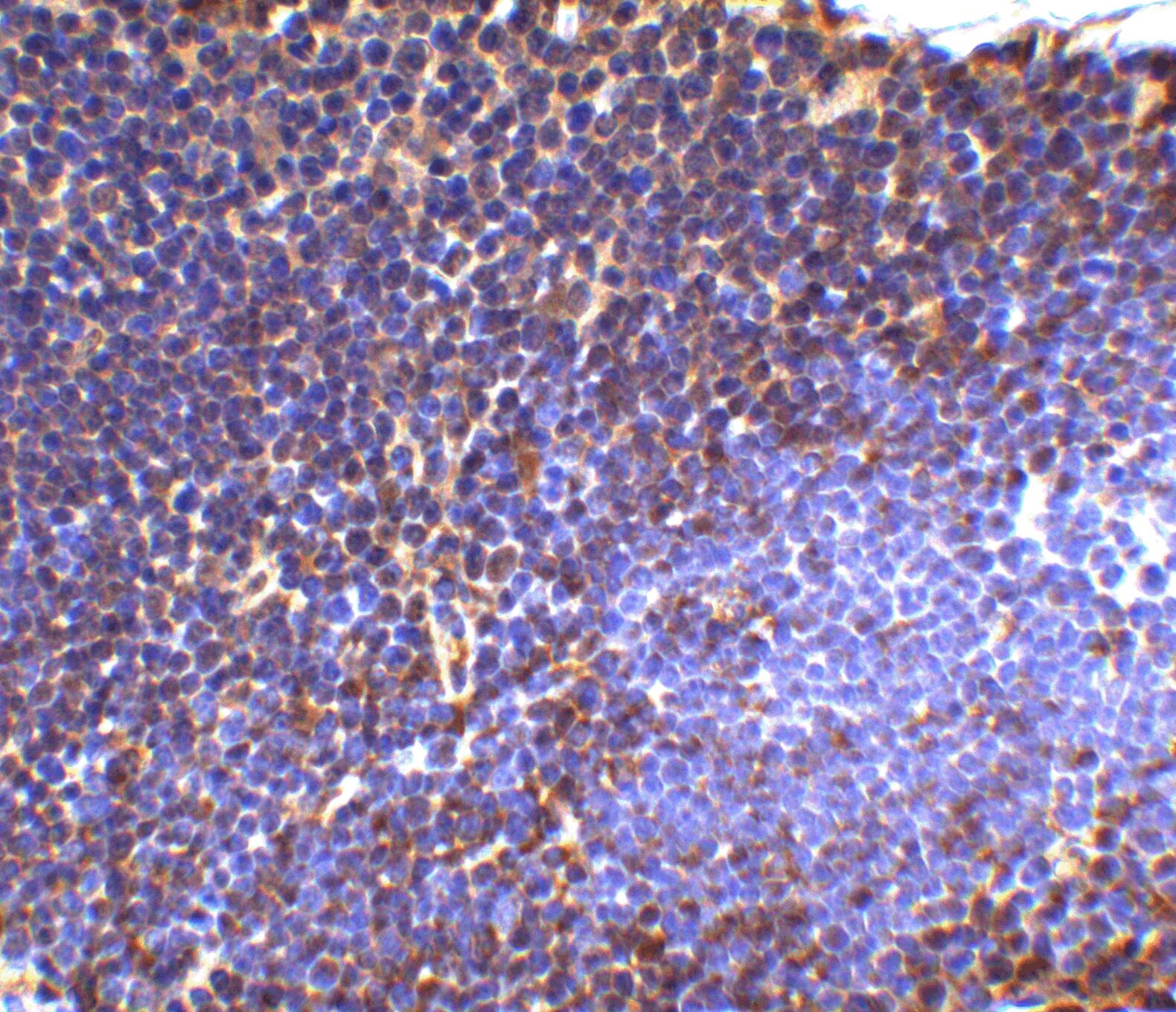
![Immunohistochemistry Butyrylcholinesterase/BCHE Antibody [Unconjugated]](https://images.novusbio.com/images/antibody/Butyrylcholinesterase_AF9024_Immunohistochemistry_19158.jpg)
![Western Blot Butyrylcholinesterase/BCHE Antibody [Unconjugated]](https://images.novusbio.com/images/antibody/Butyrylcholinesterase_AF9024_Western_Blot_19121.jpg)
![Western Blot 14-3-3 zeta Antibody (818515) [Unconjugated]](https://images.novusbio.com/images/antibody/14-3-3_zeta_MAB2669_Western_Blot_12700.jpg)
![Immunohistochemistry 14-3-3 zeta Antibody (818515) [Unconjugated]](https://images.novusbio.com/images/antibody/14-3-3_zeta_MAB2669_Immunohistochemistry_12730.jpg)
![Simple Western 14-3-3 zeta Antibody (818515) [Unconjugated]](https://images.novusbio.com/images/antibody/1433_zeta_MAB2669_Simple_Western_16526.jpg)
