Recombinant Human Ubiquitin Vinyl Sulfone Protein, CF

Images


Product Details

Summary
Product Discontinued
View other related Ubiquitin Peptides and Proteins

Order Details


    • Catalog Number
      U-202
    • Availability
      Product Discontinued

    Can't find what you are looking for? Use our Antibody Concierge Service & we will help you locate your antibody!

    Or feel free to contact us for alternative products.

Recombinant Human Ubiquitin Vinyl Sulfone Protein, CF Summary

Details of Functionality
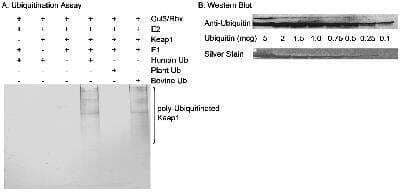
Add Recombinant Human Ubiquitin-Vinyl Sulfone to in vitro assays to inhibit deubiquitinating enzymes. Reaction conditions will need to be optimized for each specific application. We recommend an initial Recombinant Human Ubiquitin-Vinyl Sulfone concentration of 1-5 μM.
Source
E. coli-derived human Ubiquitin protein
Contains underivatized and C-terminal VS derivatized protein, quantity is by derivatized content
Accession #
Protein/Peptide Type
Recombinant Proteins
Gene
UBB
Purity
>98%, by HPLC.

Applications/Dilutions

Dilutions
  • Enzyme Activity
Theoretical MW
8.6 kDa.
Disclaimer note: The observed molecular weight of the protein may vary from the listed predicted molecular weight due to post translational modifications, post translation cleavages, relative charges, and other experimental factors.
Publications
Read Publications using
U-202 in the following applications:

Packaging, Storage & Formulations

Storage
Use a manual defrost freezer and avoid repeated freeze-thaw cycles.
  • 6 months from date of receipt, -70 °C as supplied.
  • 3 months, -70 °C under sterile conditions after opening.
Buffer
2.15 mg/ml (250 μM) in 50 mM MES, pH 6.0
Purity
>98%, by HPLC.

Notes

This product is produced by and ships from R&D Systems, Inc., a Bio-Techne brand.

Alternate Names for Recombinant Human Ubiquitin Vinyl Sulfone Protein, CF

  • RPS27A
  • UBA52
  • UBB ubiquitin B
  • UBB
  • UBC
  • Ubiquitin

Background

Ubiquitin is a 76 amino acid (aa) protein that is ubiquitously expressed in all eukaryotic organisms. Ubiquitin is highly conserved with 96% aa sequence identity shared between human and yeast Ubiquitin, and 100% aa sequence identity shared between human and mouse Ubiquitin (1). In mammals, four Ubiquitin genes encode for two Ubiquitin-ribosomal fusion proteins and two poly-Ubiquitin proteins. Cleavage of the Ubiquitin precursors by deubiquitinating enzymes gives rise to identical Ubiquitin monomers each with a predicted molecular weight of 8.6 kDa. Conjugation of Ubiquitin to target proteins involves the formation of an isopeptide bond between the C-terminal glycine residue of Ubiquitin and a lysine residue in the target protein. This process of conjugation, referred to as ubiquitination or ubiquitylation, is a multi-step process that requires three enzymes: a Ubiquitin-activating (E1) enzyme, a Ubiquitin-conjugating (E2) enzyme, and a Ubiquitin ligase (E3). Ubiquitination is classically recognized as a mechanism to target proteins for degradation and as a result, Ubiquitin was originally named ATP-dependent Proteolysis Factor 1 (APF-1) (2,3). In addition to protein degradation, ubiquitination has been shown to mediate a variety of biological processes such as signal transduction, endocytosis, and post-endocytic sorting (4-7).

Ubiquitin-Vinyl Sulfone is a potent, irreversible and specific inhibitor of Ubiquitin C-terminal hydrolases (UCHs), Ubiquitin-specific proteases (USPs) and deubiquitinating enzymes (DUBs). This protein is useful for inhibiting the hydrolysis of poly-Ubiquitin chains on substrate proteins in vitro, thus enhancing poly-Ubiquitin chain accumulation.  Some DUBs, such as those of the JAMM class, are not inhibited by Ubiquitin-Vinyl Sulfone.

  1. Sharp, P.M. & W.-H. Li. (1987) Trends Ecol. Evol. 2:328.
  2. Ciechanover, A. et al. (1980 ) Proc. Natl. Acad. Sci. USA 77:1365.
  3. Hershko, A. et al. (1980) Proc. Natl. Acad. Sci. USA 77:1783.
  4. Greene, W. et al. (2012) PLoS Pathog. 8:e1002703.
  5. Tong, X. et al. (2012) J. Biol. Chem. 287:25280.
  6. Wei, W. et al. (2004) Nature 428:194.
  7. Wertz, I.E. et al. (2004) Nature 430:694.
  8. Borodovsky A., et al. (2001) EMBO J. 20: 5187-5196.
  9. Borodovsky A., et al. (2002) Chem. Biol. 9: 1149-1159.
  10. Borodovsky A., et al. (2005) Chem. Biochem. 6: 287-291.
  11. Hemelaar J., et al. (2004) Mol. Cell. Bio. 24: 84-95.
  12. Kessler B.M. (2006) Exp. Rev. Proteomics. 3 :213-221.
  13. Misaghi S., et al. (2005) J. Biol. Chem. 280: 1512-1520.
  14. Wang G., et al. (2003) Org. Lett. 5: 737-740.
  15. Verma R., et al. (2002) Science 298: 611-615.

Customers Who Viewed This Item Also Viewed...

NB300-221
Species: Av, Bv, Ca, Ch, ChHa, Dr, Eq, Fe, Ha, Hu, Mu, Ma-Op, Po, Pm, Rb, Rt, Sh, Ze
Applications: ChIP, ICC/IF, IHC, IHC-Fr, IP, KD, Simple Western, Single-Cell Western, WB
NB100-64792
Species: Hu
Applications: ELISA, Flow, ICC/IF, IHC, IHC-Fr,  IHC-P, WB
NBP2-33600
Species: Hu, Mu
Applications: ICC/IF, IHC,  IHC-P, WB
NBP1-33527
Species: Hu, Mu, Rt
Applications: ICC/IF, IHC,  IHC-P, KO, Simple Western, WB
NBP1-89522
Species: Hu, Mu, Rt
Applications: ICC/IF, IHC,  IHC-P, WB
NB500-317
Species: Bv(-), Ca(-), Ch(-), Hu, Mu(-), Rb(-)
Applications: ELISA, Flow, ICC/IF, IHC,  IHC-P, IP, RIA, WB
NB300-263
Species: Bv, Hu, Mu
Applications: IHC,  IHC-P, WB
NB600-501
Species: Bv, Ca, Ch, Dr(-), Fe, Fi, Gt, Gp, Ha, Hu, Le, Ma, Mu, Po, Pm, Rb, Rt, Sh, Sq, Tr, Ze
Applications: ChIP, ELISA, Flow, ICC/IF, IHC, IHC-Fr,  IHC-P, IP, KD, KO, Simple Western, WB
U-100H
Species: Hu
Applications: EnzAct
MAB2669
Species: Hu
Applications: IHC, Simple Western, WB
NB100-56360
Species: Hu
Applications: WB
H00006908-Q01
Species: Hu
Applications: ELISA, AP, PA, PAGE, WB
NBP1-76593
Species: Hu, Mu, Rt
Applications: ELISA, ICC/IF, IHC,  IHC-P, WB
NBP3-13522
Species: Hu, Mu, Rt
Applications: ICC/IF, IHC,  IHC-P, WB
MAB6609
Species: Hu, Mu
Applications: IHC, WB
NB600-501
Species: Bv, Ca, Ch, Dr(-), Fe, Fi, Gt, Gp, Ha, Hu, Le, Ma, Mu, Po, Pm, Rb, Rt, Sh, Sq, Tr, Ze
Applications: ChIP, ELISA, Flow, ICC/IF, IHC, IHC-Fr,  IHC-P, IP, KD, KO, Simple Western, WB
AF9024
Species: Mu, Rt
Applications: IHC, WB
NBP2-13961
Species: Hu
Applications: ICC/IF, IHC,  IHC-P, WB
NBP2-29463
Species: Pm, Hu, Pm, Mu
Applications: Flow, ICC/IF, IHC,  IHC-P, WB
U-202
Species: Hu
Applications: Enzyme Activity

Publications for Ubiquitin (U-202)(11)

We have publications tested in 2 confirmed species: Human, Xenopus.

We have publications tested in 3 applications: Bioassay, Enzyme Assay, Western Blot.


Filter By Application
Bioassay
(9)
Enzyme Assay
(1)
Western Blot
(1)
All Applications
Filter By Species
Human
(7)
Xenopus
(4)
All Species
Showing Publications 1 - 10 of 11. Show All 11 Publications.
Publications using U-202 Applications Species
Cranford, MT;Dahmen, SN;Cortez, D;Dewar, JM; Leading and lagging strand abasic sites differentially affect vertebrate replisome progression but involve analogous bypass mechanisms Nucleic Acids Res 2025-09-23 [PMID: 41036622] (Bioassay, Xenopus) Bioassay Xenopus
S Zhang, S Zou, D Yin, L Zhao, D Finley, Z Wu, Y Mao USP14-regulated allostery of the human proteasome by time-resolved cryo-EM Nature, 2022-04-27;605(7910):567-574. 2022-04-27 [PMID: 35477760] (Bioassay, Human) Bioassay Human
S Patchett, Z Lv, W Rut, M Békés, M Drag, SK Olsen, TT Huang A molecular sensor determines the ubiquitin substrate specificity of SARS-CoV-2 papain-like protease Cell Reports, 2021-09-08;36(13):109754. 2021-09-08 [PMID: 34547223] (Bioassay, Human) Bioassay Human
A Nishiyama, CB Mulholland, S Bultmann, S Kori, A Endo, Y Saeki, W Qin, C Trummer, Y Chiba, H Yokoyama, S Kumamoto, T Kawakami, H Hojo, G Nagae, H Aburatani, K Tanaka, K Arita, H Leonhardt, M Nakanishi Two distinct modes of DNMT1 recruitment ensure stable maintenance DNA methylation Nat Commun, 2020-03-06;11(1):1222. 2020-03-06 [PMID: 32144273] (Bioassay, Xenopus) Bioassay Xenopus
HB Rycenga, KB Wolfe, ES Yeh, DT Long Uncoupling of p97 ATPase activity has a dominant negative effect on protein extraction Sci Rep, 2019-07-17;9(1):10329. 2019-07-17 [PMID: 31316150] (Bioassay, Xenopus) Bioassay Xenopus
F Liang, AS Miller, S Longerich, C Tang, D Maranon, EA Williamson, R Hromas, C Wiese, GM Kupfer, P Sung DNA requirement in FANCD2 deubiquitination by USP1-UAF1-RAD51AP1 in the Fanconi anemia DNA damage response Nat Commun, 2019-06-28;10(1):2849. 2019-06-28 [PMID: 31253762] (Bioassay, Human) Bioassay Human
L Chen, G Zhu, EM Johns, X Yang TRIM11 activates the proteasome and promotes overall protein degradation by regulating USP14 Nat Commun, 2018-03-26;9(1):1223. 2018-03-26 [PMID: 29581427] (Bioassay, Human) Bioassay Human
M Boselli, BH Lee, J Robert, MA Prado, SW Min, C Cheng, MC Silva, C Seong, S Elsasser, KM Hatle, TC Gahman, SP Gygi, SJ Haggarty, L Gan, RW King, D Finley An inhibitor of the proteasomal deubiquitinating enzyme USP14 induces tau elimination in cultured neurons J. Biol. Chem., 2017-09-26;0(0):. 2017-09-26 [PMID: 28972160] (Enzyme Assay, Human) Enzyme Assay Human
L Yamaguchi, A Nishiyama, T Misaki, Y Johmura, J Ueda, K Arita, K Nagao, C Obuse, M Nakanishi Usp7-dependent histone H3 deubiquitylation regulates maintenance of DNA methylation Sci Rep, 2017-03-03;7(1):55. 2017-03-03 [PMID: 28246399] (Bioassay, Xenopus) Bioassay Xenopus
M Deng, X Yang, B Qin, T Liu, H Zhang, W Guo, SB Lee, JJ Kim, J Yuan, H Pei, L Wang, Z Lou Deubiquitination and Activation of AMPK by USP10 Mol. Cell, 2016-02-11;61(4):614-24. 2016-02-11 [PMID: 26876938] (Western Blot, Human) Western Blot Human
Show All 11 Publications.

Reviews for Ubiquitin (U-202) (0)

There are no reviews for Ubiquitin (U-202). By submitting a review you will receive an Amazon e-Gift Card or Novus Product Discount.
  • Review with no image -- $10/€7/£6/$10 CAD/¥70 Yuan/¥1110 Yen
  • Review with an image -- $25/€18/£15/$25 CAD/¥150 Yuan/¥2500 Yen

FAQs for Ubiquitin (U-202) (0)

There are no specific FAQs related to this product. Read our general customer & technical service FAQs.

Additional Ubiquitin Products

Blogs on Ubiquitin.

There's an autophagy for that!
By Christina Towers, PhDA critical mechanism that cells use to generate nutrients and fuel metabolism is through a process called autophagy.  This process is complex and involves over 20 different proteins, most of which are highly conserved acro...  Read full blog post.

Article Review: Glucose-induced transcriptional regulation in cancer
Epigenetic mechanisms have been implicated in many physiological and pathophysiological processes. Among these, histone modifications including methylation, phosphorylation, acetylation and ubiquitination, significantly modify gene expression. In c...  Read full blog post.

PINK1: All work and no fun
The protein PINK1 is a mitochondrial-located serine/threonine kinase (PTK) that maintains organelle function and integrity. It not only protects organelles from cellular stress, but it also uses the selective auto-phagocytosis process for cleaning and...  Read full blog post.

Ubiquitin-Mediated Degradation of Cellular Proteins: The Kiss of Death
Ubiquitin is an abundant and essential cellular 9-kd protein that is conserved across evolution from yeast to humans. Ubiquitin is used by cells as a covalent modifier of other proteins both to activate their function and to target them for degradatio...  Read full blog post.

Using Ubiquitin Antibodies in Various Disease Research
Ubiquitin is a small, highly conserved protein which plays an important role in protein breakdown, covalently bonding to proteins to mark them for proteolytic degradation in a process called ubiquitination. Ubiquitin also binds to inclusion bodies (ac...  Read full blog post.

The Heat is On: Heat Shock Proteins and the Link to Cancer
Novus Biologicals offers an extensive antibody catalog targeting heat shock proteins (HSPs). A large protein group covering a number of families, the HSPs are functionally related by their dramatic upregulation in response to stress. Stress triggers m...  Read full blog post.

The Latest Research on IBR-type E3 Ubiquitin Ligases
E3 ubiquitin ligases are standards in most antibody catalogs. These proteins are essential to the process of ubiquitination, which is expressed in protein pathways throughout the body and is often linked to disease states. It is widely used as a bioma...  Read full blog post.

Contact Information

Product PDFs

Calculators

Concentration Calculator

The concentration calculator allows you to quickly calculate the volume, mass or concentration of your vial. Simply enter your mass, volume, or concentration values for your reagent and the calculator will determine the rest.

=
÷

Review this Product

Be the first to review our Recombinant Human Ubiquitin Vinyl Sulfone Protein, CF and receive a gift card or discount.

Bioinformatics

Gene Symbol UBB
Uniprot