| Reactivity | HuSpecies Glossary |
| Applications | Bioactivity |
| Format | Carrier-Free |
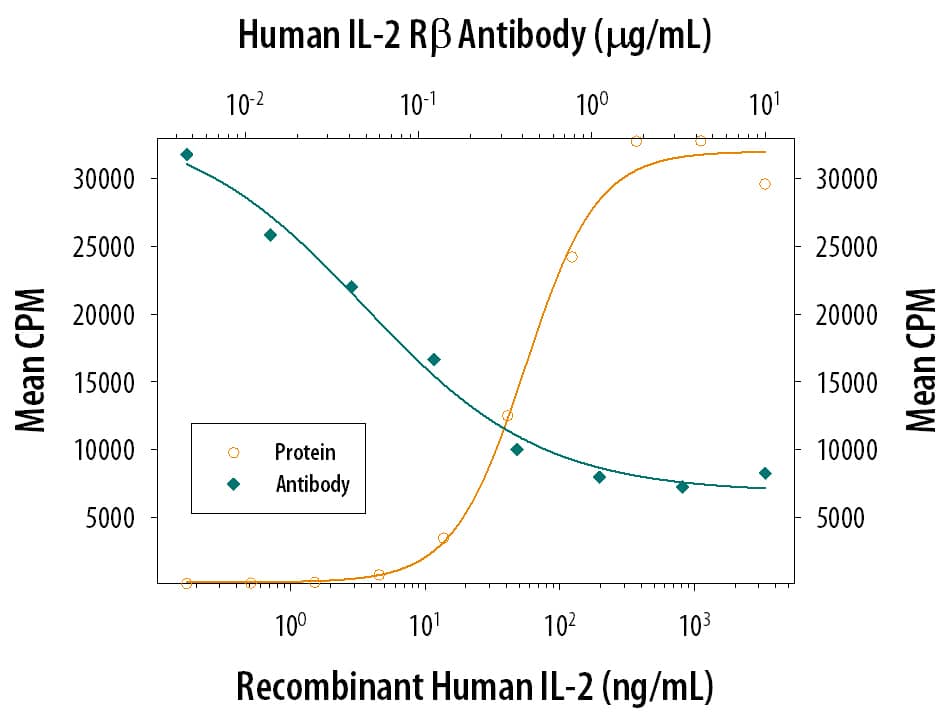
| Details of Functionality | Measured by its ability to inhibit NT-3-induced proliferation of BaF‑TrkB‑BD mouse pro‑B cells transfected with TrkB. The ED50 for this effect is 0.05-0.2 µg/mL in the presence of 40 ng/mL of rhNT-3. |
||||||||
| Source | Mouse myeloma cell line, NS0-derived human TrkC protein
|
||||||||
| Accession # | |||||||||
| N-terminal Sequence | Cys32 |
||||||||
| Structure / Form | Disulfide-linked homodimer |
||||||||
| Protein/Peptide Type | Recombinant Proteins |
||||||||
| Gene | NTRK3 |
||||||||
| Purity | >95%, by SDS-PAGE under reducing conditions and visualized by silver stain |
||||||||
| Endotoxin Note | <0.1 EU per 1 μg of the protein by the LAL method. |
| Dilutions |
|
|
| Theoretical MW | 72 kDa (monomer). Disclaimer note: The observed molecular weight of the protein may vary from the listed predicted molecular weight due to post translational modifications, post translation cleavages, relative charges, and other experimental factors. |
|
| SDS-PAGE | 130-150 kDa, reducing conditions |
|
| Publications |
|
| Storage | Use a manual defrost freezer and avoid repeated freeze-thaw cycles.
|
| Buffer | Lyophilized from a 0.2 μm filtered solution in PBS. |
| Purity | >95%, by SDS-PAGE under reducing conditions and visualized by silver stain |
| Reconstitution Instructions | Reconstitute at 100 μg/mL in sterile PBS. |
The neurotrophins, including NGF, BDNF, NT-3 and NT-4/5, constitute a group of structurally related, secreted proteins that play an important role in the development and function of the nervous system. The biological activities of the neurotrophins are mediated by binding to and activating two unrelated receptor types: the p75 neurotrophin receptor (p75NTR) and the Trk family of receptor tyrosine kinases (1, 2). P75NTR is a member of the tumor necrosis factor receptor superfamily (TNFRSF) and has been designated TNFRSF16. It binds all neurotrophins with low-affinity to transduce cellular signaling pathways that synergize or antagonize those activated by the Trk receptors. Three Trk family proteins, TrkA, TrkB and TrkC, exhibiting different ligand specificities, have been identified. TrkA binds NGF and NT-3, TrkB binds BDNF, NT-3 and NT-4/5, and TrkC only binds NT-3 (1 - 2). All Trk family proteins share a conserved, complex subdomain organization consisting of a signal peptide, two cysteine-rich domains, a cluster of three leucine-rich motifs, and two immunoglobulin-like domains in the extracellular region, as well as an intracellular region that contains the tyrosine kinase domain (3). Natural splice variants of the different Trks, lacking the first cysteine-rich domain, the first and second or all three of the leucine-rich motifs, or the tyrosine kinase domain, have been described (4). At the protein sequence level, Trks are highly conserved between species with the extracellular domains of human and mouse TrkC's showing 94% amino acid sequence identity (5). The proteins also exhibit cross-species activity. The primary location of TrkC expression is in the nervous system and, specifically, in regions of the CNS. Low level TrkC expression has also been observed in a wide variety of tissues outside the nervous system (6).
![Immunocytochemistry/ Immunofluorescence TrkB Antibody [Unconjugated]](https://images.novusbio.com/images/af1494_mouse-trkb-affinity-purified-polyclonal-ab-immunocytochemistry-immunofluorescence-121220259305217.jpg)
![Immunohistochemistry TrkB Antibody [Unconjugated]](https://images.novusbio.com/images/af1494_mouse-trkb-affinity-purified-polyclonal-ab-immunohistochemistry-12122025916385.jpg)
![Immunohistochemistry TrkB Antibody [Unconjugated]](https://images.novusbio.com/images/af1494_mouse-trkb-affinity-purified-polyclonal-ab-immunohistochemistry-12122025857416.jpg)





|
Successful Transplantation of Friedreich Ataxia Induced Pluripotent Stem Cell (iPSC)-Derived Sensory Neurons in Dorsal Root Ganglia of Adult Rodents Jamshed Arslan, Pharm D, PhD The dorsal root ganglia (DRG) are a collection of cell bodies of sensory nerves carrying sensory information – including nociception, mechanoreception and proprioception – from periphera... Read full blog post. |
|
TrkB: Bridging Ontogenesis and Oncogenesis Tropomyosin receptor kinase B (TrkB) is a member of the Trk receptor tyrosine kinases family consisting of TrkA, TrkB and TrkC. The sequence of these family members is highly conserved. Interaction of brain-derived neurotrophic factor (BDNF) with its ... Read full blog post. |
|
TrkB: Docking for Neurotrophins and Beyond. Tropomyosin receptor kinase B (TrkB) is a member of the Trk receptor tyrosine kinases family consisting of TrkA, TrkB and TrkC. The sequence of these family members is highly conserved. TrK's are activated by several neurotrophins, which are small pro... Read full blog post. |
The concentration calculator allows you to quickly calculate the volume, mass or concentration of your vial. Simply enter your mass, volume, or concentration values for your reagent and the calculator will determine the rest.


![N/A BDNF [HRP]](https://images.novusbio.com/images/elisa/BDNF_DBD00_ELISA_36.jpg)
![N/A BDNF [HRP]](https://images.novusbio.com/images/elisa/DATA_BDNF_DBD00_ELISA_587.jpg)
![N/A BDNF [HRP]](https://images.novusbio.com/images/elisa/DATA_BDNF_DBD00_ELISA_588.jpg)
![Immunohistochemistry TrkA Antibody [Unconjugated]](https://images.novusbio.com/images/antibody/TrkA_AF1056_Immunohistochemistry_6672.jpg)
![Immunohistochemistry TrkA Antibody [Unconjugated]](https://images.novusbio.com/images/af1056_rat-trka-affinity-purified-polyclonal-ab-44202415425059.jpg)
![Immunohistochemistry TrkA Antibody [Unconjugated]](https://images.novusbio.com/images/af1056_rat-trka-affinity-purified-polyclonal-ab-8220249503264.jpg)


![Immunohistochemistry NGFR/TNFRSF16/p75NTR Antibody [Unconjugated]](https://images.novusbio.com/images/af1157_mouse-ngf-r-tnfrsf16-affinity-purified-polyclonal-ab-immunohistochemistry-121220259193821.jpg)
![Immunohistochemistry NGFR/TNFRSF16/p75NTR Antibody [Unconjugated]](https://images.novusbio.com/images/antibody/NGF_R_AF1157_Immunohistochemistry_6685.jpg)
![Immunohistochemistry NGFR/TNFRSF16/p75NTR Antibody [Unconjugated]](https://images.novusbio.com/images/af1157_mouse-ngf-r-tnfrsf16-affinity-purified-polyclonal-ab-immunohistochemistry-12122025974221.jpg)
![Bioactivity beta-NGF [Unconjugated]](https://images.novusbio.com/images/protein/beta-NGF_256-GF_322.jpg)
![SDS-Page beta-NGF [Unconjugated]](https://images.novusbio.com/images/protein/beta-NGF_256-GF_321.jpg)

![Immunocytochemistry LEDGF Antibody (762815) [Unconjugated]](https://images.novusbio.com/images/antibody/12613.jpg)
![Western Blot LEDGF Antibody (762815) [Unconjugated]](https://images.novusbio.com/images/antibody/12543.jpg)
![N/A TNF RII/TNFRSF1B [HRP]](https://images.novusbio.com/images/elisa/DATA_TNF_RII_DRT200_ELISA_817.jpg)
![N/A TNF RII/TNFRSF1B [HRP]](https://images.novusbio.com/images/elisa/DATA_TNF_RII_DRT200_ELISA_818.jpg)
![N/A TNF RII/TNFRSF1B [HRP]](https://images.novusbio.com/images/elisa/TNF_RII_DRT200_ELISA_176.jpg)
![Neutralization Siglec-7/CD328 Antibody [Unconjugated]](https://images.novusbio.com/images/antibody/Siglec-7_AF1138_Block_Neutralize_8760.jpg)
![Neutralization CNTFR alpha Antibody [Unconjugated]](https://images.novusbio.com/images/antibody/CNTF_R_alpha_AF-303-NA_Block_Neutralize_763.jpg)
![Simple Western Sortilin Antibody [Unconjugated]](https://images.novusbio.com/images/antibody/Sortilin_AF2934_Simple_Western_20098.jpg)
![Western Blot Sortilin Antibody [Unconjugated]](https://images.novusbio.com/images/antibody/Sortilin_AF2934_Western_Blot_19100.jpg)
![Western Blot Sortilin Antibody [Unconjugated]](https://images.novusbio.com/images/af2934_mouse-sortilin-affinity-purified-polyclonal-ab-western-blot-12122025913309.jpg)