
| Reactivity | HuSpecies Glossary |
| Applications | Binding Activity |
| Format | Carrier-Free |
| Details of Functionality | Measured by its binding ability in a functional ELISA.
Immobilized Recombinant Human ASGR1/ASGPR1 Fc Chimera
(Catalog # 10255-AS) binds human plasma von Willebrand Factor with an ED50 of
0.15-0.9 μg/mL. |
||||||||
| Source | Human embryonic kidney cell, HEK293-derived human ASGR1/ASGPR1 protein
|
||||||||
| Accession # | |||||||||
| N-terminal Sequence | Met |
||||||||
| Structure / Form | Disulfide-linked homodimer |
||||||||
| Protein/Peptide Type | Recombinant Proteins |
||||||||
| Purity | >95%, by SDS-PAGE visualized with Silver Staining and quantitative densitometry by Coomassie® Blue Staining |
||||||||
| Endotoxin Note | <0.10 EU per 1 μg of the protein by the LAL method. |
| Dilutions |
|
| Theoretical MW | 53 kDa. Disclaimer note: The observed molecular weight of the protein may vary from the listed predicted molecular weight due to post translational modifications, post translation cleavages, relative charges, and other experimental factors. |
| SDS-PAGE | 59-71 kDa, under reducing conditions |
| Storage | Use a manual defrost freezer and avoid repeated freeze-thaw cycles.
|
| Buffer | Lyophilized from a 0.2 μm filtered solution in PBS. |
| Purity | >95%, by SDS-PAGE visualized with Silver Staining and quantitative densitometry by Coomassie® Blue Staining |
| Reconstitution Instructions | Reconstitute at 500 μg/mL in PBS. |
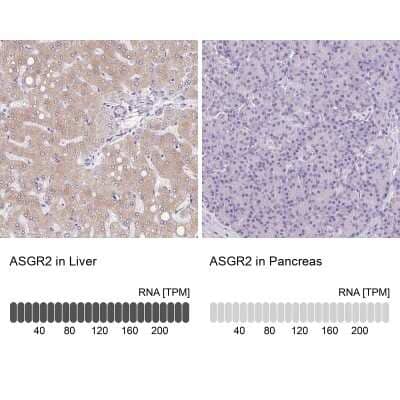
The human asialoglycoprotein receptor (ASGPR) is an endocytic recycling receptor that belongs to the long-form subfamily of the C-type/Ca+2-dependent lectin family (1, 2, 3). It is a complex of two noncovalently-linked subunits, a major 46 kDa glycoprotein (ASGR1) and a minor 50 kDa glycoprotein (ASGR2). The major human ASGPR subunit, ASGR1 (also H1), is synthesized as a 291 amino acid (aa) type II transmembrane (TM) glycoprotein. It contains a 40 aa cytoplasmic region, a 21 aa TM segment, and a 230 aa extracellular domain (ECD) (4 - 6). The cytoplasmic region contains one palmitoylation site at Cys36 that is essential for ligand endocytosis and dissociation (7). The ECD contains two important structural regions. The first is a stalk region of 62 aa (aa 61-123) that contributes to noncovalent oligomerization. The second is a 118 aa, carbohydrate-binding, Ca+2-dependent C-type lectin domain (aa 161-278) that is stabilized by three Ca+2 ions (3, 8). Human ASGR1 ECD is 79% aa identical to mouse ASGR1 ECD. There are two minor (ASGR2) subunits that interact with ASGR1/H1 in a mutually exclusive manner to generate a functional ASGPR (9). They represent alternate splice forms of a type II TM protein. Termed H2b and H2c, H2b differs from H2c only by the presence of a 19 aa insert in its cytoplasmic region. This insert is significant because it allows serine phosphorylation of the cytoplasmic tail and provides for the majority of ASGPR ligand internalization (9). The stoichiometry of a functional ASGPR is unclear, but is suggested to be either a 2:2, 3:1 or 3:2 ratio of ASGR1/H1:ASGR2/H2 (9, 10, 11). ASGPR is found on hepatocytes and a subset of T cells (6, 12). ASGPR is reported to bind Gal (nonreducing), GalNAc, and sialic acid alpha 2,6Gal and GalNAc (3, 13, 14, 15). This is generally within the context of triantennary or tetraantennary configurations (2). The sialic acid terminations are of particular interest because molecules with these motifs most likely represent the endogenous ligands for ASGPR (14).
![Immunohistochemistry Albumin Antibody (188835) [Unconjugated] - Serum](https://images.novusbio.com/images/antibody/Albumin_MAB1455_Immunohistochemistry_23317.jpg)
![Immunocytochemistry Albumin Antibody (188835) [Unconjugated] - Serum](https://images.novusbio.com/images/antibody/Albumin_MAB1455_Immunocytochemistry__Immunofluorescence_17777.jpg)
![Intracellular Staining by Flow Cytometry Albumin Antibody (188835) [Unconjugated] - Serum](https://images.novusbio.com/images/antibody/Albumin_MAB1455_Flow_Cytometry_15110.jpg)
![Intracellular Staining by Flow Cytometry AKT [p Ser473] Antibody [Unconjugated] - Pan Specific](https://images.novusbio.com/images/antibody/Akt3_AF887_Flow_Cytometry_8283.jpg)
![Western Blot AKT [p Ser473] Antibody [Unconjugated] - Pan Specific](https://images.novusbio.com/images/af887_phospho-akt-s473-pan-specific-affinity-purified-pab-41202410485440.jpg)
![Western Blot AKT [p Ser473] Antibody [Unconjugated] - Pan Specific](https://images.novusbio.com/images/af887_phospho-akt-s473-pan-specific-affinity-purified-pab-8120255552843.jpg)


The concentration calculator allows you to quickly calculate the volume, mass or concentration of your vial. Simply enter your mass, volume, or concentration values for your reagent and the calculator will determine the rest.
| Uniprot |
|


![SDS-Page TNF-alpha [Unconjugated]](https://images.novusbio.com/images/protein/TNF-alpha_210-TA_256.jpg)
![Bioactivity TNF-alpha [Unconjugated]](https://images.novusbio.com/images/protein/TNFalpha_210TA_1658.jpg)
![SEC-MALS TNF-alpha [Unconjugated]](https://images.novusbio.com/images/210-ta_recombinant-human-tnf-alpha-protein-sec-mals-35202312244..jpg)


![Immunohistochemistry Caspase-3 Antibody [Unconjugated] - Active](https://images.novusbio.com/images/af835_human-mouse-active-caspase-3-affinity-purified-pab-41202410331943.jpg)
![Western Blot Caspase-3 Antibody [Unconjugated] - Active](https://images.novusbio.com/images/af835_human-mouse-active-caspase-3-affinity-purified-pab-812025554170.jpg)
![Western Blot Caspase-3 Antibody [Unconjugated] - Active](https://images.novusbio.com/images/af835_human-mouse-active-caspase-3-affinity-purified-pab-8120255534731.jpg)
![N/A Angiogenin [HRP]](https://images.novusbio.com/images/elisa/Angiogenin_DAN00_ELISA_28.jpg)
![N/A Angiogenin [HRP]](https://images.novusbio.com/images/elisa/DATA_Angiogenin_DAN00_ELISA_571.jpg)



![Western Blot ERK2 Antibody [Unconjugated]](https://images.novusbio.com/images/antibody/ERK2_AF1230_Western_Blot_5097.jpg)
![Knockout Validated ERK2 Antibody [Unconjugated]](https://images.novusbio.com/images/antibody/ERK2_AF1230_Knockout_Validated_22864.jpg)
![Immunohistochemistry ERK2 Antibody [Unconjugated]](https://images.novusbio.com/images/antibody/ERK2_AF1230_Immunohistochemistry_20696.jpg)
![N/A IL-6 [HRP]](https://images.novusbio.com/images/elisa/DATA_IL6_M6000_ELISA_936.jpg)
![N/A IL-6 [HRP]](https://images.novusbio.com/images/elisa/IL-6_M6000_ELISA_415.jpg)
![N/A IL-6 [HRP]](https://images.novusbio.com/images/m6000b_mouse-il-6-quantikine-elisa-kit-1752025024034.jpg)
![Immunohistochemistry Atrial Natriuretic Peptide/ANP Antibody [Unconjugated]](https://images.novusbio.com/images/antibody/Atrial_Natriuretic_Peptide_AF3366_Immunohistochemistry_14706.jpg)
![Simple Western Atrial Natriuretic Peptide/ANP Antibody [Unconjugated]](https://images.novusbio.com/images/antibody/Atrial_Natriuretic_Peptide_AF3366_Simple_Western_20228.jpg)
![Immunocytochemistry/ Immunofluorescence Atrial Natriuretic Peptide/ANP Antibody [Unconjugated]](https://images.novusbio.com/images/af3366_human-anp-affinity-purified-polyclonal-ab-41202412402519.jpg)


![Immunohistochemistry EphA3 Antibody [Unconjugated]](https://images.novusbio.com/images/antibody/EphA3_AF640_Immunohistochemistry_19184.jpg)
![Holo-Transferrin [Unconjugated]](/sites/all/modules/enterprise-tech/et_datasheets/images/novus_guarantee.png "Holo-Transferrin [Unconjugated]")
![Flow Cytometry: ASGPR1 Antibody (8D7) [NBP1-60150] - Detection of ASGPR1 in HepG2 cells. Red, black and blue line represent the isotype control, cells only, and an ASGPR1 antibody conjugated to FITC with a concentration of 10 ug/ml, respectively.](https://images.novusbio.com/images/ASGPR1-Antibody-8D7-Flow-Cytometry-NBP1-60150-img0001.jpg "Flow Cytometry: ASGPR1 Antibody (8D7) [NBP1-60150] - Detection of ASGPR1 in HepG2 cells. Red, black and blue line represent the isotype control, cells only, and an ASGPR1 antibody conjugated to FITC with a concentration of 10 ug/ml, respectively.")