| Reactivity | Hu, Mu, RtSpecies Glossary |
| Applications | WB |
| Clonality | Polyclonal |
| Host | Sheep |
| Conjugate | Alexa Fluor 532 |
| Immunogen | E. coli-derived recombinant human PARL Gly71-Arg167 Accession # Q9H300 |
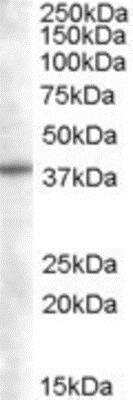
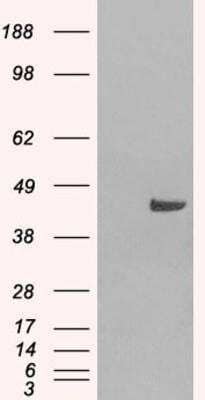
| Specificity | Detects human, mouse, and rat PARL in Western blots and detects recombinant human PARL in direct ELISAs. |
| Isotype | IgG |
| Clonality | Polyclonal |
| Host | Sheep |
| Purity Statement | Antigen Affinity-purified |
| Innovator's Reward | Test in a species/application not listed above to receive a full credit towards a future purchase. |
| Storage | Protect from light. Do not freeze. 12 months from date of receipt, 2 to 8 °C as supplied |
| Buffer | Supplied 0.2 mg/mL in a saline solution containing BSA and Sodium Azide. |
PARL (Presenilins-associated Rhomboid-like protein; also P beta ) is a 41-43 kDa member of the peptidase S54 family (alternatively, the 1 + 6 PARL subfamily; Rhomboid family) of molecules. It is ubiquitously expressed, being found in both embryo and adult. Rhomboid proteins are an ancient family of intramembrane-cleaving molecules that evolved as regulators of mitochondrial membrane dynamics. PARL is an inner mitochondrial-membrane embedded protein that appears to have at least two functions. First, it interacts with Opa1 and regulates apoptosis. Second, it appears to communicate to the nucleus information related to levels of mitochondrial stress. Human PARL is 379 amino acids (aa) in length. It consists of a mitochondrial targeting sequence (aa 1-52) plus a mature polypeptide (aa 53-379) that contains seven transmembrane segments and a 25 aa C-terminus that projects into the intermitochondrial membrane space. PARL undergoes two cleavages. The first occurs between Gly52Phe53 and removes the targeting sequence, generating a membrane-bound 37 kDa mature protein. The second occurs between Ser77Ala78, generating a membrane-bound 34 kDa processed form, plus a matrix-soluble 25 aa peptide (P beta -peptide; aa 53-77) that translocates to the nucleus. There is one potential splice variant that poseesses a Ser substitution for aa 203-253. Over aa 71-167, human PARL shares 92% aa sequence identity with mouse PARL.


Secondary Antibodies |
Isotype Controls |
The concentration calculator allows you to quickly calculate the volume, mass or concentration of your vial. Simply enter your mass, volume, or concentration values for your reagent and the calculator will determine the rest.
| Uniprot |
|


![Immunohistochemistry Insulin Antibody (182410) [Unconjugated]](https://images.novusbio.com/images/antibody/mab1417_human-bovine-mouse-insulin-mab-clone-182410-immunohistochemistry-308202115145.jpg)
![Immunocytochemistry Insulin Antibody (182410) [Unconjugated]](https://images.novusbio.com/images/antibody/Insulin_MAB1417_Immunocytochemistry_9376.jpg)





![Western Blot HTRA2/Omi Antibody [Unconjugated]](https://images.novusbio.com/images/af1458_human-mouse-rat-htra2-omi-affinity-purified-polyclonal-ab-8220249504633.jpg)
![Simple Western HTRA2/Omi Antibody [Unconjugated]](https://images.novusbio.com/images/antibody/16328.jpg)
![Western Blot HTRA2/Omi Antibody [Unconjugated]](https://images.novusbio.com/images/af1458_human-mouse-rat-htra2-omi-affinity-purified-polyclonal-ab-822024951145.jpg)


