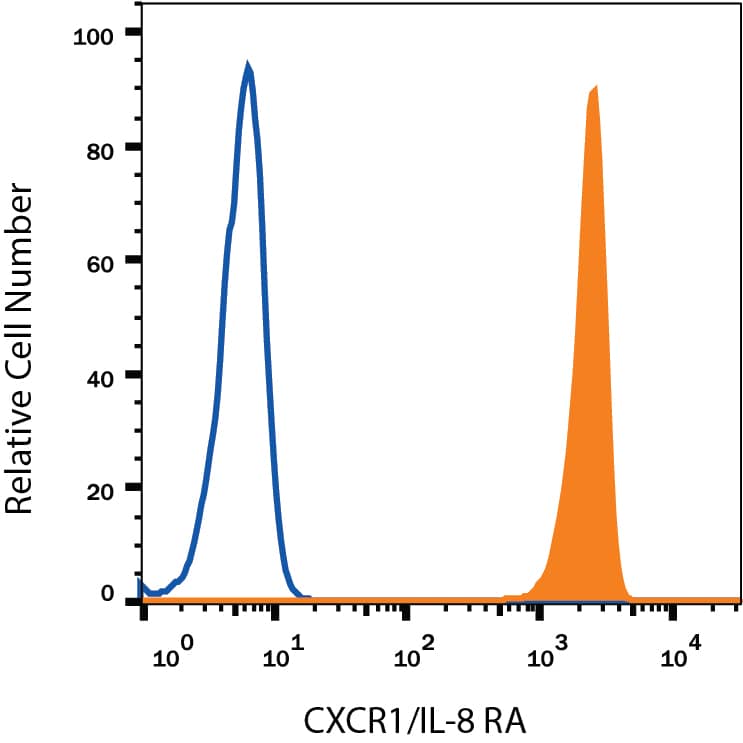
IC003A, open histogram). View our protocol for Staining Membrane-associated Proteins." title="Human mature dendritic cells were stained with Mouse Anti-Human LSECtin/CLEC4G APC-conjugated Monoclonal Antibody (Catalog # FAB2947A, filled histogram) or isotype control antibody (Catalog # IC003A, open histogram). View our protocol for Staining Membrane-associated Proteins." />
| Reactivity | HuSpecies Glossary |
| Applications | Flow |
| Clone | 845404 |
| Clonality | Monoclonal |
| Host | Mouse |
| Conjugate | Allophycocyanin |
| Immunogen | Mouse myeloma cell line NS0-derived recombinant human LSECtin/CLEC4G Ser54-Cys293 Accession # Q6UXB4 |
| Specificity | Detects human LSECtin/CLEC4G in flow cytometry. |
| Source | N/A |
| Isotype | IgG2a |
| Clonality | Monoclonal |
| Host | Mouse |
| Gene | CLEC4G |
| Purity Statement | Protein A or G purified from hybridoma culture supernatant |
| Innovator's Reward | Test in a species/application not listed above to receive a full credit towards a future purchase. |
| Dilutions |
|
|
| Publications |
|
| Storage | Protect from light. Do not freeze.
|
| Buffer | Supplied in a saline solution containing BSA and Sodium Azide. |
| Preservative | Sodium Azide |
LSECtin (liver and lymph node sinusoidal endothelial cell C-type lectin), also known as C-type lectin superfamily 4, member G (CLEC4G), is a member of subgroup II of the C-type (Ca2+-dependent) lectin superfamily (1). The protein was named LSECtin because its initial expression was described to be restricted to liver and lymph node sinusoidal endothelial cells (1). Since then, however, LSECtin has also been detected in peripheral blood and thymic dendritic cells isolated ex vivo, and in monocyte-derived macrophages and dendritic cells at the RNA and protein level (2). Human LSECtin is an approximately 40 kDa, single-pass, type II transmembrane glycoprotein that is 293 amino acids (aa) in length. It contains a short N-terminal cytoplasmic tail (aa 1‑31) and a 21 aa transmembrane region. Its extracellular region consists of two N-linked glycosylation sites (aa 73 and 159), a coil‑coil neck domain (aa 96‑136), a C‑type lectin-like domain (CTLD) of the type found in human DC‑SIGN and DC‑SIGN receptor (aa 165‑289), and a C-terminal Ca2+-dependent carbohydrate‑recognition domain (C-type CRD) (1). Human LSECtin shares 64% aa sequence identity with mouse LSECtin. LSECtin binds to mannose, GlcNAc, and fucose in a Ca2+-dependent manner (1‑3). In addition, LSECtin has the ability to bind to surface glycoproteins of enveloped viruses (3, 4). In particular, interaction of LSECtin with the surface glycoproteins of severe acute respiratory syndrome (SARS) coronavirus and Ebola virus has been described, and LSECtin‑mediated infection of cells by Ebola virus has been demonstrated (3, 4).






Secondary Antibodies |
Isotype Controls |
The concentration calculator allows you to quickly calculate the volume, mass or concentration of your vial. Simply enter your mass, volume, or concentration values for your reagent and the calculator will determine the rest.


![Immunocytochemistry/ Immunofluorescence DC-SIGNR/CD299/CLEC4M Antibody (120604) [Unconjugated]](https://images.novusbio.com/images/mab162_human-dc-signr-cd299-mab-clone-120604-41202410485449.jpg)
![Immunocytochemistry/ Immunofluorescence DC-SIGNR/CD299/CLEC4M Antibody (120604) [Unconjugated]](https://images.novusbio.com/images/mab162_human-dc-signr-cd299-mab-clone-120604-4120241049412.jpg)
![Flow Cytometry DC-SIGNR/CD299/CLEC4M Antibody (120604) [Unconjugated]](https://images.novusbio.com/images/antibody/DC-SIGNR_MAB162_Flow_Cytometry_1931.jpg)
![Immunohistochemistry DC-SIGN/CD209 Antibody (120507) [Unconjugated]](https://images.novusbio.com/images/mab161_human-dc-sign-cd209-mab-clone-120507-8120255531625.jpg)
![Western Blot DC-SIGN/CD209 Antibody (120507) [Unconjugated]](https://images.novusbio.com/images/mab161_human-dc-sign-cd209-mab-clone-120507-81202555723.jpg)
![Multiplex Immunofluorescence DC-SIGN/CD209 Antibody (120507) [Unconjugated]](https://images.novusbio.com/images/antibody/mab161_human-dc-sign-cd209-mab-clone-120507-multiplex-immunofluorescence-165202622135.png)
![Immunocytochemistry CD23/Fc epsilon RII Antibody [Unconjugated]](https://images.novusbio.com/images/antibody/CD23_AF123_Immunocytochemistry_6469.jpg)
![ELISA CD23/Fc epsilon RII Antibody [Unconjugated]](https://images.novusbio.com/images/af123_human-cd23-fc-epsilon-rii-affinity-purified-polyclonal-ab-elisa-639201850091061764.jpg)
![Bioactivity IL-4 [Unconjugated]](https://images.novusbio.com/images/protein/6507-ilcf_recombinant-human-il-4-cho-expressed-protein-cf-bioactivity-272020133214.jpg)
![Immunohistochemistry Axl Antibody [Unconjugated]](https://images.novusbio.com/images/antibody/Axl_AF854_Immunohistochemistry_23170.jpg)
![Western Blot Axl Antibody [Unconjugated]](https://images.novusbio.com/images/af854_mouse-axl-affinity-purified-polyclonal-ab-western-blot-1212202596573.jpg)
![Immunohistochemistry Axl Antibody [Unconjugated]](https://images.novusbio.com/images/af854_mouse-axl-affinity-purified-polyclonal-ab-immunohistochemistry-12122025916593.jpg)


![Immunohistochemistry Dystroglycan Antibody [Unconjugated]](https://images.novusbio.com/images/antibody/Dystroglycan_AF6868_Immunohistochemistry_11019.jpg)
![Western Blot Dystroglycan Antibody [Unconjugated]](https://images.novusbio.com/images/antibody/Dystroglycan_AF6868_Western_Blot_11065.jpg)


![Intracellular Staining by Flow Cytometry RUNX3/CBFA3 Antibody (527327) [Unconjugated]](https://images.novusbio.com/images/antibody/RUNX3_MAB3765_Flow_Cytometry_8418.jpg)
![Flow Cytometry Dtk/TYRO3 Antibody (96201) [Unconjugated]](https://images.novusbio.com/images/mab859_human-tyro3-dtk-mab-clone-96201-flow-cytometry-12122025825313.jpg)
![Flow Cytometry Dtk/TYRO3 Antibody (96201) [Unconjugated]](https://images.novusbio.com/images/mab859_human-tyro3-dtk-mab-clone-96201-flow-cytometry-1212202581251.jpg)
![Flow Cytometry Dtk/TYRO3 Antibody (96201) [Unconjugated]](https://images.novusbio.com/images/mab859_human-tyro3-dtk-mab-clone-96201-flow-cytometry-12122025811811.jpg)
![Agonist Activity CD28 Antibody (37407) [Unconjugated]](https://images.novusbio.com/images/antibody/CD28_MAB342_Functional_Assay_2393.jpg)
![Immunocytochemistry CD28 Antibody (37407) [Unconjugated]](https://images.novusbio.com/images/mab342_human-cd28-mab-clone-37407-immunocytochemistry-31102022134634.jpg)