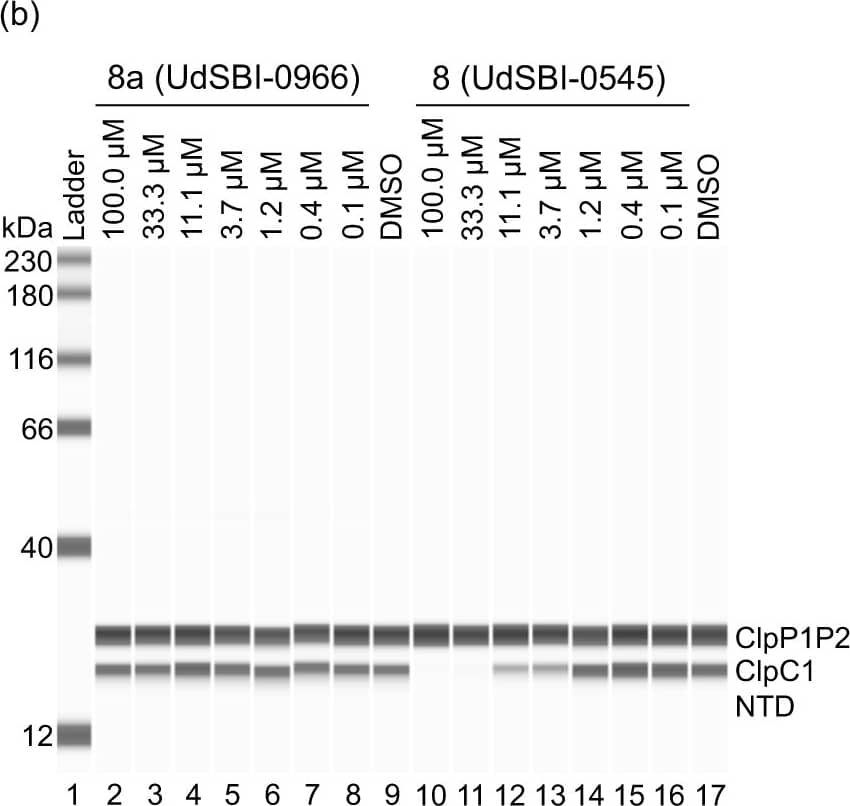
HAF016). A specific band was detected for LRPAP at approximately 42 kDa (as indicated). This experiment was conducted under reducing conditions and using Immunoblot Buffer Group 8." title="Western blot shows lysates of D3 mouse embryonic stem cell line. PVDF membrane was probed with 1 µg/mL of Sheep Anti-Mouse LRPAP Antigen Affinity-purified Polyclonal Antibody (Catalog # AF4480) followed by HRP-conjugated Anti-Sheep IgG Secondary Antibody (Catalog # HAF016). A specific band was detected for LRPAP at approximately 42 kDa (as indicated). This experiment was conducted under reducing conditions and using Immunoblot Buffer Group 8." />
| Reactivity | MuSpecies Glossary |
| Applications | WB |
| Clonality | Polyclonal |
| Host | Sheep |
| Conjugate | Unconjugated |
| Concentration | LYOPH |
| Immunogen | E. coli-derived recombinant mouse LRPAP Gln29-Leu360 Accession # P55302 |
| Specificity | Detects mouse LRPAP in direct ELISAs and Western blots. In direct ELISAs, approximately 50% cross‑reactivity with recombinant human LRPAP is observed. |
| Source | N/A |
| Isotype | IgG |
| Clonality | Polyclonal |
| Host | Sheep |
| Gene | LRPAP1 |
| Purity Statement | Antigen Affinity-purified |
| Innovator's Reward | Test in a species/application not listed above to receive a full credit towards a future purchase. |
| Dilutions |
|
|
| Publications |
|
| Storage | Use a manual defrost freezer and avoid repeated freeze-thaw cycles.
|
| Buffer | Lyophilized from a 0.2 μm filtered solution in PBS with Trehalose. *Small pack size (SP) is supplied either lyophilized or as a 0.2 µm filtered solution in PBS. |
| Preservative | No Preservative |
| Concentration | LYOPH |
| Reconstitution Instructions | Reconstitute at 0.2 mg/mL in sterile PBS. |
LRPAP (LDL receptor-related protein-associated protein 1; also named RAP) is a ubiquitously expressed 39 kDa molecular chaperone for LDL receptor family proteins (1, 2). Mature mouse LRPAP is 332 amino acids (aa) in length and secreted into the ER/Golgi of the cell. It shares 77% and 97% aa sequence identity with human and rat LRPAP, respectively. LRPAP contains three approximately 100 aa alpha -helical domains (D1‑D3). The D1 domain contains a low affinity binding site for LRP, and the associated D2 and D3 domains bind LRP with high affinity (4). Domains D2 and D3 interact with each other, while D1 is independent (3). The majority of LRPAP is localized in the endoplasmic reticulum and Golgi (5). LRPAP prevents the premature interaction of LRP, LRP2/megalin, and VLDLR with their co-expressed ligands, thereby promoting proper receptor folding and export from the ER (6‑8). Protonation of conserved histidine residues within the D3 domain induces the separation of LRPAP and LRP in the relatively acidic Golgi (9). LRPAP, which contains a C-terminal HNEL motif, can then recycle to the ER (9). A minor amount of LRPAP remains associated with LRP and can modulate receptor activity on the cell surface (5). Exogenously applied LRPAP competitively inhibits LDL receptor family binding and uptake of activated alpha 2-macroglobulin, apoB100- or apoE-enriched LDL and VLDL particles, cholesteryl esters, and complexes of PAI-1 with either tPA or uPA (10‑14).




Secondary Antibodies |
Isotype Controls |
The concentration calculator allows you to quickly calculate the volume, mass or concentration of your vial. Simply enter your mass, volume, or concentration values for your reagent and the calculator will determine the rest.


![Western Blot Rap1A/B Antibody [Unconjugated]](https://images.novusbio.com/images/antibody/Rap1B_AF3767_Western_Blot_5331.jpg)
![Immunohistochemistry Rap1A/B Antibody [Unconjugated]](https://images.novusbio.com/images/antibody/af3767_human-mouse-rat-rap1a-b-affinity-purified-polyclonal-ab-immunohistochemistry-318202392533..jpg)
![Western Blot Rap1A/B Antibody [Unconjugated]](https://images.novusbio.com/images/antibody/Rap1B_AF3767_Western_Blot_6316.jpg)
![Western Blot LDLR Antibody [Unconjugated]](https://images.novusbio.com/images/af2255_mouse-ldl-r-affinity-purified-polyclonal-ab-8120255541738.jpg)
![Western Blot LDLR Antibody [Unconjugated]](https://images.novusbio.com/images/af2255_mouse-ldl-r-affinity-purified-polyclonal-ab-8120255541731.jpg)
![Western Blot LDLR Antibody [Unconjugated]](https://images.novusbio.com/images/af2255_mouse-ldl-r-affinity-purified-polyclonal-ab-4120241240515.jpg)