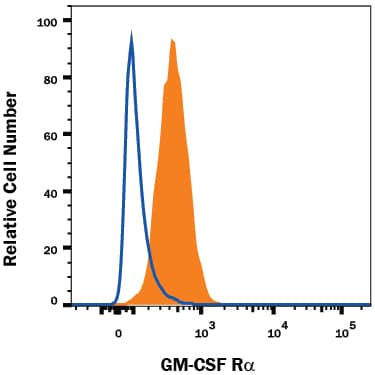
IC8214G) and either (A) Rat Anti-Mouse GITR/TNFRSF18 APC-conjugated Monoclonal Antibody (Catalog # FAB5241A) or (B) Rat IgG2AAllophycocyanin Isotype Control (Catalog # IC006A). View our protocol for Staining Membrane-associated Proteins." title="Mouse splenocytes stimulated to induce Regulatory T Cells (Tregs) were stained with Rabbit Anti-Human/Mouse FoxP3 Alexa Fluor® 488-conjugated Monoclonal Antibody (Catalog # IC8214G) and either (A) Rat Anti-Mouse GITR/TNFRSF18 APC-conjugated Monoclonal Antibody (Catalog # FAB5241A) or (B) Rat IgG2AAllophycocyanin Isotype Control (Catalog # IC006A). View our protocol for Staining Membrane-associated Proteins." />
| Reactivity | MuSpecies Glossary |
| Applications | Flow |
| Clone | 108619 |
| Clonality | Monoclonal |
| Host | Rat |
| Conjugate | Allophycocyanin |
| Immunogen | Mouse myeloma cell line NS0-derived recombinant mouse GITR/TNFRSF18 Met1-His153 Accession # O35714 |
| Specificity | Detects mouse GITR/TNFRSF18 in direct ELISAs and Western blots. In direct ELISAs, no cross-reactivity with recombinant human (rh) 4‑1BB, recombinant mouse (rm) CD27, rmCD30, rmEDAR, rmFas, rhGITR, rhHVEM, rmRANK, rhTROY, and rmTNF R1 is observed. |
| Source | N/A |
| Isotype | IgG2a |
| Clonality | Monoclonal |
| Host | Rat |
| Gene | TNFRSF18 |
| Purity Statement | Protein A or G purified from hybridoma culture supernatant |
| Innovator's Reward | Test in a species/application not listed above to receive a full credit towards a future purchase. |
| Dilutions |
|
|
| Publications |
|
| Storage | Store the unopened product at 2 - 8° C. Do not use past expiration date. Protect from light. |
| Buffer | Supplied in a saline solution containing BSA and Sodium Azide. |
| Preservative | Sodium Azide |
GITR (Glucocorticoid-induced Tumor Necrosis Factor Receptor), also known as AITR and CD357, is a 39-40 kDa member of the co‑stimulatory subset of the TNF receptor superfamily (1, 2). In mouse, the GITR gene is composed of five exons and encodes multiple length isoforms that arise from alternative splicing. The "standard", or first reported isoform is a type I transmembrane protein, 228 amino acids (aa) in length that contains a 19 aa signal sequence, a 134 aa extracellular region, a 21 aa transmembrane segment, and a 54 aa cytoplasmic domain. The extracellular region contains four potential N-linked glycosylation sites plus three cysteine-rich pseudorepeats of about 40 aa each (3, 4). The cytoplasmic domain has a P-x-Q/E-E motif that is known to associate with TRAF2. This is a common characteristic of TNFRSF members with co‑stimulatory functions (1). There is a naturally-occurring soluble form. Given its membership in the TNFRSF, it likely functions as a trimer on the cell surface (2). However, its ligand GITRL appears to act as a dimer, and this may affect stoichiometry of a functional GITR complex (5). In mouse, GITR is expressed by multiple cell types. These include keratinocytes, neutrophils, eosinophils, NK cells, NKT cells, macrophages, and CD138+ plasma cells (6-8). It has been studied most extensively on T cells, where it appears on multiple subsets of T cells, including gamma δ CD25+ Tregs, and CD4+ GITR+ CD45RBlo effector cells,thymus-derived Tregs (CD4+ CD25+ CD83+ and CD4+ CD25+ CD103+ ), Tr1 (IL-10+ FoxP3- ) cells, CD8+ CD25+ FoxP3+ IL-10+ Tregs, and CD4- CD8- FoxP3- PD-1++ DN Tregs (9). GITR would appear to have both stimulatory and inhibitory activity, depending on the context (1). Notably, seemingly analogous interactions between the human and rodent systems can produce nonequivalent outcomes. For example, the GITR:GITRL interaction between NK cells and tumor cells results in decreased IFN-gamma secretion and and cytotoxicity by human NK cells, but the opposite effect in mouse NK cells (7). Over aa 21-153, mouse GITR shares 84% and 53% aa sequence identity with rat and human GITR, respectively.


![Flow Cytometry L-Selectin/CD62L Antibody (4G8) [Unconjugated]](https://images.novusbio.com/images/antibody/bba24_human-l-selectin-cd62l-mab-cl-4g8-flow-cytometry-822024174319..jpg)
![ELISA L-Selectin/CD62L Antibody (4G8) [Unconjugated]](https://images.novusbio.com/images/bba24_human-l-selectin-cd62l-mab-cl-4g8-elisa-639201780831724199.jpg)


Secondary Antibodies |
Isotype Controls |
The concentration calculator allows you to quickly calculate the volume, mass or concentration of your vial. Simply enter your mass, volume, or concentration values for your reagent and the calculator will determine the rest.


![Bioactivity CTLA-4 [Unconjugated]](https://images.novusbio.com/images/protein/CTLA4_7268CT_2293.jpg)
![SDS-Page TNF-alpha [Unconjugated]](https://images.novusbio.com/images/protein/TNF-alpha_210-TA_256.jpg)
![Bioactivity TNF-alpha [Unconjugated]](https://images.novusbio.com/images/protein/TNFalpha_210TA_1658.jpg)
![SEC-MALS TNF-alpha [Unconjugated]](https://images.novusbio.com/images/210-ta_recombinant-human-tnf-alpha-protein-sec-mals-35202312244..jpg)
![N/A CD25/IL-2R alpha [HRP]](https://images.novusbio.com/images/elisa/IL-2_R_alpha_DR2A00_ELISA_167.jpg)
![N/A CD25/IL-2R alpha [HRP]](https://images.novusbio.com/images/elisa/DATA_CD25_DR2A00_ELISA_800.jpg)


![N/A IL-10 [Biotin]](https://images.novusbio.com/images/elisa/DATA_IL10_DY417_ELISA_2014.jpg)
![Bioactivity IL-2 [Unconjugated]](https://images.novusbio.com/images/202-il_recombinant-human-il-2-protein-bioactivity-174202314946.jpg)
![SEC-MALS IFN-gamma [Unconjugated]](https://images.novusbio.com/images/485-mi_recombinant-mouse-ifn-gamma-protein-sec-mals-1612202583245.jpg)
![Bioactivity IFN-gamma [Unconjugated]](https://images.novusbio.com/images/protein/IFN-gamma_485-MI_455.jpg)
![SDS-Page IFN-gamma [Unconjugated]](https://images.novusbio.com/images/protein/IFN-gamma_485-MI_407.jpg)


![Agonist Activity CD28 Antibody (37407) [Unconjugated]](https://images.novusbio.com/images/antibody/CD28_MAB342_Functional_Assay_2393.jpg)
![Immunocytochemistry CD28 Antibody (37407) [Unconjugated]](https://images.novusbio.com/images/mab342_human-cd28-mab-clone-37407-immunocytochemistry-31102022134634.jpg)
![N/A IL-6 [HRP]](https://images.novusbio.com/images/elisa/DATA_IL6_M6000_ELISA_936.jpg)
![N/A IL-6 [HRP]](https://images.novusbio.com/images/elisa/IL-6_M6000_ELISA_415.jpg)
![N/A IL-6 [HRP]](https://images.novusbio.com/images/m6000b_mouse-il-6-quantikine-elisa-kit-1752025024034.jpg)
![Bioactivity IL-4 [Unconjugated]](https://images.novusbio.com/images/protein/6507-ilcf_recombinant-human-il-4-cho-expressed-protein-cf-bioactivity-272020133214.jpg)