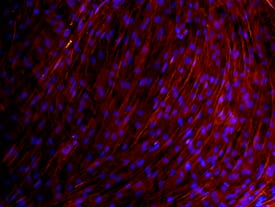
![Immunohistochemistry-Frozen: Dystrophin Antibody (MANDRA1) [NB120-7164] - Staining of frozen human tongue sections with 1:100 Monoclonal Anti-Dystrophin, Clone: MANDRA1 using Goat Anti-Mouse IgG, FITC-conjugate.](http://images.novusbio.com/fullsize/Dystrophin-Antibody-MANDRA1-Immunohistochemistry-Frozen-NB120-7164-img0002.jpg "Immunohistochemistry-Frozen: Dystrophin Antibody (MANDRA1) [NB120-7164] - Staining of frozen human tongue sections with 1:100 Monoclonal Anti-Dystrophin, Clone: MANDRA1 using Goat Anti-Mouse IgG, FITC-conjugate.")
| Immunogen | Fusion protein, corresponding to amino acids 3200-3684 of Human Dystrophin. |
| Localization | Cell Membrane |
| Specificity | The antibody recognizes an epitope located on the 128 amino acids at the end of the C-terminal domain of the human dystrophin molecule (amino acid residues 3558-3684). |
| Isotype | IgG1 |
| Clonality | Monoclonal |
| Host | Mouse |
| Gene | DMD |
| Purity | Unpurified |
| Innovator's Reward | Test in a species/application not listed above to receive a full credit towards a future purchase. |
| Dilutions |
|
|
| Application Notes | ELISA: See Nyugen thi Man et al (1992) and Morris G.E et al (1993) IF: Use freshly dissected and frozen human or animal muscle tissue. Immunohistochemical staining of muscle tissue results in a clear labeling confined to the periphery (plasma membrane) of normal striated muscle fibers. |
|
| Publications |
|
| Storage | Store at 4C short term. Aliquot and store at -20C long term. Avoid freeze-thaw cycles. |
| Buffer | Ascites |
| Preservative | 0.09% Sodium Azide |
| Purity | Unpurified |








Secondary Antibodies |
Isotype Controls |
Research Areas for Dystrophin Antibody (NB120-7164)Find related products by research area.
|
|
Could Laminin be Used to Treat Duchenne Muscular Dystrophy? Duchenne muscular dystrophy (DMD) is a severe muscle wasting condition, causing disability and early death. There is currently no cure or adequate treatment for DMD, but pioneering research indicates that injection of a laminin protein may prevent (or... Read full blog post. |
The concentration calculator allows you to quickly calculate the volume, mass or concentration of your vial. Simply enter your mass, volume, or concentration values for your reagent and the calculator will determine the rest.


![Bioactivity IGF-I/IGF-1 [Unconjugated]](https://images.novusbio.com/images/protein/IGF-I_291-G1_41.jpg)
![Mass Spectrometry IGF-I/IGF-1 [Unconjugated]](https://images.novusbio.com/images/protein/IGF-I_291-G1_42.jpg)
![SEC-MALS IGF-I/IGF-1 [Unconjugated]](https://images.novusbio.com/images/291-g1_recombinant-human-igf-i-igf-1-protein-cf-sec-mals-224202691859.jpg)
![N/A Osteoprotegerin/TNFRSF11B [Biotin]](https://images.novusbio.com/images/elisa/DATA_Osteoprotegerin_DY805_ELISA_2238.jpg)
![Immunohistochemistry Dystroglycan Antibody [Unconjugated]](https://images.novusbio.com/images/antibody/Dystroglycan_AF6868_Immunohistochemistry_11019.jpg)
![Western Blot Dystroglycan Antibody [Unconjugated]](https://images.novusbio.com/images/antibody/Dystroglycan_AF6868_Western_Blot_11065.jpg)


![SDS-Page TRANCE/TNFSF11/RANK L [Unconjugated]](https://images.novusbio.com/images/protein/TRANCE_462-TEC_442.jpg)
![Bioactivity TRANCE/TNFSF11/RANK L [Unconjugated]](https://images.novusbio.com/images/protein/TRANCE_462-TEC_556.jpg)
![N/A SLPI [HRP]](https://images.novusbio.com/images/elisa/SLPI_DPI00_ELISA_160.jpg)
![N/A SLPI [HRP]](https://images.novusbio.com/images/elisa/DATA_SLPI_DPI00_ELISA_792.jpg)
![Western Blot Growth Hormone Antibody [Unconjugated]](https://images.novusbio.com/images/antibody/Growth_Hormone_AF1067_Western_Blot_20961.jpg)
![N/A CCL27/CTACK [HRP]](https://images.novusbio.com/images/elisa/DATA_CCL27_DCC270_ELISA_615.jpg)
![N/A CCL27/CTACK [HRP]](https://images.novusbio.com/images/elisa/CCL27_DCC270_ELISA_54.jpg)