| Reactivity | Hu, Mu, RtSpecies Glossary |
| Applications | WB, IP |
| Clonality | Polyclonal |
| Host | Goat |
| Conjugate | Alexa Fluor 350 |
| Immunogen | E. coli-derived recombinant human DEP‑1/CD148 Arg997-Ala1337 Accession # Q12913 |
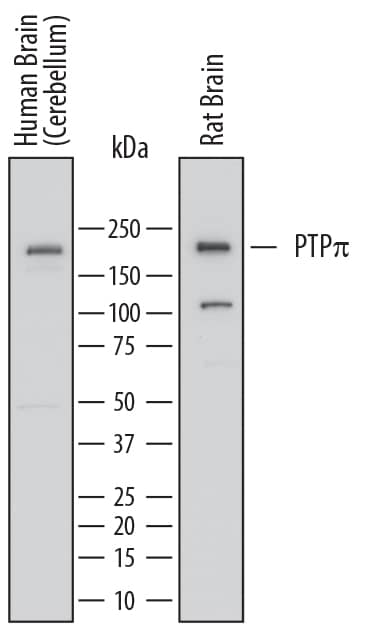
| Specificity | Detects human, mouse, and rat DEP-1/CD148 in Western blots. |
| Source | N/A |
| Isotype | IgG |
| Clonality | Polyclonal |
| Host | Goat |
| Purity Statement | Antigen Affinity-purified |
| Innovator's Reward | Test in a species/application not listed above to receive a full credit towards a future purchase. |
| Storage | Protect from light. Do not freeze. 12 months from date of receipt, 2 to 8 °C as supplied |
| Buffer | Supplied 0.2 mg/mL in a saline solution containing BSA and Sodium Azide. |
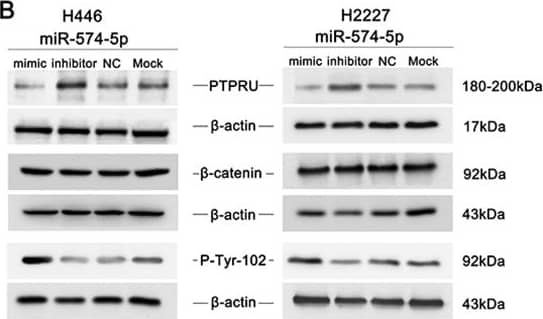
Density Enhanced Protein Tyrosine Phosphatase (DEP-1), also known as CD148, HPTP-eta, and PTP receptor type J (PTPRJ), is an enzyme that removes phosphate groups covalently attached to tyrosine residues in proteins. A large (220 kilodalton) glycoprotein found at the cell surface, DEP-1 levels are increased with high cell density (1). DEP-1 phosphatase activity is enhanced by basement membrane proteins (2), suggesting it is involved in regulating cell adhesion and contact interactions. High levels of expression dampen PDGF (3), VEGF (4), and T-cell receptor (5) responses. DEP-1 is widely expressed in tissues, particularly ones forming epithelioid monolayers (6). In the immune system, DEP-1 is found on all cell lineages and is highest on granulocytes (7). Dep-1 is the mutated gene in the Susceptibility to Colon Cancer locus Scc1, which is altered in many human colorectal adenomas (8). Gene knockout mice lacking DEP-1 die at midgestation due to failures in cardiovascular development (9). DEP-1 dephosphorylates a variety of proteins, including the HGF (10), PDGF (11), and VEGF (4) receptors, and beta ‑catenin (12). The recombinant protein is the intracellular region of DEP-1 containing the catalytic domain. Over aa 997-337, human Dep-1 shares 95% aa sequence identity with mouse and rat Dep-1.


![Immunocytochemistry EGFR Antibody [Unconjugated]](https://images.novusbio.com/images/antibody/EGF_R_AF231_Immunocytochemistry__Immunofluorescence_21143.jpg)
![Flow Cytometry EGFR Antibody [Unconjugated]](https://images.novusbio.com/images/antibody/EGF_R_AF231_Flow_Cytometry_20401.jpg)
![Western Blot EGFR Antibody [Unconjugated]](https://images.novusbio.com/images/antibody/EGF_R_AF231_Western_Blot_19925.jpg)


![Intracellular Staining by Flow Cytometry AKT [p Ser473] Antibody [Unconjugated] - Pan Specific](https://images.novusbio.com/images/antibody/Akt3_AF887_Flow_Cytometry_8283.jpg)
![Western Blot AKT [p Ser473] Antibody [Unconjugated] - Pan Specific](https://images.novusbio.com/images/af887_phospho-akt-s473-pan-specific-affinity-purified-pab-41202410485440.jpg)
![Western Blot AKT [p Ser473] Antibody [Unconjugated] - Pan Specific](https://images.novusbio.com/images/af887_phospho-akt-s473-pan-specific-affinity-purified-pab-8120255552843.jpg)
![DEP-1/CD148 Antibody [Alexa Fluor® 350]](/sites/all/modules/enterprise-tech/et_datasheets/images/novus_guarantee.png "DEP-1/CD148 Antibody [Alexa Fluor® 350]")
Secondary Antibodies |
Isotype Controls |
The concentration calculator allows you to quickly calculate the volume, mass or concentration of your vial. Simply enter your mass, volume, or concentration values for your reagent and the calculator will determine the rest.
| Uniprot |
|




![Immunohistochemistry CD45 Antibody [Unconjugated]](https://images.novusbio.com/images/antibody/CD45_AF114_Immunohistochemistry_23525.jpg)
![Immunocytochemistry CD45 Antibody [Unconjugated]](https://images.novusbio.com/images/antibody/af114_mouse-cd45-affinity-purified-polyclonal-ab-immunocytochemistry-6122021145449.jpg)


![N/A VEGF [HRP]](https://images.novusbio.com/images/elisa/VEGF_DVE00_ELISA_208.jpg)
![N/A VEGF [HRP]](https://images.novusbio.com/images/elisa/DATA_VEGF_DVE00_ELISA_871.jpg)
![N/A VEGF [HRP]](https://images.novusbio.com/images/elisa/DATA_VEGF_DVE00_ELISA_872.jpg)
![Bioactivity CTLA-4 [Unconjugated]](https://images.novusbio.com/images/protein/CTLA4_7268CT_2293.jpg)


![Western Blot Src [p Tyr419] Antibody [Unconjugated]](https://images.novusbio.com/images/antibody/Src_AF2685_Western_Blot_5209.jpg)
![Immunohistochemistry Src [p Tyr419] Antibody [Unconjugated]](https://images.novusbio.com/images/af2685_human-phospho-src-y419-affinity-purified-polyclonal-ab-412024124022.jpg)
![Immunohistochemistry Src [p Tyr419] Antibody [Unconjugated]](https://images.novusbio.com/images/antibody/Src_AF2685_Immunohistochemistry_9943.jpg)
![Western Blot ERK2 Antibody [Unconjugated]](https://images.novusbio.com/images/antibody/ERK2_AF1230_Western_Blot_5097.jpg)
![Knockout Validated ERK2 Antibody [Unconjugated]](https://images.novusbio.com/images/antibody/ERK2_AF1230_Knockout_Validated_22864.jpg)
![Immunohistochemistry ERK2 Antibody [Unconjugated]](https://images.novusbio.com/images/antibody/ERK2_AF1230_Immunohistochemistry_20696.jpg)