After August 17, 2026, Novus Biologicals products and services will no longer be available on this website; you will access all products and services on rndsystems.com. Create your R&D Systems online account today.
Recombinant Mouse CX3CL1/Fractalkine (Full Length) Protein Summary
Details of Functionality
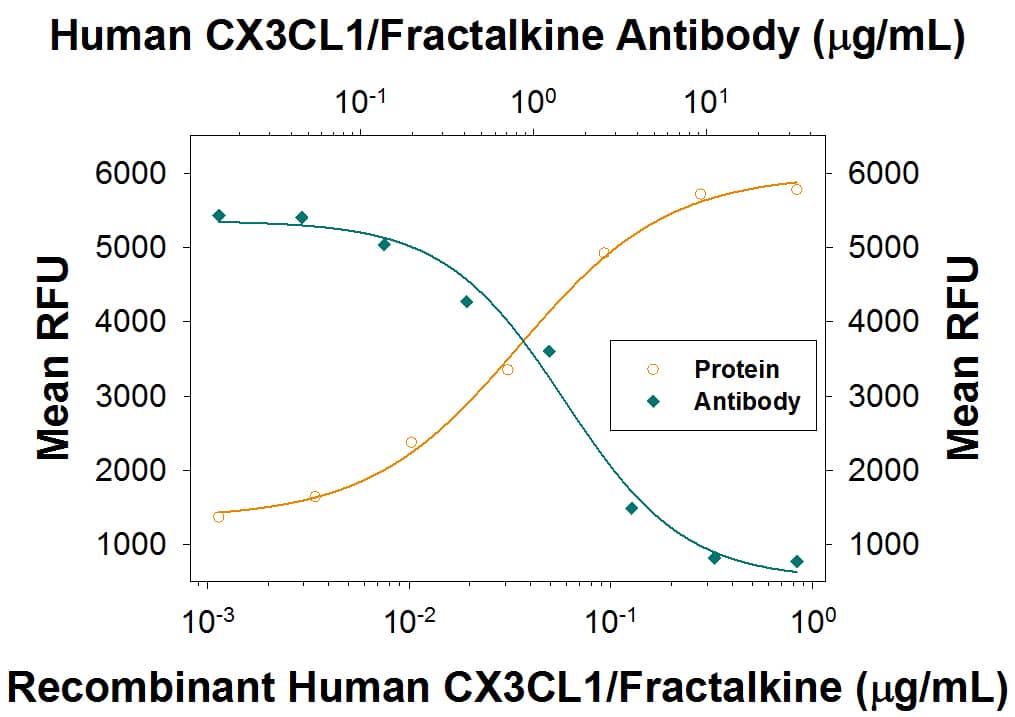
Measured by its ability to chemoattract freshly isolated human peripheral blood lymphocytes (PBL). The ED50 for this effect is 0.2-0.6 µg/mL. Measured by its ability to chemoattract BaF3 mouse pro‑B cells transfected with mouse CX3CR1. The ED50 for this effect is 0.03-0.12 μg/mL.
Source
Spodoptera frugiperda, Sf 21 (baculovirus)-derived mouse CX3CL1/Fractalkine protein Gln25-Arg337 , with a C-terminal 6-His tag
>97%, by SDS-PAGE under reducing conditions and visualized by silver stain
Endotoxin Note
<0.10 EU per 1 μg of the protein by the LAL method.
Applications/Dilutions
Dilutions
Bioactivity
Bioactivity2
Theoretical MW
34 kDa. Disclaimer note: The observed molecular weight of the protein may vary from the listed predicted molecular weight due to post translational modifications, post translation cleavages, relative charges, and other experimental factors.
SDS-PAGE
90 kDa, reducing conditions
Publications
Read Publications using 472-FF in the following applications:
Use a manual defrost freezer and avoid repeated freeze-thaw cycles.
12 months from date of receipt, -20 to -70 °C as supplied.
1 month, 2 to 8 °C under sterile conditions after reconstitution.
3 months, -20 to -70 °C under sterile conditions after reconstitution.
Buffer
Lyophilized from a 0.2 μm filtered solution in PBS with BSA as a carrier protein.
Purity
>97%, by SDS-PAGE under reducing conditions and visualized by silver stain
Reconstitution Instructions
Reconstitute at 100 μg/mL in sterile PBS containing at least 0.1% human or bovine serum albumin.
Notes
This product is produced by and ships from R&D Systems, Inc., a Bio-Techne brand.
Alternate Names for Recombinant Mouse CX3CL1/Fractalkine (Full Length) Protein
ABCD-3
C3Xkine
chemokine (C-X3-C motif) ligand 1
CX3C membrane-anchored chemokine
CX3CL1
CXC3
CXC3C
FKN
Fractalkine
Neurotactin
neurotactin)
NTNsmall inducible cytokine subfamily D (Cys-X3-Cys), member 1 (fractalkine
NTTSmall-inducible cytokine D1
SCYD1C-X3-C motif chemokine 1
small inducible cytokine subfamily D (Cys-X3-Cys), member-1
Background
Fractalkine, designated CX3CL1 and also known as neurotactin, is the only member of the CX3C, or delta, chemokine subfamily (1 ‑ 4). Unlike most other chemokines, CX3CL1 is a type I transmembrane (TM) adhesion protein (1). The mouse CX3CL1 cDNA encodes 395 amino acids (aa), including a signal sequence (aa 1 ‑ 24), a chemokine domain (aa 25 ‑ 100), a mucin stalk region (aa 101 ‑ 336), a transmembrane segment (aa 337 ‑ 357), and a cytoplasmic tail (aa 358 ‑ 395). The chemokine domain contains binding and chemotactic determinants, while the mucin stalk appears to function only as a spacer (4, 5). Mouse CX3CL1 shares 85% and 78% aa sequence identity with rat and human CX3CL1, respectively, within the chemokine domain, but lower sequence identity within other domains. CX3CL1 is up‑regulated by pro‑inflammatory stimuli, especially IFN‑ gamma and TNF‑ alpha , on cell types including macrophages, dendritic cells, endothelium, neurons, smooth muscle and epithelium lining the intestines and other tubules (1, 8, 9). The 40 kDa, 7‑TM non‑glycosylated G‑protein coupled CX3CL1 receptor, CX3CR1, is expressed by cytotoxic effector cells and cytokine producers, including type I helper and cytotoxic T cells, gamma δ T cells, CD16+ NK cells, monocytes and microglia (1, 2). The 95 ‑ 100 kDa TM CX3CL1 can be inducibly cleaved near the TM segment by ADAM10 or ADAM17 to generate a 60 ‑ 80 kDa soluble form (6, 7). TM CX3CL1 functions as an adhesion molecule, while both forms are chemoattractants for target cells expressing CX3CR1 (1, 2). During extravasation, membrane‑bound CX3CL1 traps leukocytes, then is cleaved to allow diapedesis (6). In coronary artery disease, soluble CX3CL1 and CD8+ T cell CX3CR1 are overexpressed and appear to contribute to pathogenesis (1, 10). In the brain, CX3CL1/CX3CR1 interaction protects against microglial neurotoxicity (11). CX3CL1 also contributes to wound healing by recruiting macrophages, and to bone resorption by recruiting and mediating adhesion of osteoclast precursors (12, 13).
Stievano, L. et al. (2004) Crit. Rev. Immunol. 24:205.
Umehara, H. et al. (2004) Arterioscler. Thromb. Vasc. Biol. 24:34.
Rossi, D.L. et al. (1998) Genomics 47:163.
Mizoue, L.S. et al. (2001) J. Biol. Chem. 276:33906.
Harrison, J.K. et al. (2001) J. Biol. Chem. 276:21632.
Hundhausen, C. et al. (2007) J. Immunol. 178:8064.
Tsou, C. et al. (2001) J. Biol. Chem. 276:44622.
Tarozzo, G. et al. (2003) J. Neurosci. Res. 73:81.
Lucas, A.D. et al. (2001) Am. J. Pathol. 158:855.
Damas, J.K. et al. (2005) Arterioscler. Thromb. Vasc. Biol. 25:2567.
The concentration calculator allows you to quickly calculate the volume, mass or concentration of your vial. Simply enter your mass, volume, or concentration values for your reagent and the calculator will determine the rest.
=
÷
Review this Product
Be the first to review our Recombinant Mouse CX3CL1/Fractalkine (Full Length) Protein and receive a gift card or discount.


![SDS-Page TNF-alpha [Unconjugated]](https://images.novusbio.com/images/protein/TNF-alpha_210-TA_256.jpg)
![Bioactivity TNF-alpha [Unconjugated]](https://images.novusbio.com/images/protein/TNFalpha_210TA_1658.jpg)
![SEC-MALS TNF-alpha [Unconjugated]](https://images.novusbio.com/images/210-ta_recombinant-human-tnf-alpha-protein-sec-mals-35202312244..jpg)
![N/A CCL2/JE/MCP-1 [HRP]](https://images.novusbio.com/images/elisa/CCL2_DCP00_ELISA_67.jpg)
![N/A CCL2/JE/MCP-1 [HRP]](https://images.novusbio.com/images/elisa/DATA_CCL2_DCP00_ELISA_633.jpg)
![N/A CCL2/JE/MCP-1 [HRP]](https://images.novusbio.com/images/elisa/DATA_CCL2_DCP00_ELISA_634.jpg)
![N/A CCL5/RANTES [HRP]](https://images.novusbio.com/images/elisa/CCL5_DRN00_ELISA_393.jpg)
![N/A CCL5/RANTES [HRP]](https://images.novusbio.com/images/elisa/DATA_CCL5_DRN00_ELISA_811.jpg)
![N/A CCL5/RANTES [HRP]](https://images.novusbio.com/images/elisa/DATA_CCL5_DRN00_ELISA_810.jpg)

![Bioactivity GDNF [Unconjugated]](https://images.novusbio.com/images/protein/GDNF_212GD_2846.jpg)
![SDS-Page GDNF [Unconjugated]](https://images.novusbio.com/images/protein/GDNF_212-GD_62.jpg)
![SEC-MALS GDNF [Unconjugated]](https://images.novusbio.com/images/212-gd_recombinant-human-gdnf-protein-sec-mals-25202393740..jpg)
![N/A IL-6 [HRP]](https://images.novusbio.com/images/elisa/DATA_IL6_M6000_ELISA_936.jpg)
![N/A IL-6 [HRP]](https://images.novusbio.com/images/elisa/IL-6_M6000_ELISA_415.jpg)
![N/A IL-6 [HRP]](https://images.novusbio.com/images/m6000b_mouse-il-6-quantikine-elisa-kit-1752025024034.jpg)
![N/A CXCL10/IP-10/CRG-2 [HRP]](https://images.novusbio.com/images/elisa/CXCL10_DIP100_ELISA_121.jpg)
![N/A CXCL10/IP-10/CRG-2 [HRP]](https://images.novusbio.com/images/elisa/DATA_CXCL10_DIP100_ELISA_723.jpg)
![N/A CXCL10/IP-10/CRG-2 [HRP]](https://images.novusbio.com/images/elisa/DATA_CXCL10_DIP100_ELISA_724.jpg)
![SEC-MALS IFN-gamma [Unconjugated]](https://images.novusbio.com/images/485-mi_recombinant-mouse-ifn-gamma-protein-sec-mals-1612202583245.jpg)
![Bioactivity IFN-gamma [Unconjugated]](https://images.novusbio.com/images/protein/IFN-gamma_485-MI_455.jpg)
![SDS-Page IFN-gamma [Unconjugated]](https://images.novusbio.com/images/protein/IFN-gamma_485-MI_407.jpg)
![Western Blot ERK2 Antibody [Unconjugated]](https://images.novusbio.com/images/antibody/ERK2_AF1230_Western_Blot_5097.jpg)
![Knockout Validated ERK2 Antibody [Unconjugated]](https://images.novusbio.com/images/antibody/ERK2_AF1230_Knockout_Validated_22864.jpg)
![Immunohistochemistry ERK2 Antibody [Unconjugated]](https://images.novusbio.com/images/antibody/ERK2_AF1230_Immunohistochemistry_20696.jpg)


![Bioactivity CXCL12/SDF-1 alpha [Unconjugated]](https://images.novusbio.com/images/protein/CXCL12SDF1_alpha_350NS_1178.jpg)
![SDS-Page CXCL12/SDF-1 alpha [Unconjugated]](https://images.novusbio.com/images/protein/CXCL12_SDF-1_alpha_350-NS_308.jpg)
![N/A CCL22/MDC [HRP]](https://images.novusbio.com/images/elisa/CCL22_DMD00_ELISA_142.jpg)
![N/A CCL22/MDC [HRP]](https://images.novusbio.com/images/elisa/DATA_CCL22_DMD00_ELISA_762.jpg)
![N/A CCL17/TARC [HRP]](https://images.novusbio.com/images/elisa/DATA_CCL17_MCC170_ELISA_950.jpg)
![N/A CCL17/TARC [HRP]](https://images.novusbio.com/images/elisa/CCL17_MCC170_ELISA_247.jpg)
![Western Blot Ret Antibody [Unconjugated]](https://images.novusbio.com/images/af482_mouse-ret-affinity-purified-polyclonal-ab-8120255541732.jpg)
![Western Blot Ret Antibody [Unconjugated]](https://images.novusbio.com/images/af482_mouse-ret-affinity-purified-polyclonal-ab-8120255541771.jpg)
![Western Blot Ret Antibody [Unconjugated]](https://images.novusbio.com/images/af482_mouse-ret-affinity-purified-polyclonal-ab-8120255534722.jpg)
![N/A IL-10 [Biotin]](https://images.novusbio.com/images/elisa/DATA_IL10_DY417_ELISA_2014.jpg)
![Bioactivity IL-4 [Unconjugated]](https://images.novusbio.com/images/protein/6507-ilcf_recombinant-human-il-4-cho-expressed-protein-cf-bioactivity-272020133214.jpg)