| Details of Functionality | Recombinant Human His6-SUMO3 can be conjugated to substrate proteins via the subsequent actions of an SUMO-activating (E1) enzyme, an SUMO-conjugating (E2) enzyme, and an SUMO ligase (E3). Reaction conditions will need to be optimized for each specific application. We recommend an initial Recombinant Human His6-SUMO3 concentration of 10-50 μM. |
| Source | E. coli-derived human SUMO3 protein Contains a N-terminal Met-Arg-Gly-Ser and 6-His tag |
| Accession # | |
| Protein/Peptide Type | Recombinant Proteins |
| Gene | SUMO3 |
| Purity | >95%, by SDS-PAGE under reducing conditions and visualized by Colloidal Coomassie® Blue stain |
| Dilutions |
|
| Theoretical MW | 12 kDa. Disclaimer note: The observed molecular weight of the protein may vary from the listed predicted molecular weight due to post translational modifications, post translation cleavages, relative charges, and other experimental factors. |
| Storage | Use a manual defrost freezer and avoid repeated freeze-thaw cycles.
|
| Buffer | Supplied as a solution in HEPES, NaCl and DTT. |
| Purity | >95%, by SDS-PAGE under reducing conditions and visualized by Colloidal Coomassie® Blue stain |
Human Small Ubiquitin-like Modifier 3 (SUMO3), also known as SMT3A, is synthesized as a 103 amino acid (aa), propeptide with a predicted 11.5 kDa. SUMO3 contains a two aa C-terminal prosegment. Human SUMO3 shares 83% sequence identity with mouse SUMO3. SUMO3 also has high aa sequence homology to SUMO2 and SUMO4, 87% and 75%, respectively. SUMO3 shares only 47% sequence identity with SUMO1. SUMOs are a family of small, related proteins that can be enzymatically attached to a target protein by a post-translational modification process termed SUMOylation (1-3). All SUMO proteins share a conserved Ubiquitin domain and a C-terminal diglycine cleavage/attachment site. Following prosegment cleavage, the C-terminal glycine residue of SUMO3 is enzymatically attached to a lysine residue on a target protein. In humans, SUMO3 is conjugated to a variety of molecules in the presence of the SAE1/UBA2 SUMO-activating (E1) enzyme and the UBE2I/Ubc9 SUMO-conjugating (E2) enzyme (4,5). In yeast, the SUMO-activating (E1) enzyme is Aos1/Uba2p (6). Because of the high level of sequence homology most studies report effects of SUMO2/3. For example, addition of SUMO2/3 was shown to modulate the function of ARHGAP21, a RhoGAP protein known to be involved in cell migration (7). Other reports indicate that the conjugation by SUMO2/3, but not SUMO1, may represent an important mechanism to protect neurons during episodes of cerebral ischemia (8,9). However, studies suggest that SUMO2/3 expression is regulated in an isoform-specific manner since oxidative stress downregulated the transcription of SUMO3 but not SUMO2 (10).
SUMOylation can occur without the requirement of a specific E3 ligase activity, where SUMO is transferred directly from Ubc9 to specific substrates. SUMOylated substrates are primarily localized to the nucleus (RanGAP-1,RANBP2, PML, p53, Sp100, HIPK2) but there are also cytosolic substrates (I kappa B alpha , GLUT1,GLUT4). SUMO modification has been implicated in functions such as nuclear transport, chromosome segregation, transcriptional regulation, apoptosis, and protein stability.






The concentration calculator allows you to quickly calculate the volume, mass or concentration of your vial. Simply enter your mass, volume, or concentration values for your reagent and the calculator will determine the rest.


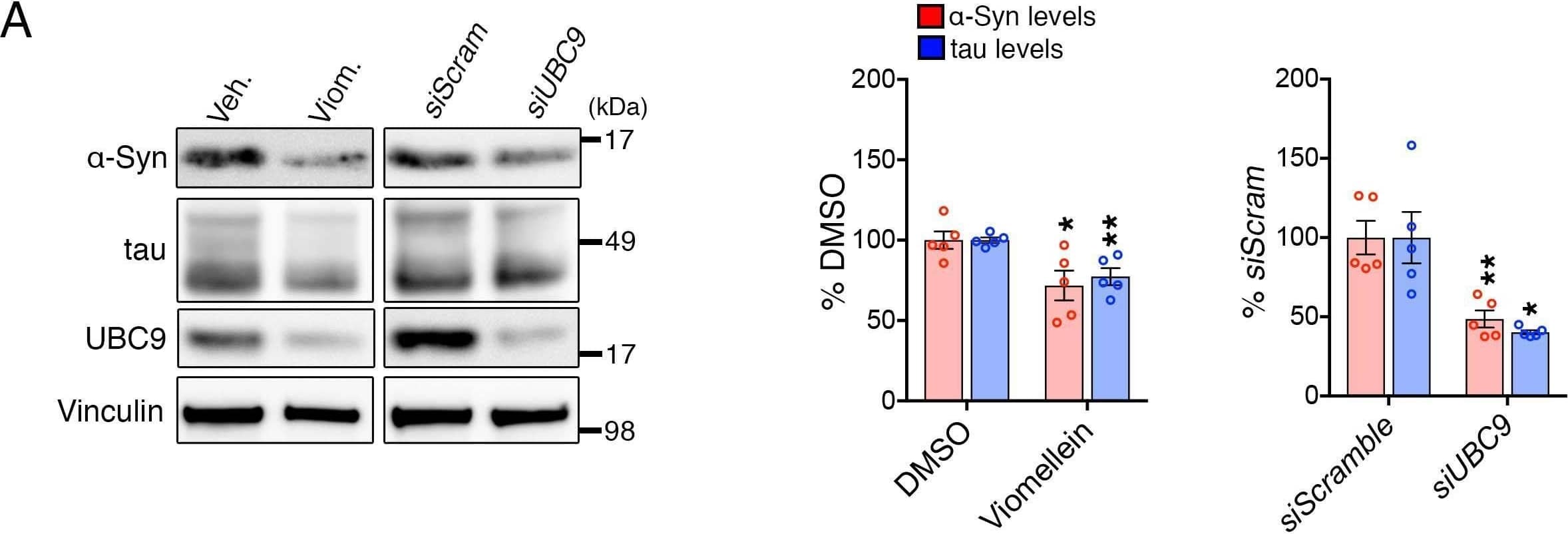


![Western Blot Androgen R/NR3C4 [p Ser213, p Ser210] Antibody (156C135.2) - BSA Free](https://images.novusbio.com/images/Androgen-R-NR3C4-p-Ser213-p-Ser210-Antibody-156C135-2-Western-Blot-NB100-56603-img0004.jpg)