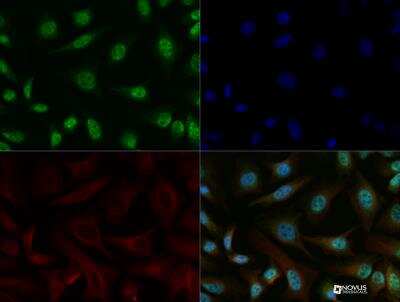
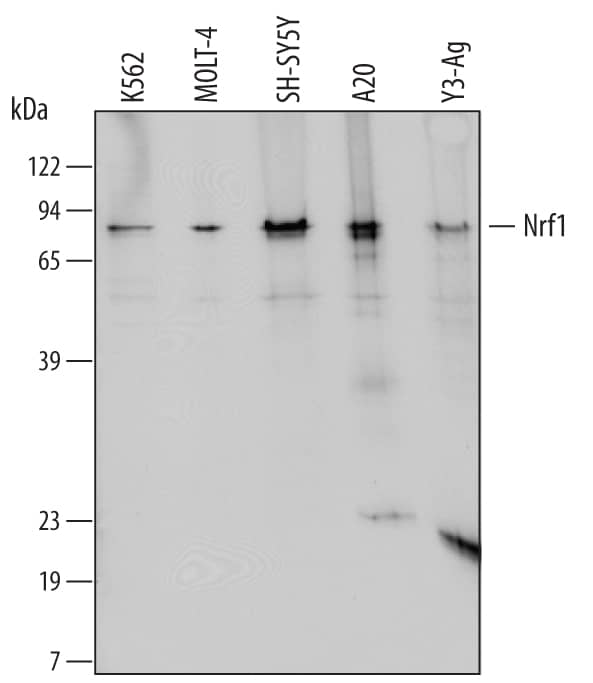
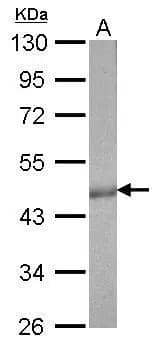
| Reactivity | HuSpecies Glossary |
| Applications | WB, IHC, ICC/IF |
| Clone | 474915 |
| Clonality | Monoclonal |
| Host | Mouse |
| Conjugate | Alexa Fluor 647 |
| Immunogen | E. coli-derived human PGC1 alpha Glu11-Ile280 Accession # Q9UBK2 |
| Specificity | Detects human PGC1 alpha in direct ELISAs. |
| Source | N/A |
| Isotype | IgG1 |
| Clonality | Monoclonal |
| Host | Mouse |
| Purity Statement | Protein A or G purified from hybridoma culture supernatant |
| Innovator's Reward | Test in a species/application not listed above to receive a full credit towards a future purchase. |
| Storage | Protect from light. Do not freeze. 12 months from date of receipt, 2 to 8 °C as supplied |
| Buffer | Supplied 0.2 mg/mL in a saline solution containing BSA and Sodium Azide. |
PGC1 alpha (PPAR-gamma Coactivator 1 alpha; also LEM6) is a 97-120 kDa member of the PGC-1 family of proteins. It is expressed in select cell types, including brown adipocytes, skeletal muscle and hepatocytes. PGC1 alpha participates in both RNA processing and transcriptional coactivation in conjunction with multiple nuclear hormone receptors such as PPAR gamma , RAR and TR. Human PCG1 alpha is 798 amino acids (aa) in length. It contains an LxxLL nuclear receptor binding motif (aa 144-148), one PPAR-gamma interaction domain (aa 293-339), two NLSs and an RNA binding/processing region (aa 566-710). PGC1 alpha activity is regulated by phosphorylation. AMPK is known to phosphorylate Thr178 and Ser539, promoting cotranscriptional activity. Conversely, Akt-mediated phosphorylation at Ser571 is reported to downregulate PGC1 alpha activity. This latter effect is achieved by an initial Ser571 phosphorylation, followed by GCN5 binding and subsequent PCG1 alpha acetylation that promotes PGC-1 alpha dissociation from target gene promoters.








![Intracellular Staining by Flow Cytometry AKT [p Ser473] Antibody [Unconjugated] - Pan Specific](https://images.novusbio.com/images/antibody/Akt3_AF887_Flow_Cytometry_8283.jpg)
![Western Blot AKT [p Ser473] Antibody [Unconjugated] - Pan Specific](https://images.novusbio.com/images/af887_phospho-akt-s473-pan-specific-affinity-purified-pab-41202410485440.jpg)
![Western Blot AKT [p Ser473] Antibody [Unconjugated] - Pan Specific](https://images.novusbio.com/images/af887_phospho-akt-s473-pan-specific-affinity-purified-pab-8120255552843.jpg)


![PGC1 alpha Antibody (474915) [Alexa Fluor® 647]](/sites/all/modules/enterprise-tech/et_datasheets/images/novus_guarantee.png "PGC1 alpha Antibody (474915) [Alexa Fluor® 647]")
Secondary Antibodies |
Isotype Controls |
|
Tired T cells: Hypoxia Drives T cell Exhaustion in the Tumor Microenvironment By Hunter MartinezThe paradigm shifting view of the immune system being leveraged to target cancer has led to numerous therapeutic breakthroughs. One major cell group responsible for this revelation is a T cell. ... Read full blog post. |
The concentration calculator allows you to quickly calculate the volume, mass or concentration of your vial. Simply enter your mass, volume, or concentration values for your reagent and the calculator will determine the rest.
| Uniprot |
|


![Immunohistochemistry Insulin Antibody (182410) [Unconjugated]](https://images.novusbio.com/images/antibody/mab1417_human-bovine-mouse-insulin-mab-clone-182410-immunohistochemistry-308202115145.jpg)
![Immunocytochemistry Insulin Antibody (182410) [Unconjugated]](https://images.novusbio.com/images/antibody/Insulin_MAB1417_Immunocytochemistry_9376.jpg)


![Immunocytochemistry AMPK alpha 2 Antibody [Unconjugated]](https://images.novusbio.com/images/antibody/AMPK_alpha_2_AF2850_Immunocytochemistry__Immunofluorescence_19686.jpg)
![Western Blot AMPK alpha 2 Antibody [Unconjugated]](https://images.novusbio.com/images/antibody/AMPK_alpha_2_AF2850_Western_Blot_5219.jpg)
![Simple Western AMPK alpha 2 Antibody [Unconjugated]](https://images.novusbio.com/images/antibody/AMPK_alpha_2_AF2850_Simple_Western_16678.jpg)
![Immunohistochemistry AMPK beta 1 Antibody [Unconjugated]](https://images.novusbio.com/images/antibody/af2854_human-mouse-rat-ampk-beta-1-affinity-purified-polyclonal-ab-immunohistochemistry-255202312830..jpg)
![Western Blot AMPK beta 1 Antibody [Unconjugated]](https://images.novusbio.com/images/antibody/AMPK_beta_1_AF2854_Western_Blot_5220.jpg)
![Immunohistochemistry AMPK beta 1 Antibody [Unconjugated]](https://images.novusbio.com/images/af2854_human-mouse-rat-ampk-beta-1-affinity-purified-polyclonal-ab-immunohistochemistry-252023124938.jpg)