| Reactivity | Hu, Bv, PmSpecies Glossary |
| Applications | ELISA, Flow, IP, CyTOF-ready |
| Clone | MEM-123 |
| Clonality | Monoclonal |
| Host | Mouse |
| Conjugate | Allophycocyanin |
| Description | This conjugate is made on demand and is not held in inventory. Each order represents a unique lot. All conjugates are generated using validated conjugation protocols and meet strict degree of labeling (F/P) specifications; additional information is available upon request. The antibody concentration is provided on the individual product label. For specialized conjugation needs, like large quantities, specific concentrations, and defined F/P ratios, bulk and custom antibody conjugation services are available. |
| Immunogen | COS-7 African green monkey kidney cells |
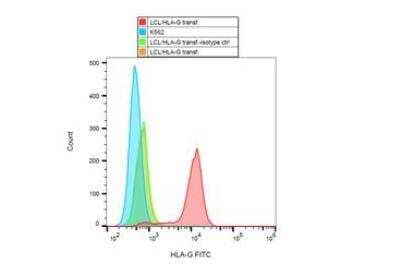
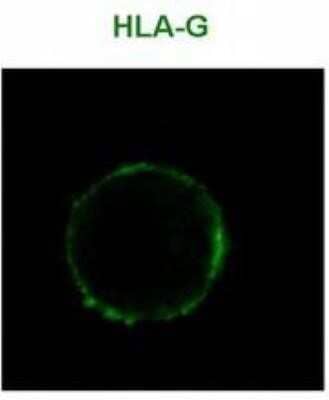
| Specificity | This antibody (clone MEM-123) reacts with all human classical MHC Class I molecules (major histocompatibility complex) in native cell-surface forms as well as with human HLA-G cDNA transfected cells. MHC Class I molecules (MHC Class Ia) are expressed on the surface of all human cell types. This antibody completely blocks binding of classical W6/32 to surface-expressed HLA-G, but does not cross-blocks This antibody MEM-G/9. |
| Isotype | IgG3 |
| Clonality | Monoclonal |
| Host | Mouse |
| Gene | HLA-A |
| Purity | Protein A purified |
| Innovator's Reward | Test in a species/application not listed above to receive a full credit towards a future purchase. |
| Dilutions |
|
| Application Notes | Recommended applications are based on validated applications from the unconjugated base product NB500-505. This conjugated antibody is not kept in inventory and is made to order using validated conjugation protocols. |
| Storage | Store at 4C in the dark. |
| Buffer | PBS |
| Preservative | 0.05% Sodium Azide |
| Purity | Protein A purified |








Secondary Antibodies |
Isotype Controls |
Research Areas for HLA Class I Antibody (NB500-505APC)Find related products by research area.
|
The concentration calculator allows you to quickly calculate the volume, mass or concentration of your vial. Simply enter your mass, volume, or concentration values for your reagent and the calculator will determine the rest.


![SEC-MALS IFN-gamma [Unconjugated]](https://images.novusbio.com/images/485-mi_recombinant-mouse-ifn-gamma-protein-sec-mals-1612202583245.jpg)
![Bioactivity IFN-gamma [Unconjugated]](https://images.novusbio.com/images/protein/IFN-gamma_485-MI_455.jpg)
![SDS-Page IFN-gamma [Unconjugated]](https://images.novusbio.com/images/protein/IFN-gamma_485-MI_407.jpg)
![Bioactivity IL-2 [Unconjugated]](https://images.novusbio.com/images/202-il_recombinant-human-il-2-protein-bioactivity-174202314946.jpg)
![SDS-Page TNF-alpha [Unconjugated]](https://images.novusbio.com/images/protein/TNF-alpha_210-TA_256.jpg)
![Bioactivity TNF-alpha [Unconjugated]](https://images.novusbio.com/images/protein/TNFalpha_210TA_1658.jpg)
![SEC-MALS TNF-alpha [Unconjugated]](https://images.novusbio.com/images/210-ta_recombinant-human-tnf-alpha-protein-sec-mals-35202312244..jpg)
![Neutralization TRAILR1/TNFRSF10A Antibody [Unconjugated]](https://images.novusbio.com/images/antibody/TRAIL_R1_AF347_Block_Neutralize_875.jpg)
![Western Blot TRAILR1/TNFRSF10A Antibody [Unconjugated]](https://images.novusbio.com/images/antibody/TRAIL_R1_AF347_Western_Blot_5303.jpg)
![Immunohistochemistry TRAILR1/TNFRSF10A Antibody [Unconjugated]](https://images.novusbio.com/images/antibody/TRAIL_R1_AF347_Immunohistochemistry_17355.jpg)