| Reactivity | HuSpecies Glossary |
| Applications | WB |
| Clonality | Polyclonal |
| Host | Goat |
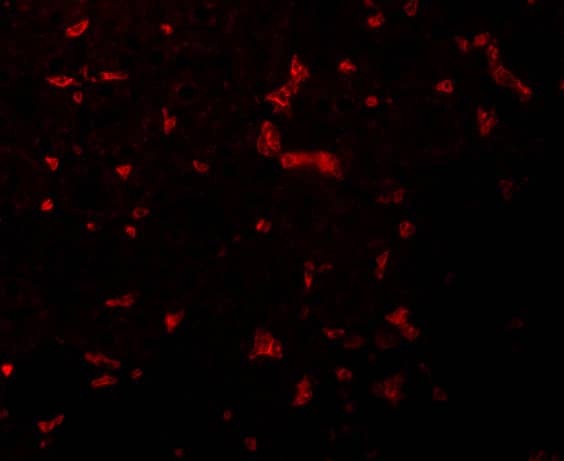
| Conjugate | Alexa Fluor 532 |
| Immunogen | E. coli-derived recombinant human TRAF-1 Met1-Thr416 Accession # Q13077 |
| Specificity | Detects human TRAF-1 in Western blots. In Western blots, less than 1% cross-reactivity with recombinant human TRAF-2, -3, -4, -5, and -6 is observed. |
| Isotype | IgG |
| Clonality | Polyclonal |
| Host | Goat |
| Purity Statement | Antigen Affinity-purified |
| Innovator's Reward | Test in a species/application not listed above to receive a full credit towards a future purchase. |
| Storage | Protect from light. Do not freeze. 12 months from date of receipt, 2 to 8 °C as supplied |
| Buffer | Supplied 0.2 mg/mL in a saline solution containing BSA and Sodium Azide. |
Tumor Necrosis Factor (TNF) Receptor-Associated Factors (TRAFs) are a family of adaptor proteins that interact with a wide range of cell surface receptors and participate in the regulation of cell survival, proliferation, differentiation, and stress response. TRAFs were identified by their ability to form complexes with TNF receptor superfamily members but more recently are reported to also bind to Toll/IL-1 receptor family members and mediate cellular signaling. Six members of the TRAF family have been identified. All TRAF proteins have a homologous C-terminal TRAF domain that can bind the cytoplasmic domain of receptors as well as other TRAFs. TRAF-1, also known as EBI6, is a 416 amino acid, 46 kDa protein that is a unique member of the TRAF family, in that it lacks the N-terminal RING finger domain common in TRAFs 2-6. TRAF-1 interacts with the cytoplasmic domain of TNFR2 and other TNFR family members to mediate downstream signaling events. TRAF-1 is a substrate for caspases activated by TNF family death receptors. TRAF-1 can homodimerize as well as form heterodimers with TRAF-2.


![Western Blot TRADD Antibody [Unconjugated]](https://images.novusbio.com/images/antibody/TRADD_AF2658_Western_Blot_5202.jpg)
![Immunocytochemistry TRADD Antibody [Unconjugated]](https://images.novusbio.com/images/antibody/TRADD_AF2658_Immunocytochemistry__Immunofluorescence_22493.jpg)



Secondary Antibodies |
Isotype Controls |
The concentration calculator allows you to quickly calculate the volume, mass or concentration of your vial. Simply enter your mass, volume, or concentration values for your reagent and the calculator will determine the rest.
| Uniprot |
|


![SDS-Page TNF-alpha [Unconjugated]](https://images.novusbio.com/images/protein/TNF-alpha_210-TA_256.jpg)
![Bioactivity TNF-alpha [Unconjugated]](https://images.novusbio.com/images/protein/TNFalpha_210TA_1658.jpg)
![SEC-MALS TNF-alpha [Unconjugated]](https://images.novusbio.com/images/210-ta_recombinant-human-tnf-alpha-protein-sec-mals-35202312244..jpg)
![Western Blot TRAF-2 Antibody (324522) [Unconjugated]](https://images.novusbio.com/images/antibody/TRAF-2_MAB3277_Western_Blot_6081.jpg)

![N/A TNF RI/TNFRSF1A [HRP]](https://images.novusbio.com/images/elisa/DATA_TNF_RI_DRT100_ELISA_816.jpg)
![N/A TNF RI/TNFRSF1A [HRP]](https://images.novusbio.com/images/elisa/DATA_TNF_RI_DRT100_ELISA_815.jpg)
![N/A TNF RI/TNFRSF1A [HRP]](https://images.novusbio.com/images/elisa/TNF_RI_DRT100_ELISA_175.jpg)
![Bioactivity Complement Component C5a [Unconjugated]](https://images.novusbio.com/images/protein/Complement_Component_C5a_2150-C5_647.jpg)
![SDS-Page Complement Component C5a [Unconjugated]](https://images.novusbio.com/images/protein/Complement_Component_C5a_2150-C5_638.jpg)
![Western Blot CD40/TNFRSF5 Antibody [Unconjugated]](https://images.novusbio.com/images/af632_human-cd40-tnfrsf5-affinity-purified-polyclonal-ab-822024950191.jpg)
![Western Blot CD40/TNFRSF5 Antibody [Unconjugated]](https://images.novusbio.com/images/af632_human-cd40-tnfrsf5-affinity-purified-polyclonal-ab-44202415425047.jpg)
![Simple Western CD40/TNFRSF5 Antibody [Unconjugated]](https://images.novusbio.com/images/antibody/af632_human-cd40-tnfrsf5-affinity-purified-polyclonal-ab-simple-western-58202111562.jpg)
![Bioactivity CTLA-4 [Unconjugated]](https://images.novusbio.com/images/protein/CTLA4_7268CT_2293.jpg)
![Western Blot JNK1 Antibody (228601) [Unconjugated]](https://images.novusbio.com/images/antibody/JNK1_MAB17761_Western_Blot_5991.jpg)
![Western Blot JNK1 Antibody (228601) [Unconjugated]](https://images.novusbio.com/images/antibody/JNK1_MAB17761_Western_Blot_6327.jpg)
![Immunocytochemistry JNK1 Antibody (228601) [Unconjugated]](https://images.novusbio.com/images/antibody/JNK1_MAB17761_Immunocytochemistry__Immunofluorescence_20184.jpg)

![Simple Western cIAP-2/HIAP-1 Antibody [Unconjugated]](https://images.novusbio.com/images/antibody/cIAP2_AF8171_Simple_Western_16646.jpg)
![Immunohistochemistry cIAP-2/HIAP-1 Antibody [Unconjugated]](https://images.novusbio.com/images/antibody/cIAP-2_AF8171_Immunohistochemistry_6903.jpg)
![Western Blot cIAP-2/HIAP-1 Antibody [Unconjugated]](https://images.novusbio.com/images/antibody/cIAP-2_AF8171_Western_Blot_5906.jpg)
![Simple Western cIAP-1/HIAP-2 Antibody [Unconjugated]](https://images.novusbio.com/images/antibody/cIAP1_AF8181_Simple_Western_22632.jpg)
![Western Blot cIAP-1/HIAP-2 Antibody [Unconjugated]](https://images.novusbio.com/images/af8181_human-ciap-1-hiap-2-affinity-purified-polyclonal-ab-41202412394955.jpg)
![Western Blot cIAP-1/HIAP-2 Antibody [Unconjugated]](https://images.novusbio.com/images/af8181_human-ciap-1-hiap-2-affinity-purified-polyclonal-ab-8120255531698.jpg)


![N/A TNF RII/TNFRSF1B [HRP]](https://images.novusbio.com/images/elisa/DATA_TNF_RII_DRT200_ELISA_817.jpg)
![N/A TNF RII/TNFRSF1B [HRP]](https://images.novusbio.com/images/elisa/DATA_TNF_RII_DRT200_ELISA_818.jpg)
![N/A TNF RII/TNFRSF1B [HRP]](https://images.novusbio.com/images/elisa/TNF_RII_DRT200_ELISA_176.jpg)