STARD10 Overexpression Lysate Summary
| Description |
STARD10 Transient Overexpression Lysate Expression Host: HEK293T
Plasmid: RC203228
Accession#: NM_006645
Protein Tag: C-MYC/DDK
You will receive 1 vial of lysate (100ug), 1 vial of empty vector negative control (100ug), and 1 vial of 2xSDS sample buffer (250ul). Each vial of cell lysate contains 100ug of total protein (at 1 mg/ml). The 2xSDS Sample Buffer consists of 4% SDS, 125mM Tris-HCl pH6.8, 10% Glycerol, 0.002% Bromophenol blue, 100mM DTT. |
| Gene |
STARD10 |
Applications/Dilutions
| Dilutions |
|
| Application Notes |
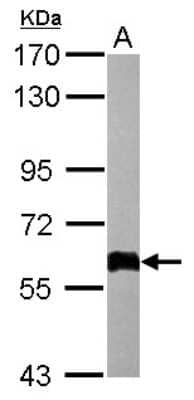
This product is intended for use as a positive control in Western Blot. Overexpression of the target protein was confirmed using an antibody to DDK (FLAG) epitope tag ( NBP1-71705) present on the protein construct. Each vial of cell lysate contains 100ug of total protein which should be sufficient for 20-50 reactions. Depending on over-expression level, antibody affinity and detection system, some lysates can go as low as 0.1 ug per load. We recommend starting with 5ug of cell lysate. Add an equal amount of cell lysate and 2X SDS Sample buffer and boil the SDS samples for 10 minutes before loading. |
| Theoretical MW |
32.9 kDa. Disclaimer note: The observed molecular weight of the protein may vary from the listed predicted molecular weight due to post translational modifications, post translation cleavages, relative charges, and other experimental factors. |
Packaging, Storage & Formulations
| Storage |
Store at -80C. Avoid freeze-thaw cycles. |
| Buffer |
RIPA buffer |
Lysate Details for Array
Notes
HEK293T cells in 10-cm dishes were transiently transfected with a non-lipid polymer transfection reagent specially designed and manufactured for large volume DNA transfection. Transfected cells were cultured for 48hrs before collection. The cells were lysed in modified RIPA buffer (25mM Tris-HCl pH7.6, 150mM NaCl, 1% NP-40, 1mM EDTA, 1xProteinase inhibitor cocktail mix, 1mM PMSF and 1mM Na3VO4, and then centrifuged to clarify the lysate. Protein concentration was measured by BCA protein assay kit.
Alternate Names for STARD10 Overexpression Lysate
Background
STARD10, STAR-related lipid transfer protein 10 or PCTP-like (33 kDa) is a transporter for lipids which specifically shuttles phosphatidylcholine and phosphatidylethanolamine between membranes. Mammalian STARD10 belongs to a family of fifteen START-domain proteins. In these family members, the carboxy terminal START-domain is conserved and functions in lipid binding or as a lipid sensing domain. The specificity for the type of lipid bound differs among family members (e.g., STARD1,3,5 binds Cholesterol, STARD5 binds 25-hydroxycholesterol, STARD2 binds phosphatidylcholine, and STARD11 binds ceramides). STARD proteins have been associated with various cellular processes such as lipid trafficking, lipid metabolism, and cell signaling (1, 2).
STARD10 is broadly expressed in different organs and tissues such as the brain, endocrine tissues, liver, and gastrointestinal tract. STARD10 is regulated by Casein kinase II, which phosphorylates STARD10 at serine 284 leading to decreased lipid transfer activity and reduced membrane association. STARD10 is overexpressed in breast carcinoma cell lines and in primary breast cancers (3). STARD10 has been implicated in the regulation of bile acid homeostasis and more recently in the regulation of insulin secretion from beta-cells (1, 2, 4).
References
1. Alpy, F., & Tomasetto, C. (2005). Give lipids a START: The StAR-related lipid transfer (START) domain in mammals. Journal of Cell Science. https://doi.org/10.1242/jcs.02485
2. Alpy, F., Legueux, F., Tomasetto, C., & Bianchetti, L. (2009). START domain-containing proteins: A review of their role in lipid transport and exchange. Medecine/Sciences. https://doi.org/10.1051/medsci/2009252181
3. Olayioye, M. A., Hoffmann, P., Pomorski, T., Armes, J., Simpson, R. J., Kemp, B. E., ... Visvader, J. E. (2004). The phosphoprotein StarD10 is overexpressed in breast cancer and cooperates with ErbB receptors in cellular transformation. Cancer Research. https://doi.org/10.1158/0008-5472.CAN-03-3731
4. Carrat, G. R., Hu, M., Nguyen-Tu, M. S., Chabosseau, P., Gaulton, K. J., van de Bunt, M., ... Rutter, G. A. (2017). Decreased STARD10 Expression Is Associated with Defective Insulin Secretion in Humans and Mice. American Journal of Human Genetics. https://doi.org/10.1016/j.ajhg.2017.01.011
Limitations
This product is for research use only and is not approved for use in humans or in clinical diagnosis. Lysates are
guaranteed for 6 months from date of receipt.
Customers Who Viewed This Item Also Viewed...
Species: Hu
Applications: BA
Species: Hu, Mu
Applications: ICC/IF, IHC, IHC-P, WB
Species: Hu
Applications: ELISA, KD, S-ELISA, WB
Species: Hu
Applications: IP, WB
Species: Hu, Mu
Applications: ICC/IF, IHC, IHC-P, WB
Species: Hu, Mu, Rt
Applications: Flow, ICC/IF, IHC, IHC-P, Simple Western, WB
Species: Hu
Applications: CyTOF-ready, Dual ISH-IHC, ELISA(Cap), ELISA(Det), ELISA(Sta), Flow, ICC, IHC, IP, Simple Western, WB
Species: Hu, Mu
Applications: ICC/IF, IHC, IHC-P, WB
Species: Hu
Applications: ICC/IF, IHC, IHC-P, WB
Species: Hu
Applications: WB
Species: Hu
Applications: ELISA, AP, PA, PAGE, WB
Species: Hu
Applications: ICC/IF, PEP-ELISA, WB
Species: Hu
Applications: ICC, IHC, Simple Western, WB
Species: Hu
Applications: ICC/IF, IHC, IHC-P
Species: Hu, Mu
Applications: ICC/IF, IHC, IHC-P, WB
Species: Hu, Mu, Rt
Applications: ELISA, IHC, IHC-P, WB
Publications for STARD10 Lysate (NBL1-16517) (0)
There are no publications for STARD10 Lysate (NBL1-16517).
By submitting your publication information earn gift cards and discounts for future purchases.
Reviews for STARD10 Lysate (NBL1-16517) (0)
There are no reviews for STARD10 Lysate (NBL1-16517).
By submitting a review you will receive an Amazon e-Gift Card or Novus Product Discount.
- Review with no image -- $10/€7/£6/$10 CAD/¥70 Yuan/¥1110 Yen
- Review with an image -- $25/€18/£15/$25 CAD/¥150 Yuan/¥2500 Yen
Product General Protocols
Find general support by application which include: protocols, troubleshooting, illustrated assays, videos and webinars.
Video Protocols
FAQs for STARD10 Lysate (NBL1-16517) (0)
Additional STARD10 Products
Blogs on STARD10