| Reactivity | CaSpecies Glossary |
| Applications | Bioactivity |
| Details of Functionality | Measured in a cell proliferation assay using TF‑1 human erythroleukemic cells. Kitamura, T. et al. (1989) J. Cell Physiol. 140:323. The ED50 for this effect is 0.75-3.75 ng/mL. |
| Source | E. coli-derived canine IL-13 protein Ser19-Arg131, with an N-terminal Met |
| Accession # | |
| N-terminal Sequence | Met |
| Protein/Peptide Type | Recombinant Proteins |
| Purity | >95%, by SDS-PAGE under reducing conditions and visualized by silver stain |
| Endotoxin Note | <0.10 EU per 1 μg of the protein by the LAL method. |
| Dilutions |
|
|
| Theoretical MW | 12.5 kDa. Disclaimer note: The observed molecular weight of the protein may vary from the listed predicted molecular weight due to post translational modifications, post translation cleavages, relative charges, and other experimental factors. |
|
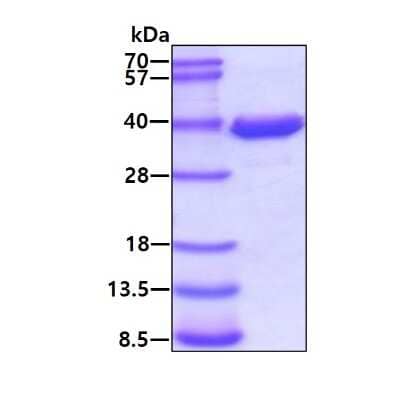
| SDS-PAGE | 10 kDa and 11 kDa, reducing conditions |
|
| Publications |
|
| Storage | Use a manual defrost freezer and avoid repeated freeze-thaw cycles.
|
| Buffer | Lyophilized from a 0.2 μm filtered solution in PBS with BSA as a carrier protein. |
| Purity | >95%, by SDS-PAGE under reducing conditions and visualized by silver stain |
| Reconstitution Instructions | Reconstitute at 100 μg/mL in PBS containing at least 0.1% human or bovine serum albumin. |
Interleukin-13 (IL-13) is a 17 kDa immunoregulatory cytokine that plays a key role in the pathogenesis of allergic asthma and atopy. It is secreted by Th1 and Th2 CD4+ T cells, NK cells, visceral smooth muscle cells, eosinophils, mast cells, and basophils (1 - 3). IL-13 circulates as a monomer with two internal disulfide bonds that contribute to a bundled four alpha -helix configuration (4, 5). Mature canine IL-13 shares 69%, 56%, and 55% amino acid sequence identity with human, mouse, and rat IL-13, respectively. Despite the low homology, it exhibits cross-species activity between human, mouse, and rat (6, 7). IL-13 has diverse activities on numerous cell types (8). On macrophages, IL-13 suppresses the production of proinflammatory cytokines and other cytotoxic substances. On B cells, IL-13 induces immunoglobulin class switching to IgE, upregulates the expression of MHC class II, CD71, CD72, and CD23, and costimulates proliferation. IL-13 upregulates IL-6 while downregulating IL-1 and TNF-alpha production by fibroblasts and endothelial cells. IL-13 binds with low affinity to IL-13 R alpha 1, triggering IL-13 R alpha 1 association with IL-4 R alpha . This high affinity receptor complex also functions as the type 2 IL-4 receptor complex (9, 10). Additionally, IL-13 binds with high affinity to IL-13 R alpha 2 which is expressed intracellularly, on the cell surface, and as a soluble molecule (11 - 14). IL-13 R alpha 2 regulates the bioavailability of both IL-13 and IL-4 and is overexpressed in glioma and several bronchial pathologies (10, 15, 16). Compared to wild type IL-13, the atopy-associated R110Q variant of IL-13 elicits increased responsiveness from eosinophils that express low levels of IL-13 R alpha 2 (17).



|
Signal Transducer and Activator of Transcription STAT6: More than a Player in Allergic Inflammation By Jamshed Arslan, Pharm. D., PhD. What is STAT6?The cellular pathway comprising tyrosine kinase Janus Kinase (JAK) and the transcription factor STAT connect extracellular signals from various cytokines, hormones an... Read full blog post. |
|
FLICE, FLICE, baby Cell death via apoptosis is a fundamental cellular function triggered by the cell death receptor family and their ligands which signal through downstream adaptor molecules and the caspase protease family. All caspases exist in a precursor form compose... Read full blog post. |
The concentration calculator allows you to quickly calculate the volume, mass or concentration of your vial. Simply enter your mass, volume, or concentration values for your reagent and the calculator will determine the rest.
| Uniprot |
|


![Bioactivity IL-4 [Unconjugated]](https://images.novusbio.com/images/protein/6507-ilcf_recombinant-human-il-4-cho-expressed-protein-cf-bioactivity-272020133214.jpg)
![N/A IL-5 [HRP]](https://images.novusbio.com/images/elisa/IL-5_M5000_ELISA_237.jpg)
![N/A IL-5 [HRP]](https://images.novusbio.com/images/elisa/DATA_IL5_M5000_ELISA_935.jpg)
![N/A IL-10 [Biotin]](https://images.novusbio.com/images/elisa/DATA_IL10_DY417_ELISA_2014.jpg)
![SDS-Page TNF-alpha [Unconjugated]](https://images.novusbio.com/images/protein/TNF-alpha_210-TA_256.jpg)
![Bioactivity TNF-alpha [Unconjugated]](https://images.novusbio.com/images/protein/TNFalpha_210TA_1658.jpg)
![SEC-MALS TNF-alpha [Unconjugated]](https://images.novusbio.com/images/210-ta_recombinant-human-tnf-alpha-protein-sec-mals-35202312244..jpg)
![SEC-MALS IFN-gamma [Unconjugated]](https://images.novusbio.com/images/485-mi_recombinant-mouse-ifn-gamma-protein-sec-mals-1612202583245.jpg)
![Bioactivity IFN-gamma [Unconjugated]](https://images.novusbio.com/images/protein/IFN-gamma_485-MI_455.jpg)
![SDS-Page IFN-gamma [Unconjugated]](https://images.novusbio.com/images/protein/IFN-gamma_485-MI_407.jpg)
![N/A IL-6 [HRP]](https://images.novusbio.com/images/elisa/DATA_IL6_M6000_ELISA_936.jpg)
![N/A IL-6 [HRP]](https://images.novusbio.com/images/elisa/IL-6_M6000_ELISA_415.jpg)
![N/A IL-6 [HRP]](https://images.novusbio.com/images/m6000b_mouse-il-6-quantikine-elisa-kit-1752025024034.jpg)
![Bioactivity IL-2 [Unconjugated]](https://images.novusbio.com/images/202-il_recombinant-human-il-2-protein-bioactivity-174202314946.jpg)


![N/A CCL11/Eotaxin [HRP]](https://images.novusbio.com/images/elisa/CCL11_MME00_ELISA_294.jpg)
![N/A CCL11/Eotaxin [HRP]](https://images.novusbio.com/images/elisa/DATA_CCL11_MME00_ELISA_1002.jpg)
![Flow Cytometry IL-13R alpha 1 Antibody [Unconjugated]](https://images.novusbio.com/images/antibody/IL-13_R_alpha_1_AF152_Flow_Cytometry_8155.jpg)
![Neutralization IL-13R alpha 1 Antibody [Unconjugated]](https://images.novusbio.com/images/antibody/IL-13_R_alpha_1_AF152_Block_Neutralize_337.jpg)
![Immunohistochemistry IL-13R alpha 1 Antibody [Unconjugated]](https://images.novusbio.com/images/antibody/af152_human-il-13-r-alpha-1-affinity-purified-polyclonal-ab-immunohistochemistry-2712023135520.jpg)
![Bioactivity CTLA-4 [Unconjugated]](https://images.novusbio.com/images/protein/CTLA4_7268CT_2293.jpg)
![N/A CCL2/JE/MCP-1 [HRP]](https://images.novusbio.com/images/elisa/CCL2_DCP00_ELISA_67.jpg)
![N/A CCL2/JE/MCP-1 [HRP]](https://images.novusbio.com/images/elisa/DATA_CCL2_DCP00_ELISA_633.jpg)
![N/A CCL2/JE/MCP-1 [HRP]](https://images.novusbio.com/images/elisa/DATA_CCL2_DCP00_ELISA_634.jpg)
![N/A IL-17/IL-17A [Biotin]](https://images.novusbio.com/images/elisa/DATA_IL17_DY421_ELISA_2448.jpg)
![Bioactivity GM-CSF [Unconjugated]](https://images.novusbio.com/images/protein/7954-gmcf_recombinant-human-gm-csf-cho-expressed-protein-cf-bioactivity-272020121514.jpg)