| Description | A recombinant protein antigen with a N-terminal His6-ABP tag corresponding to human RAD51. Source: E. coli Amino Acid Sequence: MAMQMQLEANADTSVEEESFGPQPISRLEQCGINANDVKKLEEAGFHTVEAVAYAPKKELINIKGISEAKA Fusion Tag: N-terminal His6ABP (ABP = Albumin Binding Protein derived from Streptococcal Protein G) This product is intended to be used as a blocking antigen for antibody competition assays. Any other use of this antigen is done at the risk of the user. The use of this product for commercial production is strictly prohibited. Please contact technical support if you have any questions. |
| Source | E. coli |
| Protein/Peptide Type | Recombinant Protein Antigen |
| Gene | RAD51 |
| Purity | >80% by SDS-PAGE and Coomassie blue staining |
| Dilutions |
|
| Application Notes | This recombinant antigen is only intended to be used as a blocking agent to confirm antibody specificity with the corresponding antibody, catalog number NBP2-32622. It is purified by IMAC chromatography, and the expected concentration is greater than 0.5 mg/ml. For current lot information, including availability, please contact our technical support team click nb-technical@bio-techne.com |
| Theoretical MW | 25 kDa. Disclaimer note: The observed molecular weight of the protein may vary from the listed predicted molecular weight due to post translational modifications, post translation cleavages, relative charges, and other experimental factors. |
| Storage | Store at -20C. Avoid freeze-thaw cycles. |
| Buffer | PBS and 1M Urea, pH 7.4. |
| Preservative | No Preservative |
| Purity | >80% by SDS-PAGE and Coomassie blue staining |


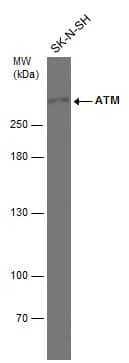


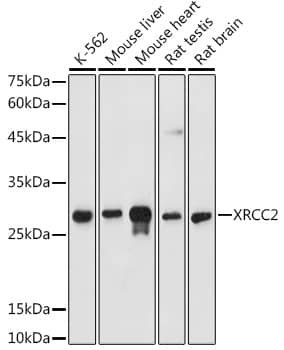
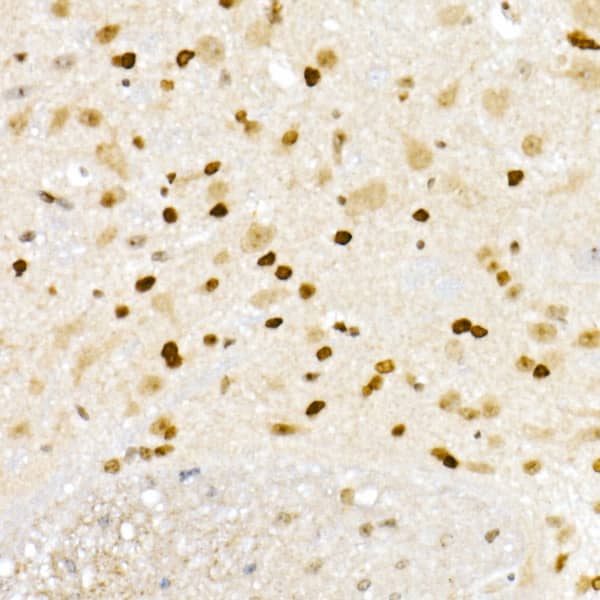
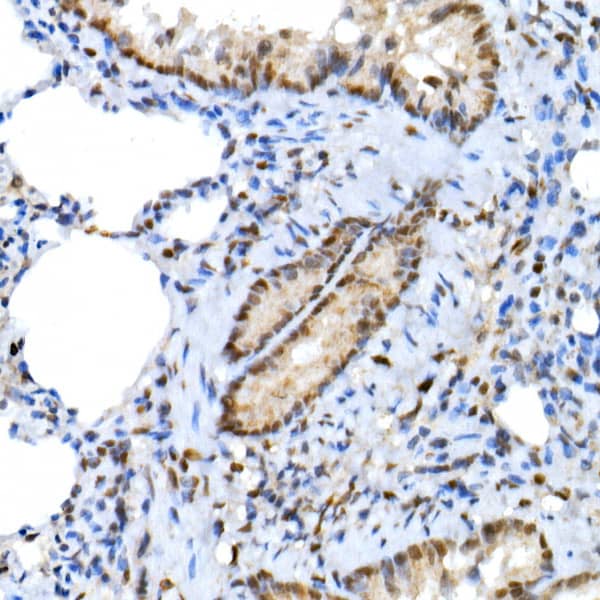
Research Areas for Rad51 Recombinant Protein Antigen (NBP2-32622PEP)Find related products by research area.
|
|
The recent relationship of BRCA1 and 53BP1 The p53-binding protein 1 (53BP1) is a DNA damage response factor, which is recruited to nuclear structures at the site of DNA damage. DNA double-strand breaks (DSBs) are mutations that are detrimental to cell viability and genome stability, and m... Read full blog post. |
|
RAD51: The cell's 'Mr. Fix-it' RAD51 is a recombinase protein encoded by RAD51 gene in humans. Human RAD51 family members are highly similar to bacterial RecA and yeast Rad51, both biochemically and structurally. It is a 339-amino acid protein that plays an important role in homolo... Read full blog post. |
|
NUP153 & 53BP1: A Novel DNA Repair Pathway Mediating DNA damage is a crucial process, and one of the most important cellular guards against cancer. In response to DNA damage, sophisticated cellular machinery is recruited to repair the breaks, and if it fails, the cell is committed to death. De... Read full blog post. |
|
Determining DMC1's role in Homologus Recombination The DMC1 gene encodes a 36.7 kDa nuclear protein involved in meiotic homologous recombination. This recombinase is functionally related to the yeast RAD51 and E. coli RecA genes. In contrast to RAD51, which functions in both mitotic and meiotic recomb... Read full blog post. |
|
Rad51 Antibody Reveals a Canine Model for Human Breast Cancer Our antibody catalog includes an extensive range of Rad51 antibody reagents. Encoded by the RAD51 gene, the Rad51 protein plays a vital role in DNA repair, interacting with several other proteins, including BRCA1 and BRCA2, to effect homologous recomb... Read full blog post. |
|
Industrial Chemicals, Tumour Suppressor Genes and the Need for More Research Human cancer research is the largest research area in our antibody database, with new oncogenes and cell lines being added all the time.Cancer triggers come from many sources, with a worrying amount of evidence to suggest that chemicals we’re in con... Read full blog post. |
The concentration calculator allows you to quickly calculate the volume, mass or concentration of your vial. Simply enter your mass, volume, or concentration values for your reagent and the calculator will determine the rest.
| Gene Symbol | RAD51 |


![Western Blot BRCA2 Antibody (234403) [Unconjugated]](https://images.novusbio.com/images/antibody/BRCA2_MAB2476_Western_Blot_6033.jpg)
![Immunohistochemistry BRCA2 Antibody (234403) [Unconjugated]](https://images.novusbio.com/images/antibody/mab2476_human-brca2-mab-clone-234403-immunohistochemistry-10520211657.jpg)


![Western Blot Plexin A1 Antibody [Unconjugated]](https://images.novusbio.com/images/antibody/Plexin_A1_AF4309_Western_Blot_9601.jpg)
![Immunocytochemistry Plexin A1 Antibody [Unconjugated]](https://images.novusbio.com/images/antibody/Plexin_A1_AF4309_Immunocytochemistry_11095.jpg)
![Immunohistochemistry Plexin A1 Antibody [Unconjugated]](https://images.novusbio.com/images/antibody/Plexin_A1_AF4309_Immunohistochemistry_10417.jpg)


