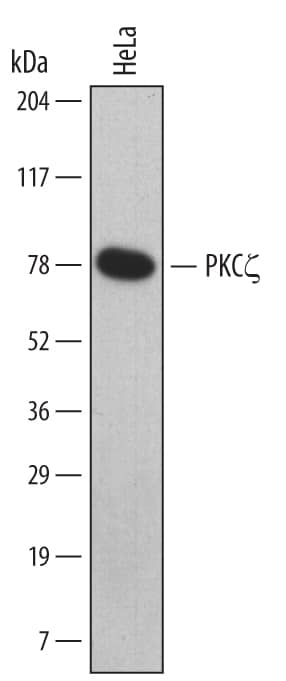
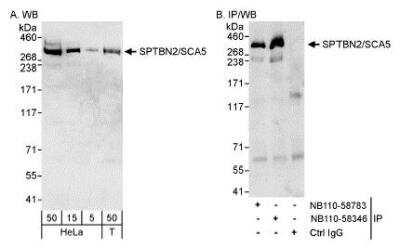
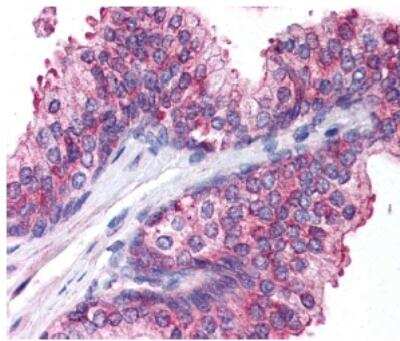
| Applications | WB |
| Clonality | Polyclonal |
| Host | Goat |
| Conjugate | Alexa Fluor 405 |
| Immunogen | E. coli-derived recombinant human PKC gamma Arg621-Met697 Accession # P05129 |
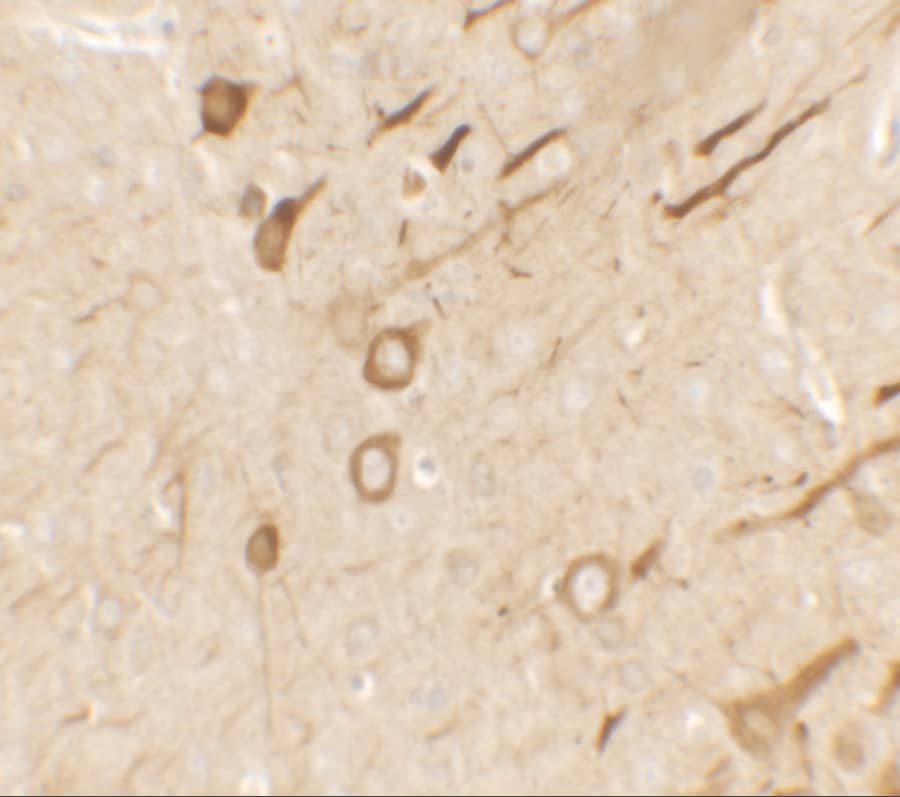
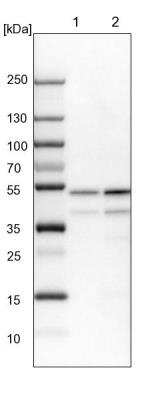
| Specificity | Detects endogenous human, mouse and rat PKC gamma in Western blots. |
| Source | N/A |
| Isotype | IgG |
| Clonality | Polyclonal |
| Host | Goat |
| Purity Statement | Antigen Affinity-purified |
| Innovator's Reward | Test in a species/application not listed above to receive a full credit towards a future purchase. |
| Storage | Protect from light. Do not freeze. 12 months from date of receipt, 2 to 8 °C as supplied |
| Buffer | Supplied 0.2 mg/mL in a saline solution containing BSA and Sodium Azide. |
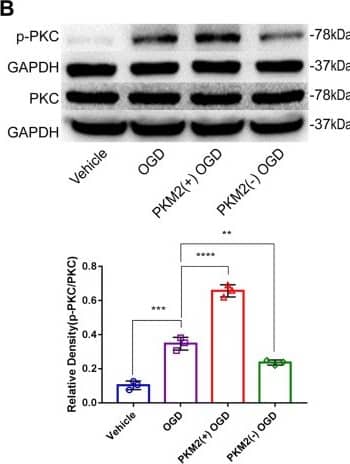
PKC gamma (protein kinase C-gamma) is a 78-80 kDa member of the PKC subfamily, AGC Ser/Thr protein kinase family of enzymes. It is a Ca++-activated and phospholipid-dependent neuronal enzyme that catalyzes the phosphorylation of multiple proteins. Human PKC gamma is 697 amino acids (aa) in length. It contains two general regions: a lipid and Ca++-binding regulatory region (aa 35‑150 and 170‑260, respectively), and an ATP-binding catalytic region (aa 351‑614). PDK1-mediated phosphorylation of PKC gamma on Thr514 activates the enzyme. In addition, oxidative stress also mediates activation by inducing interchain disulfide-bond homodimerization. Over aa 621‑697, human PKC gamma is 99% and 95% aa identical to mouse and canine PKC gamma , respectively. PKC gamma is predominantly expressed in brain tissue.





![PKC gamma Antibody [Alexa Fluor® 405]](/sites/all/modules/enterprise-tech/et_datasheets/images/novus_guarantee.png "PKC gamma Antibody [Alexa Fluor® 405]")
The concentration calculator allows you to quickly calculate the volume, mass or concentration of your vial. Simply enter your mass, volume, or concentration values for your reagent and the calculator will determine the rest.