 HAF005). A specific band was detected for Legumain/Asparaginyl Endopeptidase at approximately 37 kDa (as indicated). This experiment was conducted under reducing conditions and using Immunoblot Buffer Group 1." title="Western blot shows lysates of J774A.1 mouse reticulum cell sarcoma macrophage cell line. PVDF membrane was probed with 2 µg/mL of Rat Anti-Mouse Legumain/Asparaginyl Endopeptidase Monoclonal Antibody (Catalog # MAB2058) followed by HRP-conjugated Anti-Rat IgG Secondary Antibody (Catalog # HAF005). A specific band was detected for Legumain/Asparaginyl Endopeptidase at approximately 37 kDa (as indicated). This experiment was conducted under reducing conditions and using Immunoblot Buffer Group 1." />
| Reactivity | MuSpecies Glossary |
| Applications | WB |
| Clone | 301417 |
| Clonality | Monoclonal |
| Host | Rat |
| Conjugate | Unconjugated |
| Concentration | LYOPH |
| Immunogen | Mouse myeloma cell line NS0-derived recombinant mouse Legumain/Asparaginyl Endopeptidase Val18-Tyr435 Accession # O89017 |
| Specificity | Detects mouse Legumain/Asparaginyl Endopeptidase in direct ELISAs and Western blots. In Western blots, approximately 25% cross‑reactivity with recombinant human Legumain is observed. |
| Source | N/A |
| Isotype | IgG2a |
| Clonality | Monoclonal |
| Host | Rat |
| Gene | LGMN |
| Purity Statement | Protein A or G purified from hybridoma culture supernatant |
| Innovator's Reward | Test in a species/application not listed above to receive a full credit towards a future purchase. |
| Dilutions |
|
|
| Reviewed Applications |
|
|
| Publications |
|
| Storage | Use a manual defrost freezer and avoid repeated freeze-thaw cycles.
|
| Buffer | Lyophilized from a 0.2 μm filtered solution in PBS with Trehalose. *Small pack size (SP) is supplied either lyophilized or as a 0.2 µm filtered solution in PBS. |
| Preservative | No Preservative |
| Concentration | LYOPH |
| Reconstitution Instructions | Reconstitute at 0.5 mg/mL in sterile PBS. |
Legumain is a lysosomal cysteine protease found in all mouse tissues examined, but was particularly abundant in kidney and placenta (1). Legumain plays a pivotal role in the endosomal/lysosomal degradation system because the Legumain deficiency causes the accumulation of pro cathepsins B, H and L, another group of lysosomal cysteine proteases (2). Over-expression of Legumain in tumors is significant for invasion/metastasis (3). Also known as asparaginyl endopeptidase, it specifically cleaves peptide bonds with Asn at the P1 position. Nevertheless, it also cleaves peptide bonds with Asp at the P1 position. Auto-activation of pro Legumain involves both types of cleavage, which results in the removal of the pro peptides in both C- and N-termini (4). In addition, Legumain activates pro MMP‑2 and processes bacterial antigens for MHC class II presentation and pro thymosin alpha to thymosin alpha 1 and thymosin alpha 11, two acidic peptides with immunoregulatory properties (5‑7). Mouse Legumain is synthesized as a 435 amino acid precursor with a signal peptide (residues 1 to 17). The pro enzyme (residues 18 to 435) was expressed with an N-terminal His tag. The purified pro enzyme can be activated under the conditions as described above. Legumain activity can be inhibited by rmCystatin C and recombinant human cystatins C and E/M (R&D Systems, Catalog # 1238-PI, 1196-PI, and 1286-PI).


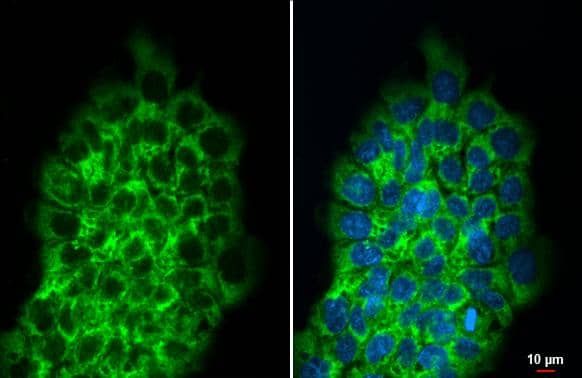
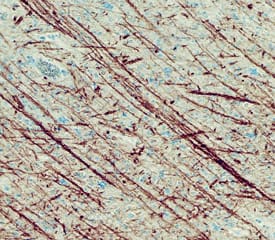
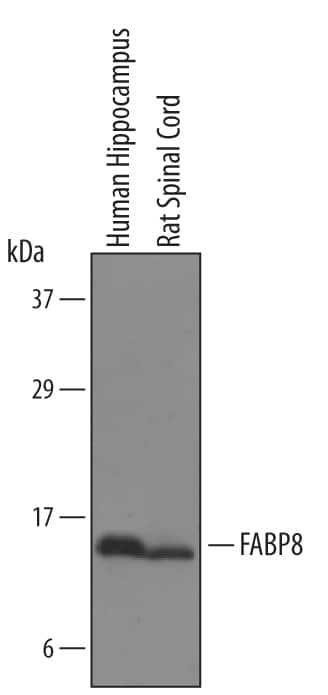
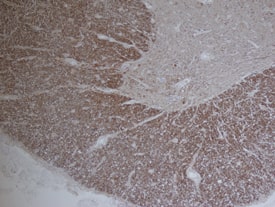




| Images | Ratings | Applications | Species | Date | Details | ||||||
|---|---|---|---|---|---|---|---|---|---|---|---|
|
reviewed by:
Verified Customer |
IF | Mouse | 02/16/2015 |
Summary
|
Secondary Antibodies |
Isotype Controls |
The concentration calculator allows you to quickly calculate the volume, mass or concentration of your vial. Simply enter your mass, volume, or concentration values for your reagent and the calculator will determine the rest.


![Immunohistochemistry Cathepsin B Antibody [Unconjugated]](https://images.novusbio.com/images/antibody/Cathepsin_B_AF965_Immunohistochemistry_6922.jpg)
![Immunocytochemistry/ Immunofluorescence Cathepsin B Antibody [Unconjugated]](https://images.novusbio.com/images/af965_mouse-cathepsin-b-affinity-purified-polyclonal-ab-8220249505955.jpg)
![Immunohistochemistry Cathepsin B Antibody [Unconjugated]](https://images.novusbio.com/images/af965_mouse-cathepsin-b-affinity-purified-polyclonal-ab-8220249505984.jpg)


![Western Blot Cystatin E/M/CST6 Antibody [Unconjugated]](https://images.novusbio.com/images/antibody/Cystatin_E_M_AF1286_Western_Blot_20495.jpg)
![Simple Western Cystatin E/M/CST6 Antibody [Unconjugated]](https://images.novusbio.com/images/antibody/Cystatin_E_M_AF1286_Simple_Western_20496.jpg)
![Western Blot Cystatin E/M/CST6 Antibody [Unconjugated]](https://images.novusbio.com/images/af1286_human-cystatin-e-m-affinity-purified-polyclonal-ab-812025548570.jpg)


![Flow Cytometry Neprilysin-2/MMEL1 Antibody [Unconjugated]](https://images.novusbio.com/images/antibody/af2340_human-neprilysin-2-mmel1-affinity-purified-polyclonal-ab-flow-cytometry-172202685327.jpg)
![Plexin B1 Antibody [Unconjugated]](/sites/all/modules/enterprise-tech/et_datasheets/images/novus_guarantee.png "Plexin B1 Antibody [Unconjugated]")

