| Applications | WB |
| Clonality | Polyclonal |
| Host | Sheep |
| Conjugate | Alexa Fluor 594 |
| Immunogen | Chinese hamster ovary cell line CHO-derived recombinant mouse Kynureninase Gly267-Ser464 Accession # Q9CXF0 |
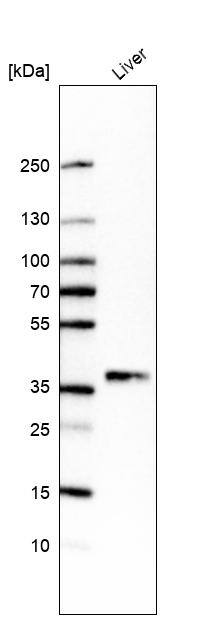
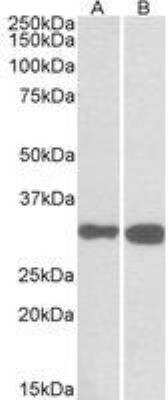
| Specificity | Detects mouse and rat Kynureninase in Western blots. Detects recombinant mouse Kynureninase in direct ELISAs. In direct ELISAs, less than 1% cross-reactivity with recombinant human Kynureninase is observed. |
| Isotype | IgG |
| Clonality | Polyclonal |
| Host | Sheep |
| Purity Statement | Antigen Affinity-purified |
| Innovator's Reward | Test in a species/application not listed above to receive a full credit towards a future purchase. |
| Storage | Protect from light. Do not freeze. 12 months from date of receipt, 2 to 8 °C as supplied |
| Buffer | Supplied 0.2 mg/mL in a saline solution containing BSA and Sodium Azide. |
Kynu (kyureninase (a hydrolase that acts on dog [Greek: kyon] urine [Greek: ouron]) is a 52-55 kDa member of the kyureninase family of enzymes. It is a pyridoxal phosphate-dependent cytosolic hydrolase that occurs in a variety of cell types, including hepatocytes and macrophages. Kynu participates in the metabolism of tryptophan. Dietary Trp is either incorporated into protein, or metabolized into niacin, serotonin or NAD. Kynu catalyzes one of two steps that lead to the formation of a key downstream intermediate called 3-hydroxyanthranilic acid. Mouse Kynu is 464 amino acids (aa) in length. It contains one large catalytic site (aa 24-462), and typically functions as a noncovalent homodimer. There are at least two potential isoform variants. One contains a three aa substitution for aa 425-464, while another possesses a 22 aa substitution for aa 302-464. Over aa267-464 mouse Kynu shares 91% and 80% aa sequence identity with rat and human Kynu, respectively.






![Kynureninase Antibody [Alexa Fluor® 594]](/sites/all/modules/enterprise-tech/et_datasheets/images/novus_guarantee.png "Kynureninase Antibody [Alexa Fluor® 594]")
The concentration calculator allows you to quickly calculate the volume, mass or concentration of your vial. Simply enter your mass, volume, or concentration values for your reagent and the calculator will determine the rest.







![SDS-Page TNF-alpha [Unconjugated]](https://images.novusbio.com/images/protein/TNF-alpha_210-TA_256.jpg)
![Bioactivity TNF-alpha [Unconjugated]](https://images.novusbio.com/images/protein/TNFalpha_210TA_1658.jpg)
![SEC-MALS TNF-alpha [Unconjugated]](https://images.novusbio.com/images/210-ta_recombinant-human-tnf-alpha-protein-sec-mals-35202312244..jpg)


![Bioactivity GM-CSF [Unconjugated]](https://images.novusbio.com/images/protein/7954-gmcf_recombinant-human-gm-csf-cho-expressed-protein-cf-bioactivity-272020121514.jpg)