| Reactivity | HuSpecies Glossary |
| Applications | ELISA |
| Conjugate | Biotin |
| Source | N/A |
| Assay Type | Solid Phase Sandwich ELISA |
| Inter-Assay | See PDF Datasheet for details |
| Intra-Assay | See PDF Datasheet for details |
| Spike Recovery | See PDF Datasheet for details |
| Sample Volume | See PDF Datasheet for details |
| Gene | PGR |
| Dilutions |
|
|
| Application Notes | No significant interference observed with available related molecules. |
|
| Publications |
|
| Storage | Store the unopened product at 2 - 8 °C. Do not use past expiration date. |
The progesterone Receptor (PR; NR3C3) is a member of the steroid receptor superfamily which binds progesterone. The progesterone receptor is expressed in uterus, ovary, vagina, fallopian tubes and breast. Progesterone receptors play a central role in diverse reproductive events associated with the establishment and maintenance of pregnancy, alveolar development in the breast, and sexual behavior. Two isoforms of the progesterone receptor have been identified, progesterone receptor-A (PR-A) and progesterone receptor-B (PR-B), 94 and 114 kDa in size, respectively.
The B progesterone receptor (PR-B), or long form, is 933 amino acids (aa) in length. Progesterone receptor-A (PR-A) utilizes a different start site that shortens the N-terminus by 164 amino acids. The N-terminus in both progesterone receptor isoforms is rich in serine that is phosphorylated in response to hormone binding. In the absence of progesterone, few receptor molecules are phosphorylated at Serine 190 (S190). Progesterone increases this number two-fold, providing evidence for hormone stimulation. It has been shown that the two progesterone receptor isoforms can form homodimers as well as heterodimers.


![Immunocytochemistry EGFR Antibody [Unconjugated]](https://images.novusbio.com/images/antibody/EGF_R_AF231_Immunocytochemistry__Immunofluorescence_21143.jpg)
![Flow Cytometry EGFR Antibody [Unconjugated]](https://images.novusbio.com/images/antibody/EGF_R_AF231_Flow_Cytometry_20401.jpg)
![Western Blot EGFR Antibody [Unconjugated]](https://images.novusbio.com/images/antibody/EGF_R_AF231_Western_Blot_19925.jpg)






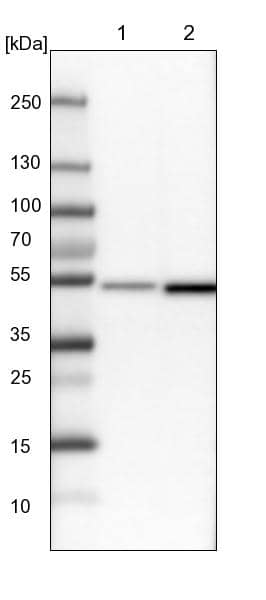


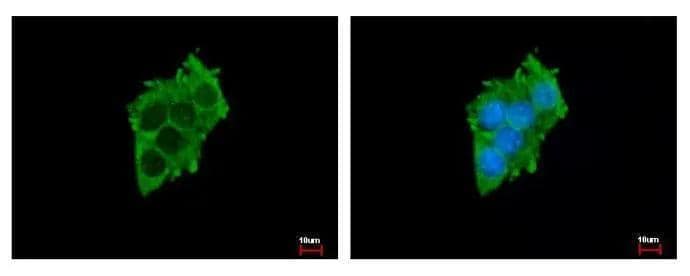
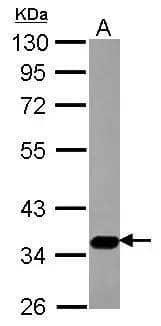
| Publication using DYC5415-2 | Applications | Species |
|---|---|---|
| José M Pingarrón Disposable Amperometric Immunosensor for the Determination of Human P53 Protein in Cell Lysates Using Magnetic Micro-Carriers Biosensors (Basel), 2016-11-21;6(4):. 2016-11-21 [PMID: 27879639] (Human) | Human |
| Gene Symbol | PGR |


![Bioactivity ErbB2/Her2 [Unconjugated]](https://images.novusbio.com/images/protein/1129-er_recombinant-human-erbb2-her2-fc-chimera-protein-cf-bioactivity-7122020142841.jpg)
![SDS-Page ErbB2/Her2 [Unconjugated]](https://images.novusbio.com/images/protein/ErbB2_1129-ER_70.jpg)
![Western Blot Androgen R/NR3C4 [p Ser213, p Ser210] Antibody (156C135.2) - BSA Free](https://images.novusbio.com/images/Androgen-R-NR3C4-p-Ser213-p-Ser210-Antibody-156C135-2-Western-Blot-NB100-56603-img0004.jpg)