Human CARD12 ELISA Kit (Colorimetric) Summary
| Description |
Assay Length: 3 h 30 min |
| Standard Curve Range |
78.13 - 5000 pg/mL |
| Sensitivity |
46.88 pg/mL |
| Assay Type |
Sandwich ELISA |
| Inter-Assay |
CV% < 10 |
| Intra-Assay |
CV% < 10 |
| Spike Recovery |
80 - 120% |
| Sample Volume |
100 uL |
| Kit Type |
ELISA Kit (Colorimetric) |
| Gene |
NLRC4 |
Applications/Dilutions
Packaging, Storage & Formulations
| Storage |
Storage of components varies. See protocol for specific instructions. |
Kit Components
|
Components
|
- Biotinylated Detection Ab Diluent
- Certificate of Analysis
- Concentrated Biotinylated Detection Ab (100x)
- Concentrated HRP Conjugate (100x)
- Concentrated Wash Buffer (25x)
- HRP Conjugate Diluent
- Micro ELISA Plate (Dismountable)
- Plate Sealer
- Product Description
- Reference Standard & Sample Diluent
- Reference Standard
- Stop Solution
- Substrate Reagent
|
Alternate Names for Human CARD12 ELISA Kit (Colorimetric)
Background
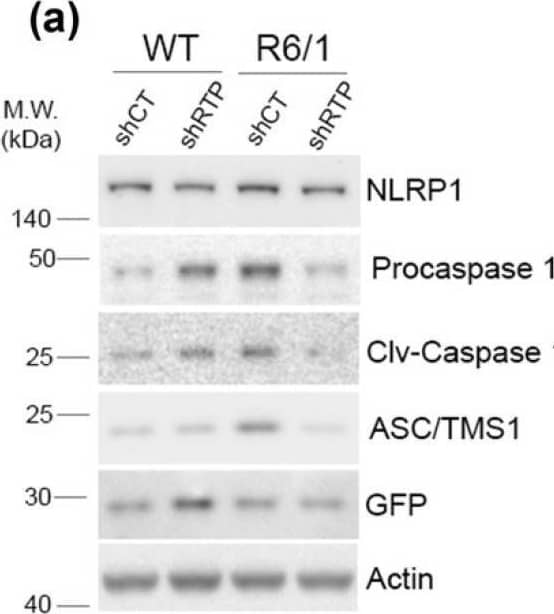
Ipaf (also known as Clan/CARD12) is a CARD domain containing protein. CARD (caspase-associated recruitment domain) proteins are key regulators of cell death, cell survival and cytokine production (reviewed in Damiano and Reed, 2004). In general CARD proteins are implicated in host defense against infection, environmental stress or cellular damage. CARD domains are found in the N-terminal pro-domains of certain caspases, a family of apoptotic and pro-inflammatory proteases, as well as in a diversity of other proteins including Ipaf/Clan/CARD12. CARD domains are homotypic protein interaction motifs that enable networks of proteins to communicate via CARD-CARD interactions. There are at least three major signaling pathways in which CARD proteins act: (1) Regulation of caspase activation in the context of apoptosis (2) Regulation of caspase activation in the context of inflammation (3) Regaultion of NF-kB activation in the context of innate or adaptive immune responses. As there is significant crosstalk between pathways that lead to caspase-mediated apoptosis or inflammation and pathways that result in NF-kB activation, it is logical that similar protein modules such as CARD domains are found repeatedly in proteins from all three pathways. Ipaf plays a role in regulating caspase-1 activity, which in turn mediates the maturation of inflammatory cytokines IL-1b and IL-18 (reviewed in Lu et al, 2005). In transfected cells, Ipaf has been shown to directly interact with procaspase-1 and induce proteolytic activation of procaspase-1 in transfected cells. On the flip side, macrophages from IPAF deficient mice failed to activate caspase-1 in response to Salmonella typhimurium infection underscoring the importance of IPAF in vivo. IPAF also interact with the pro-apoptotic adaptor protein ASC and co-expression of IPAF with ASC has been shown to induce NF-kB activation and apoptosis.
Limitations
This product is for research use only and is not approved for use in humans or in clinical diagnosis. ELISA Kits are
guaranteed for 6 months from date of receipt.
Customers Who Viewed This Item Also Viewed...
Species: Hu, Mu, Rt
Applications: Flow, ICC/IF, IHC, IHC-Fr, IHC-P, IM, IP, KD, WB
Species: Hu, Mu, Rt
Applications: ICC/IF, IHC, IHC-Fr, IHC-P, Simple Western, WB
Species: Mu
Applications: ELISA
Species: Hu, Mu, Rt
Applications: Flow-IC, Flow, ICC/IF, IHC, IHC-P, IM, IP, Simple Western, WB
Species: Hu
Applications: IHC, IHC-P
Species: Hu, Rt
Applications: ICC/IF, IHC, IHC-Fr, WB
Species: Hu
Applications: WB
Species: Hu, Mu
Applications: Flow-IC, Flow, ICC/IF, IHC, IHC-Fr, IHC-P, IP, WB
Species: Hu
Applications: WB
Species: Ca, Hu, Mu
Applications: DB, Flow-CS, Flow-IC, Flow, ICC/IF, IHC, IHC-Fr, IHC-P, IP, WB
Species: Hu
Applications: ICC/IF, IHC, IHC-P, IP, WB
Species: Hu
Applications: BA
Species: Hu
Applications: BA
Species: Hu
Applications: Flow, ICC/IF, PEP-ELISA
Species: Hu
Applications: ICC/IF, IHC, IHC-P, WB
Species: Hu
Applications: ELISA
Publications for CARD12 ELISA Kit (NBP3-49853) (0)
There are no publications for CARD12 ELISA Kit (NBP3-49853).
By submitting your publication information earn gift cards and discounts for future purchases.
Reviews for CARD12 ELISA Kit (NBP3-49853) (0)
There are no reviews for CARD12 ELISA Kit (NBP3-49853).
By submitting a review you will receive an Amazon e-Gift Card or Novus Product Discount.
- Review with no image -- $10/€7/£6/$10 CAD/¥70 Yuan/¥1110 Yen
- Review with an image -- $25/€18/£15/$25 CAD/¥150 Yuan/¥2500 Yen
Product General Protocols
Find general support by application which include: protocols, troubleshooting, illustrated assays, videos and webinars.
FAQs for CARD12 ELISA Kit (NBP3-49853). (Showing 1 - 1 of 1 FAQ).
-
What is the difference between the Quantikine and Duoset ELISA kits?
- Our Quantikine kits are fully optimized and validated for the sample types listed on the product specific webpage and datasheet, as this can vary between kits. Each kit is supplied ready to use with one pre-coated 96-well plate, a detection antibody directly conjugated to HRP, and all other necessary reagents. These kits are ideal for researchers who want the convenience of a ready to use and optimized ELISA product. Some of these kits are also available prepackaged in larger 6 and 50 plate sizes.Our DuoSet Kits, in contrast, are ELISA development kits containing the capture and detection antibody, the mass-value calibrated standard, and streptavidin-HRP to prepare approximately 5 or 15 plates. Ancillary reagents will need to be used/purchased, and for most kits, we will recommend one of our Ancillary Reagent Kits, which contain the reagents we use ourselves in-house. DuoSet kits are validated only for cell culture supernatant samples and therefore require further development and validation for accurate measurement in more complex samples such as serum and plasma. Our DuoSet Kits offer an economical, flexible alternative for the experienced ELISA user.