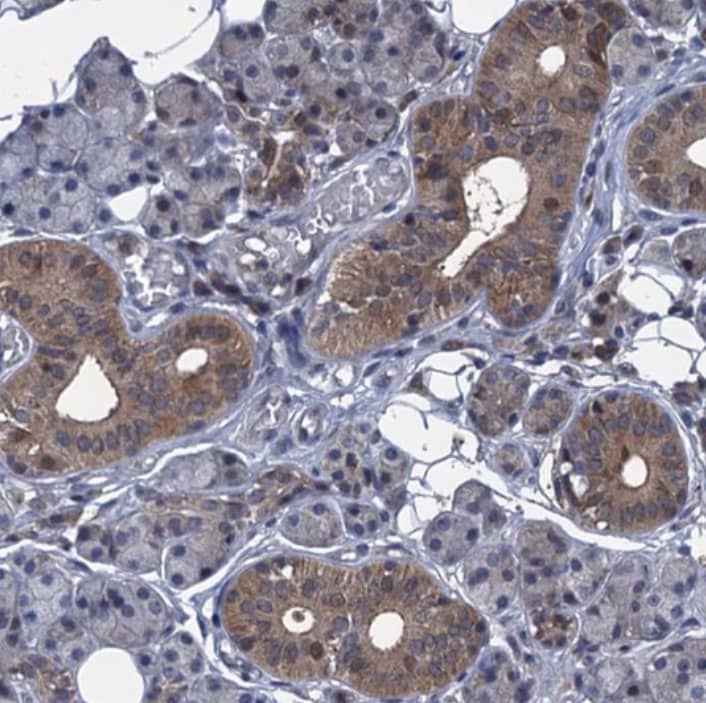
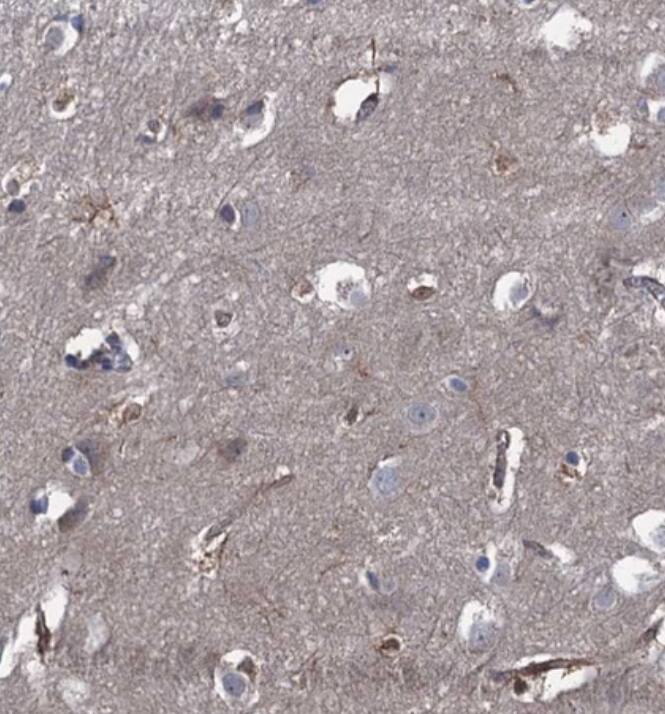
| Applications | WB |
| Clonality | Polyclonal |
| Host | Goat |
| Conjugate | Alexa Fluor 350 |
| Immunogen | Mouse myeloma cell line NS0-derived recombinant human SorCS3 Glu34-Ser1125 Accession # Q9UPU3 |
| Specificity | Detects human SorCS3 in direct ELISAs and Western blots. In direct ELISAs and Western blots, approximately 40% cross-reactivity with recombinant mouse SorCS3 is observed and 5% cross-reactivity with recombinant human SorCS1 is observed. |
| Isotype | IgG |
| Clonality | Polyclonal |
| Host | Goat |
| Purity Statement | Antigen Affinity-purified |
| Innovator's Reward | Test in a species/application not listed above to receive a full credit towards a future purchase. |
| Storage | Protect from light. Do not freeze. 12 months from date of receipt, 2 to 8 °C as supplied |
| Buffer | Supplied 0.2 mg/mL in a saline solution containing BSA and Sodium Azide. |
SorCS3 (sortilin-related YPS10 domain containing receptor 3) is a type I transmembrane receptor that belongs to the mammalian Vps10p (vacuolar protein-sorting 10 protein) family of sorting receptors. This family includes sortilin, SorLA, and three SorCS proteins (1, 2). It is synthesized as a 1222 amino acid (aa) preproform with a 33 aa signal sequence and a 100 aa propeptide. After proteolytic processing at a furin-type consensus sequence, mature SorCS3 is generated that is 100‑110 kDa in size and 1089 aa in length. It contains a 992 aa extracellular/lumenal domain (ECD), a 21 aa transmembrane segment and a 76 aa cytoplasmic domain. Human SorCS3 ECD shares 92%, 93%, 94% and 91% aa identity with mouse, rat, bovine and canine SorCS3 ECD, respectively. It also shares 70% and 46% aa identity with human SorCS1 and SorCS2 ECD, respectively. The ECD contains an imperfect leucine-rich repeat (LRR) and a Vps10p domain that binds both pro- and mature NGF (2, 3). The ECD may be shed constitutively, or up‑regulated when induced by phorbol esters (4). The metalloproteinase TACE/ADAM17 is known to cleave SorCS3 near the membrane (4). The shed ECD is able to bind PDGF-BB and the NGF propeptide (4, 5). The function of the SorCS3 propeptide is unknown. It does not block activity or influence protein processing in a manner analogous to the sortilin propeptide (3, 5). SorCS3 is predominantly expressed on the plasma membrane where it can be slowly internalized (3). Despite the presence of a sorting domain, there is no evidence for SorCS3-mediated intracellular trafficking activity (3). It is expressed in mouse embryonic and adult central nervous system in areas distinct from that of SorCS1 and SorCS2 (1). Neuronal activity up‑regulates SorCS3 expression in the mouse hippocampus (1).






![SorCS3 Antibody [Alexa Fluor® 350]](/sites/all/modules/enterprise-tech/et_datasheets/images/novus_guarantee.png "SorCS3 Antibody [Alexa Fluor® 350]")
The concentration calculator allows you to quickly calculate the volume, mass or concentration of your vial. Simply enter your mass, volume, or concentration values for your reagent and the calculator will determine the rest.


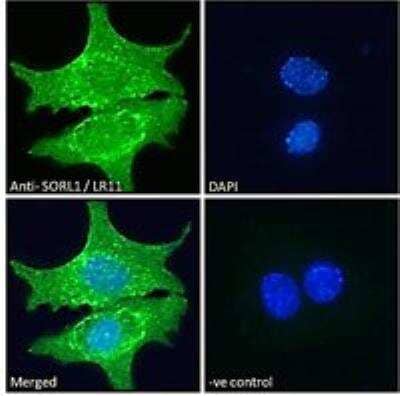


![Simple Western Sortilin Antibody [Unconjugated]](https://images.novusbio.com/images/antibody/Sortilin_AF2934_Simple_Western_20098.jpg)
![Western Blot Sortilin Antibody [Unconjugated]](https://images.novusbio.com/images/antibody/Sortilin_AF2934_Western_Blot_19100.jpg)
![Western Blot Sortilin Antibody [Unconjugated]](https://images.novusbio.com/images/af2934_mouse-sortilin-affinity-purified-polyclonal-ab-western-blot-12122025913309.jpg)
![Immunohistochemistry SorCS2 Antibody [Unconjugated]](https://images.novusbio.com/images/antibody/SorCS2_AF4237_Immunohistochemistry_7174.jpg)
![Immunohistochemistry SorCS2 Antibody [Unconjugated]](https://images.novusbio.com/images/antibody/SorCS2_AF4237_Immunohistochemistry_7175.jpg)
![N/A BDNF [HRP]](https://images.novusbio.com/images/elisa/BDNF_DBD00_ELISA_36.jpg)
![N/A BDNF [HRP]](https://images.novusbio.com/images/elisa/DATA_BDNF_DBD00_ELISA_587.jpg)
![N/A BDNF [HRP]](https://images.novusbio.com/images/elisa/DATA_BDNF_DBD00_ELISA_588.jpg)


![Immunohistochemistry TrkA Antibody [Unconjugated]](https://images.novusbio.com/images/antibody/TrkA_AF1056_Immunohistochemistry_6672.jpg)
![Immunohistochemistry TrkA Antibody [Unconjugated]](https://images.novusbio.com/images/af1056_rat-trka-affinity-purified-polyclonal-ab-44202415425059.jpg)
![Immunohistochemistry TrkA Antibody [Unconjugated]](https://images.novusbio.com/images/af1056_rat-trka-affinity-purified-polyclonal-ab-8220249503264.jpg)
![N/A TIMP-2 [HRP]](https://images.novusbio.com/images/elisa/DATA_TIMP2_DTM200_ELISA_848.jpg)
![N/A TIMP-2 [HRP]](https://images.novusbio.com/images/elisa/TIMP2_DTM200_ELISA_2722.jpg)
![N/A TIMP-2 [HRP]](https://images.novusbio.com/images/elisa/DATA_TIMP2_DTM200_ELISA_849.jpg)