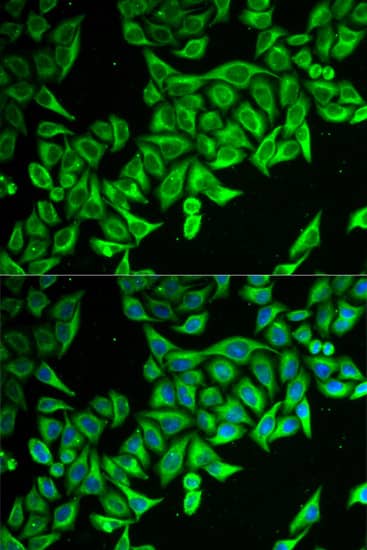
Recombinant Human PGLYRP1/PGRP-S Protein, CF

Images

 
When peptidoglycan is coated at 1 µg/mL, 100 µL/well, Recombinant Human PGLYRP1/PGRP-S binds with an ED50 of 0.75-4.5 ng/mL.

Product Details

Summary
Reactivity HuSpecies Glossary
Applications Bioactivity
Format
Carrier-Free

Order Details

View Available Formulations
Catalog# & Formulation Size Price

Recombinant Human PGLYRP1/PGRP-S Protein, CF Summary

Details of Functionality
Measured by its binding ability in a functional ELISA. When peptidoglycan is coated at 1 µg/mL (100 µL/well), the concentration of Recombinant Human PGLYRP1/PGRP-S that produces 50% optimal binding response is 0.75-4.5 ng/mL.
Source
Mouse myeloma cell line, NS0-derived human PGLYRP1/PGRP-S protein
Gln22-Pro196, with a C-terminal 6-His tag
Accession #
N-terminal Sequence
No results obtained. Gln22 predicted
Structure / Form
Disulfide-linked homodimer
Protein/Peptide Type
Recombinant Proteins
Gene
PGLYRP1
Purity
>95%, by SDS-PAGE visualized with Silver Staining and quantitative densitometry by Coomassie® Blue Staining
Endotoxin Note
<0.10 EU per 1 μg of the protein by the LAL method.

Applications/Dilutions

Dilutions
  • Bioactivity
Theoretical MW
20 kDa.
Disclaimer note: The observed molecular weight of the protein may vary from the listed predicted molecular weight due to post translational modifications, post translation cleavages, relative charges, and other experimental factors.
SDS-PAGE
23-27 kDa, reducing conditions
Publications
Read Publications using
2590-PGB in the following applications:

Packaging, Storage & Formulations

Storage
Use a manual defrost freezer and avoid repeated freeze-thaw cycles.
  • 12 months from date of receipt, -20 to -70 °C as supplied.
  • 1 month, 2 to 8 °C under sterile conditions after reconstitution.
  • 3 months, -20 to -70 °C under sterile conditions after reconstitution.
Buffer
Lyophilized from a 0.2 μm filtered solution in MOPS and NaCl.
Purity
>95%, by SDS-PAGE visualized with Silver Staining and quantitative densitometry by Coomassie® Blue Staining
Reconstitution Instructions
Reconstitute at 200 μg/mL in PBS.

Notes

This product is produced by and ships from R&D Systems, Inc., a Bio-Techne brand.

Alternate Names for Recombinant Human PGLYRP1/PGRP-S Protein, CF

  • peptidoglycan recognition protein 1
  • Peptidoglycan recognition protein short
  • PGLYRP
  • PGLYRP1
  • PGRPpeptidoglycan recognition protein
  • PGRPS
  • PGRP-S
  • PGRP-SMGC126894
  • PGRPSMGC126896
  • TAG7
  • TNF superfamily, member 3 (LTB)-like (peptidoglycan recognition protein)
  • TNFSF3L

Background

The human PGRP family is comprised of four peptidoglycan recognition proteins that may function as innate immunity pattern recognition molecules (1, 2). Termed PGRP-L, PGRP-I alpha , PGRP-I beta and PGRP-S, they are all products of separate genes, and all are named for the relative length of their translated product (3). PGRP-L (for long) is 576 amino acids (aa) in length, while PGRP-I alpha and I beta are (I) intermediate in length at 341 aa and 373 aa, respectively, and PGRP-S is the shortest at 196 aa in length (3, 4). All human PGRPs bind peptidoglycan and Gram-positive bacteria, and all have at least three C-terminal PGRP domains at variable sites that are highly conserved from insects to mammals (3). Human PGRP-S, the first described member of the family, is a 28 kDa secreted glycoprotein associated with neutrophils (4). The mature molecule is 175 aa in length and contains three variably-sized peptide-carbohydrate recognition sequences of 15 aa, 29 aa and 49 aa, respectively. Human PGRP-S is 72%, 71% and 70% aa identical to mouse, bovine and rat mature PGRP-S, respectively. Studies with PGRP-S deficient mice indicate that knock-out mice have increased susceptibility to infections with non-pathogenic bacteria. Neutrophils from knock-out mice exhibit normal phagocytosis of bacteria but are defective in intracellular killing and digestion of nonpathogenic bacteria (5). The longer three PGRP members are all membrane-bound molecules that contain two membrane-spanning segments. Both the N- and C-termini are depicted as being extracellular with a joining cytoplasmic domain. All three transmembrane forms show at least one PGRP domain on the C-terminal extracellular region; other PGRP domains are variably distributed over their two extracellular and one cytoplasmic region (3).
  1. Girardin, S.E. and D.J. Philpott (2004) Eur. J. Immunol. 34:1777.
  2. Steiner, H. (2004) Immunol. Rev. 198:83.
  3. Liu, C. et al. (2001) J. Biol. Chem. 276:34686.
  4. Kang, D. et al. (1998) Proc. Natl. Acad. Sci. USA 95:10078.
  5. Dziarski, R. et al. (2003) Blood 102:689.

Customers Who Viewed This Item Also Viewed...

NBP2-01860
Species: Ca, Hu, Pm, Mu, Rt
Applications: Flow, ICC/IF, IHC,  IHC-P, WB
NBP2-49690
Species: Hu, Mu
Applications: ICC/IF, WB
NB100-56566
Species: Bv, Hu, Ma, Mu, Po, Rt
Applications: B/N, ChIP, CyTOF-ready, DB, Dual ISH-IHC, ELISA(Cap), ELISA, Flow-CS, Flow-IC, Flow, ICC/IF, IHC, IHC-Fr,  IHC-P, In vitro, KD, KO, PAGE, Simple Western, WB
NB100-56729
Species: Hu
Applications: Flow-CS, Flow-IC, Flow, ICC/IF, WB
NBP1-81696
Species: Hu, Mu, Rt
Applications: ICC/IF, IHC,  IHC-P, WB
NBP2-61118
Species: Hu, Mu
Applications: Flow, ICC/IF, IHC,  IHC-P, Simple Western, WB
NB100-56721
Species: Hu
Applications: Flow-CS, Flow-IC, ICC/IF, WB
NB100-56722
Species: Ca, Hu, Mu, Rb, Rt
Applications: B/N, DB, ELISA, Flow-CS, Flow, Func, ICC/IF, IP, In vitro, WB
H00006275-M01
Species: Hu, Mu
Applications: ELISA, ICC/IF, IHC, WB
NB100-524
Species: Hu, Mu
Applications: Flow-IC, Flow, ICC/IF, IHC, IHC-Fr,  IHC-P, IP, WB
M6000B
Species: Mu
Applications: ELISA
NBP2-33680
Species: Hu
Applications: IHC,  IHC-P
NBP2-92897
Species: Hu, Mu, Rt
Applications: ICC/IF, IHC,  IHC-P, WB
NB100-56152
Species: Hu
Applications: ICC/IF, IHC,  IHC-P, IP, WB
NBP1-91684
Species: Hu, Mu, Rt
Applications: IHC,  IHC-P, WB
NB100-56583
Species: Hu, Rb, Rt
Applications: Flow, IHC,  IHC-P, KO, Simple Western, WB
NBP2-01168
Species: Hu, Pm, Mu, Rt
Applications: Flow, IHC,  IHC-P, WB

Publications for PGLYRP1/PGRP-S (2590-PGB)(5)

We have publications tested in 4 confirmed species: Human, Mouse, Borrelia burgdorferi (Lyme Disease), N/A.

We have publications tested in 4 applications: Bioassay, ICC, Immunoassay Development, Surface Plasmon Resonance.


Filter By Application
Bioassay
(2)
ICC
(1)
Immunoassay Development
(1)
Surface Plasmon Resonance
(1)
All Applications
Filter By Species
Human
(2)
Mouse
(1)
Borrelia burgdorferi (Lyme Disease)
(1)
N/A
(1)
All Species
Showing Publications 1 - 5 of 5.
Publications using 2590-PGB Applications Species
Chen, S;Putnik, R;Li, X;Diwaker, A;Vasconcelos, M;Liu, S;Gondi, S;Zhou, J;Guo, L;Xu, L;Temme, S;Bersch, K;Hyland, S;Yin, J;Burstein, E;Bahnson, BJ;Gildersleeve, JC;Grimes, CL;Reinecker, HC; PGLYRP1-mediated intracellular peptidoglycan detection promotes intestinal mucosal protection Nature communications 2025-02-21 [PMID: 39984444] (Bioassay, Mouse) Bioassay Mouse
Reinecker, HC;Chen, S;Putnik, R;Li, X;Diwaker, A;Vasconcelos, M;Liu, S;Zhou, J;Guo, L;Xu, L;Temme, JS;Bersch, K;Hyland, S;Yin, J;Burstein, E;Gildersleeve, J;Grimes, C; PGLYRP-1 mediated intracellular peptidoglycan detection promotes mucosal protection Research square 2024-10-14 [PMID: 39483916] (Immunoassay Development, N/A) Immunoassay Development N/A
Giraud, J;Chalopin, D;Ramel, E;Boyer, T;Zouine, A;Derieppe, MA;Larmonier, N;Adotevi, O;Le Bail, B;Blanc, JF;Laurent, C;Chiche, L;Derive, M;Nikolski, M;Saleh, M; THBS1+ myeloid cells expand in SLD hepatocellular carcinoma and contribute to immunosuppression and unfavorable prognosis through TREM1 Cell reports 2024-02-12 [PMID: 38350444] (Bioassay, Human) Bioassay Human
A Gupta, G Arora, CE Rosen, Z Kloos, Y Cao, J Cerny, A Sajid, D Hoornstra, M Golovchenk, N Rudenko, U Munderloh, JW Hovius, CJ Booth, C Jacobs-Wag, NW Palm, AM Ring, E Fikrig A human secretome library screen reveals a role for Peptidoglycan Recognition Protein 1 in Lyme borreliosis PLoS Pathog, 2020-11-11;16(11):e1009030. 2020-11-11 [PMID: 33175909] (ICC, Borrelia burgdorferi (Lyme Disease)) ICC Borrelia burgdorferi (Lyme Disease)
Read C, Kuijper J, Hjorth S, Heipel M, Tang X, Fleetwood A, Dantzler J, Grell S, Kastrup J, Wang C, Brandt C, Hansen A, Wagtmann N, Xu W, Stennicke V Cutting Edge: identification of neutrophil PGLYRP1 as a ligand for TREM-1. J Immunol, 2015-01-16;194(4):1417-21. 2015-01-16 [PMID: 25595774] (Surface Plasmon Resonance, Human) Surface Plasmon Resonance Human

Reviews for PGLYRP1/PGRP-S (2590-PGB) (0)

There are no reviews for PGLYRP1/PGRP-S (2590-PGB). By submitting a review you will receive an Amazon e-Gift Card or Novus Product Discount.
  • Review with no image -- $10/€7/£6/$10 CAD/¥70 Yuan/¥1110 Yen
  • Review with an image -- $25/€18/£15/$25 CAD/¥150 Yuan/¥2500 Yen

FAQs for PGLYRP1/PGRP-S (2590-PGB) (0)

There are no specific FAQs related to this product. Read our general customer & technical service FAQs.

Additional PGLYRP1/PGRP-S Products

Blogs on PGLYRP1/PGRP-S

There are no specific blogs for PGLYRP1/PGRP-S, but you can read our latest blog posts.

Customers Who Bought This Also Bought

Contact Information

Product PDFs

Calculators

Concentration Calculator

The concentration calculator allows you to quickly calculate the volume, mass or concentration of your vial. Simply enter your mass, volume, or concentration values for your reagent and the calculator will determine the rest.

=
÷

Review this Product

Be the first to review our Recombinant Human PGLYRP1/PGRP-S Protein, CF and receive a gift card or discount.

Bioinformatics

Gene Symbol PGLYRP1
Uniprot