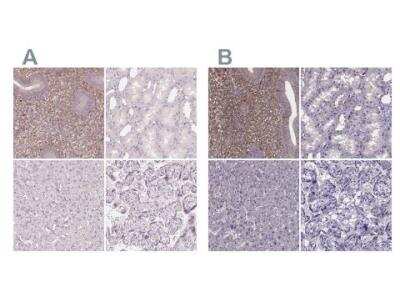
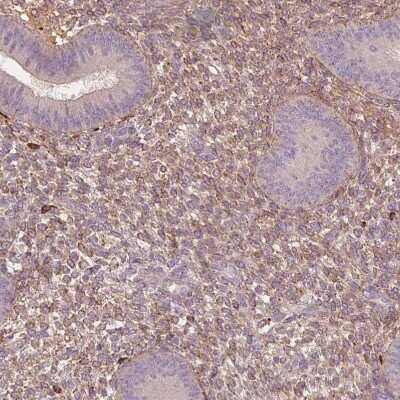
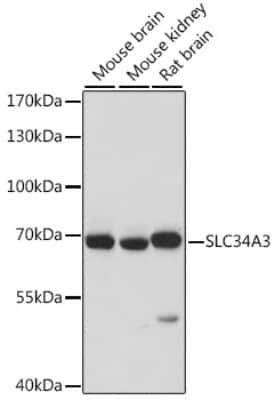
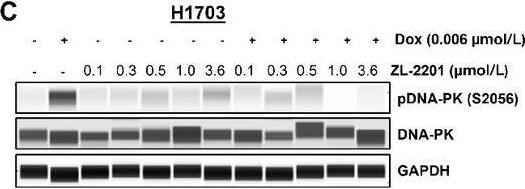
HAF019). A specific band was detected for FGF-23 at approximately 35 kDa (as indicated). This experiment was conducted under reducing conditions and using Immunoblot Buffer Group 8." title="Western blot shows lysates of bEnd.3 mouse endothelioma cell line and mouse thymus tissue. PVDF membrane was probed with 1 µg/mL of Mouse FGF-23 Antigen Affinity-purified Polyclonal Antibody (Catalog # AF2629) followed by HRP-conjugated Anti-Goat IgG Secondary Antibody (Catalog # HAF019). A specific band was detected for FGF-23 at approximately 35 kDa (as indicated). This experiment was conducted under reducing conditions and using Immunoblot Buffer Group 8." />
| Reactivity | MuSpecies Glossary |
| Applications | WB |
| Clonality | Polyclonal |
| Host | Goat |
| Conjugate | Unconjugated |
| Concentration | LYOPH |
| Immunogen | Mouse myeloma cell line NS0-derived recombinant mouse FGF-23 Tyr25-Val251 Accession # Q9EPC2 |
| Specificity | Detects mouse FGF-23 in direct ELISAs and Western blots. In direct ELISAs, approximately 30% cross-reactivity with recombinant human FGF-23 is observed and less than 1% cross-reactivity with recombinant mouse (rm) FGF-21 and rmFGF-1 is observed. |
| Source | N/A |
| Isotype | IgG |
| Clonality | Polyclonal |
| Host | Goat |
| Gene | Fgf23 |
| Purity Statement | Antigen Affinity-purified |
| Innovator's Reward | Test in a species/application not listed above to receive a full credit towards a future purchase. |
| Storage | Use a manual defrost freezer and avoid repeated freeze-thaw cycles.
|
| Buffer | Lyophilized from a 0.2 μm filtered solution in PBS with Trehalose. *Small pack size (SP) is supplied either lyophilized or as a 0.2 µm filtered solution in PBS. |
| Preservative | No Preservative |
| Concentration | LYOPH |
| Reconstitution Instructions | Reconstitute at 0.2 mg/mL in sterile PBS. |
Fibroblast growth factor 23 (FGF-23) is a 30‑32 kDa member of the FGF gene family. Based on its structure, it is further classified as an FGF19 subfamily member. This subfamily includes FGF-19, -21, and -23. Like all other FGF subfamilies, FGF-19 subfamily members contain a 120 amino acid (aa) core FGF domain that exhibits a beta -trefoil structure (1, 2). Unlike other FGF subfamilies, FGF-19 subfamily members exist as highly diffusible molecules that is attributed to poor ECM/heparin sulfate binding (3, 4, 5, 6). The cDNA for mouse FGF-23 predicts a 251 aa polypeptide that contains a 24 aa signal sequence and a 227 aa mature region (7). Mature mouse FGF-23 shows 72% aa identity to human FGF-23 (8). The FGF‑19 subfamily shares an unusual receptor configuration. The standard model for FGF signaling requires an FGF:FGFR:heparin sulfate complex. Given FGF-23’s minimal association with heparin, a substitute termed ( alpha -) Klotho has evolved that serves the same function. Although FGF-23 binds to the widely expressed “c” isoforms of FGFR1 and 3 plus FGFR4, Klotho has a restricted distribution that limits FGF-23 activity (10, 11, 12). It should be noted that heparin-dependency has been reported for FGF‑19 signaling, and this observation may extend to FGF-23 (13). The FGF‑19 subfamily is considered endocrine in nature. All three subfamily members impact some aspect of metabolism and all three are induced by a nuclear receptor heterodimer that includes the retinoid X receptor (14, 15, 16). FGF-23 is considered a phosphatonin; that is, a molecule that reduces circulating plasma phosphate. It is produced by osteocytes and osteoblasts in response to high circulating phosphate levels, elevated parathyroid hormone that induces hypercalcemia, and circulatory volume loading. Upon binding to FGF-23 receptors on renal proximal tubular epithelium, two basic changes are seen. First, the enzyme responsible for generating the active form of vitamin D is suppressed, resulting in decreased levels of bioactive vitamin D. Since vitamin D promotes intestinal phosphate absorption, plasma phosphate declines. Second, the transporters responsible for phosphate resorption on renal epithelium are down regulated, resulting in decreased uptake from urine and again a decline in blood phosphorus (17, 18).








Secondary Antibodies |
Isotype Controls |
The concentration calculator allows you to quickly calculate the volume, mass or concentration of your vial. Simply enter your mass, volume, or concentration values for your reagent and the calculator will determine the rest.


![Immunohistochemistry Klotho Antibody [Unconjugated]](https://images.novusbio.com/images/antibody/Klotho_AF1819_Immunohistochemistry_6720.jpg)
![Western Blot Klotho Antibody [Unconjugated]](https://images.novusbio.com/images/antibody/Klotho_AF1819_Western_Blot_22658.jpg)
![ELISA Klotho Antibody [Unconjugated]](https://images.novusbio.com/images/antibody/Klotho_AF1819_ELISA_22841.jpg)
![Immunohistochemistry DMP-1 Antibody [Unconjugated]](https://images.novusbio.com/images/antibody/DMP-1_AF4386_Immunohistochemistry_6833.jpg)
![Immunohistochemistry DMP-1 Antibody [Unconjugated]](https://images.novusbio.com/images/af4386_mouse-dmp-1-affinity-purified-polyclonal-ab-4120241240226.jpg)


![Immunohistochemistry Serpin A3N Antibody [Unconjugated]](https://images.novusbio.com/images/antibody/af4709_mouse-serpin-a3n-affinity-purified-polyclonal-ab-immunohistochemistry-2362025152035.png)
![Western Blot Serpin A3N Antibody [Unconjugated]](https://images.novusbio.com/images/af4709_mouse-serpin-a3n-affinity-purified-polyclonal-ab-western-blot-121220259313311.jpg)