Can't find what you are looking for? Use our Antibody Concierge Service & we will help you locate your antibody!
Or feel free to contact us for alternative products.
Datasheet
Reviews & Publications
Protocols & FAQs
Support & Research
Cytokeratin, pan Antibody (Lu-5) Summary
Immunogen
Lung cancer cell line.
Localization
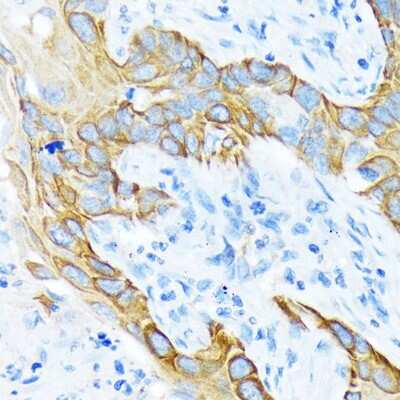
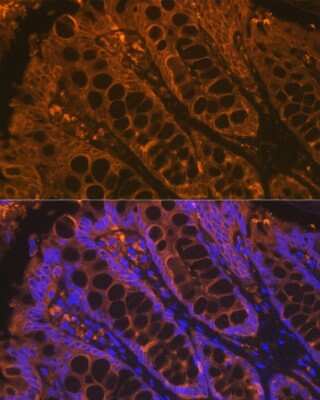
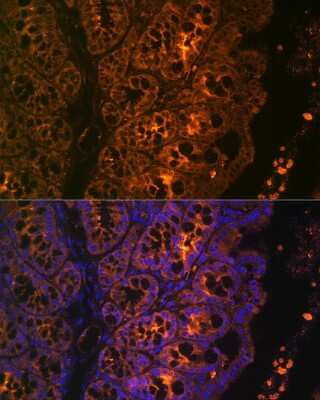
Cytoplasmic
Marker
Epithelial marker
Specificity
This reacts with cytokeratins of acidic as well as basic subfamilies, i.e. 1,2,3,4,5,6,7,8,10,12,13,14,15,16,17,18 and 19. It reacts with keratinized and corneal epidermis, stratified epithelia, hyperproliferative keratinocytes and simple epithelia. This antibody is a broad spectrum anti-pan cytokeratin antibody, which differentiates epithelial from non-epithelial tumors
Isotype
IgG1
Clonality
Monoclonal
Host
Mouse
Gene
KRT1
Purity
Protein A or G purified
Innovator's Reward
Test in a species/application not listed above to receive a full credit towards a future purchase.
IHC-P: 1/50 - 1/75 in an ABC method, we suggest an incubation period of 30 minutes at room temperature. Perform enzymatic antigen retrieval before commencing with IHC staining protocol.Not tested in other applications.Optimal dilutions/concentrations should be determined by the end user.
Publications
Read Publication using NB120-17155 in the following applications:
Cross-reacts with Human, Rat, Cow, Chicken, Frog and Snake.Not yet tested in other species.
Packaging, Storage & Formulations
Storage
Store at 4C short term. Aliquot and store at -20C long term. Avoid freeze-thaw cycles.
Buffer
PBS
Preservative
Sodium Azide
Purity
Protein A or G purified
Alternate Names for Cytokeratin, pan Antibody (Lu-5)
AEI2
CK1
CK10
CK13
CK14
CK15
CK16
CK-17
CK-18
CK19
CK20
CK-2e
CK3
CK4
CK5
CK6A
CK8
CK-9
Cytokeratin, pan
EHK
EPPK
K1
K12
KRT1
KRT10
KRT12
KRT13
KRT14
KRT15
KRT16
KRT17
KRT18
KRT19
KRT1A
KRT2
KRT20
KRT3
KRT4
krt5
KRT6A
KRT8
KRT9
NEPPK
panck
Background
Cytokeratins are a family of intermediate filamentous proteins that are expressed by epithelial cells (1,2). Cytokeratins range in size with a theoretic molecular weight varying from approximately 40 kDa to 68 kDa (2,3). The cytokeratin family consists of 20 polypeptides that are further divided into two main groups based on isoelectric point and molecular weight (1-3). The type I group are smaller, acidic polypeptides designated as cytokeratin 9 through cytokeratin 20 (CK9 - CK20) (1-4). Conversely, CK1 - CK8 belong to the type II group, classified as larger, basic or neutral polypeptides (1-4). Structurally, cytokeratins have homologous basic structure with other intermediate filaments; they possess a 300-315 amino acid (aa) central helical region that consists of four conserved domains (1A, 2A, 1B, and 2B) which are separated by linker domains (L1, L12, and L2) (1,5). Additionally, flanking this central region, both the amino- and carboxyl-terminal ends have a homologous subdomain (H), a variable domain (V), and charged end subdomains (E) (1). Furthermore, the central rod of one cytokeratin monomer binds with another monomer to form a coiled-coil dimer which subsequently binds another dimer to form a tertramer (3). Finally, many tetramers join together to ultimately form an intermediate filament of approximately 10nm in diameter (1-3, 5). Cytokeratins are expressed as pairs, typically with a type I and type II member; for example, CK10 pairs with CK1 (1,3).
Epithelial cells express multiple subtypes of cytokeratins which can be used to classify epithelial cell type or differentiation status, as well tumor progression or diagnosis (2). Cytokeratins are important for both stability and integrity of epithelial cells and function in intracellular signaling, from wound healing to apoptosis (1). Cytokeratins are useful immunohistochemistry tumor markers and antibodies to cytokeratins are a common pathological tool (1,3,6). Cytokeratin pan antibody is an antibody cocktail mixture that can detect multiple cytokeratins and reacts to multiple epithelial tissues (1,3,6). For example, AE-1/AE-3 is a commonly used specific pan cytokeratin that detects cytokeratins 1-8, 10, 14-16 and 19 (1,3,6).
Given the role of cytokeratins in the structural integrity of epithelial cells, mutations in cytokeratins have been shown to play a role in a variety of human diseases including epidermolysis bullosa simplex (EBS) (4,5). EBS is an autosomal dominant disorder that is caused by missense mutations in either CK5 or CK14 (5). Other known cytokeratin-related disorders include bullous ichthyosis, a skin disorder characterized by redness, blistering, and hyperkeratosis, and epidermolytic palmoplantar keratoderma (EPPK), which results in hyperkeratosis on the palms and soles of the body (7).
References
1. Awasthi, P., Thahriani, A., Bhattacharya, A., Awasthi, P., & Keratins, B. A. (2016). Keratins or cytokeratins: a review article. Journal of Advanced Medical and Dental Sciences Research. https://10.21276/jamdsr.2016.4.4.30
2. Southgate, J., Harnden, P., & Trejdosiewicz, L. K. (1999). Cytokeratin expression patterns in normal and malignant urothelium: a review of the biological and diagnostic implications. Histology and histopathology. https://doi.org/10.14670/HH-14.657
3. Belaldavar, C., Mane, D. R., Hallikerimath, S., Kale, A. D. (2016). Cytokeratins: Its role and expression profile in oral health and disease. Journal of Oral and Maxillofacial Surgery, Medicine, and Pathology. https://doi.org/10.1016/j.ajoms.2015.08.001.
4. Linder S. (2007). Cytokeratin markers come of age. Tumour biology : the journal of the International Society for Oncodevelopmental Biology and Medicine. https://doi.org/10.1159/000107582
5. Jacob, J. T., Coulombe, P. A., Kwan, R., & Omary, M. B. (2018). Types I and II Keratin Intermediate Filaments. Cold Spring Harbor perspectives in biology. https://doi.org/10.1101/cshperspect.a018275
6. Ordonez N. G. (2013). Broad-spectrum immunohistochemical epithelial markers: a review. Human pathology. https://doi.org/10.1016/j.humpath.2012.11.016
7. McLean, W. H., & Moore, C. B. (2011). Keratin disorders: from gene to therapy. Human molecular genetics. https://doi.org/10.1093/hmg/ddr379
Limitations
This product is for research use only and is not approved for use in humans or in clinical diagnosis. Primary Antibodies are guaranteed for 1 year from date of receipt.
Reviews for Cytokeratin, pan Antibody (NB120-17155) (0)
There are no reviews for Cytokeratin, pan Antibody (NB120-17155).
By submitting a review you will receive an Amazon e-Gift Card or Novus Product Discount.
Review with no image -- $10/€7/£6/$10 CAD/¥70 Yuan/¥1110 Yen
Review with an image -- $25/€18/£15/$25 CAD/¥150 Yuan/¥2500 Yen
Product General Protocols
Find general support by application which include: protocols, troubleshooting, illustrated assays, videos and webinars.
The concentration calculator allows you to quickly calculate the volume, mass or concentration of your vial. Simply enter your mass, volume, or concentration values for your reagent and the calculator will determine the rest.
=
÷
Review this Product
Be the first to review our Cytokeratin, pan Antibody (Lu-5) and receive a gift card or discount.