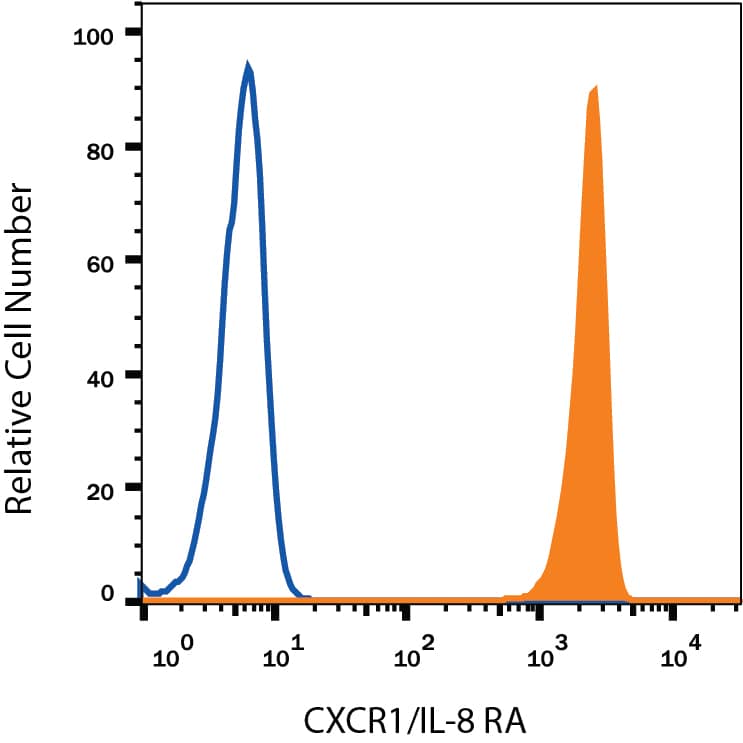
MAB003, open histogram), followed by Phycoerythrin-conjugated Anti-Mouse IgG F(ab')2Secondary Antibody (Catalog # F0102B). View our protocol for Staining Membrane-associated Proteins." title="Human whole blood monocytes were stained with Mouse Anti-Human CD37 Monoclonal Antibody (Catalog # MAB4625, filled histogram) or isotype control antibody (Catalog # MAB003, open histogram), followed by Phycoerythrin-conjugated Anti-Mouse IgG F(ab')2Secondary Antibody (Catalog # F0102B). View our protocol for Staining Membrane-associated Proteins." />
| Reactivity | HuSpecies Glossary |
| Applications | Flow, CyTOF-ready |
| Clone | 424925 |
| Clonality | Monoclonal |
| Host | Mouse |
| Conjugate | Unconjugated |
| Concentration | LYOPH |
| Immunogen | Mouse myeloma cell line NS0-derived recombinant human CD37 Accession # Q96LM7 |
| Specificity | Detects human CD37. Stains human CD37 transfectants but not irrelevant transfectants. |
| Source | N/A |
| Isotype | IgG2a |
| Clonality | Monoclonal |
| Host | Mouse |
| Gene | CD37 |
| Purity Statement | Protein A or G purified from hybridoma culture supernatant |
| Innovator's Reward | Test in a species/application not listed above to receive a full credit towards a future purchase. |
| Dilutions |
|
|
| Publications |
|
| Storage | Use a manual defrost freezer and avoid repeated freeze-thaw cycles.
|
| Buffer | Lyophilized from a 0.2 μm filtered solution in PBS with Trehalose. *Small pack size (SP) is supplied either lyophilized or as a 0.2 µm filtered solution in PBS. |
| Preservative | No Preservative |
| Concentration | LYOPH |
| Reconstitution Instructions | Reconstitute at 0.5 mg/mL in sterile PBS. |
CD37, also known as TSPAN26, is a 40‑45 kDa palmitoylated tetraspanin superfamily glycoprotein that is expressed by lymphocytes and myeloid cells. CD37 directly associates with dectin-1 on macrophages and stabilizes cell surface dectin-1 expression. It also inhibits T cell activation and proliferation by limiting T cell receptor signaling. Human CD37 shares 80% aa sequence identity with mouse and rat CD37.




![CD37 Antibody (424925) [Unconjugated]](/sites/all/modules/enterprise-tech/et_datasheets/images/novus_guarantee.png "CD37 Antibody (424925) [Unconjugated]")
| Publication using MAB4625 | Applications | Species |
|---|---|---|
| Jorgensen MM, Baek R, Varming K. Potentials and capabilities of the Extracellular Vesicle (EV) Array. J Extracell Vesicles 1/1/2015 [PMID: 25862471] |
Secondary Antibodies |
Isotype Controls |
|
CD81/TAPA1: I'm on Tapa the Cell Target of the antiproliferative 1 (TAPA1), also known as CD81, is found in the plasma membrane in lymphocytes and plays an important role in the regulation of lymphoma cell growth. This transmembrane 4 superfamily (TM4SF) protein is primarily found on... Read full blog post. |
The concentration calculator allows you to quickly calculate the volume, mass or concentration of your vial. Simply enter your mass, volume, or concentration values for your reagent and the calculator will determine the rest.


![Bioactivity CTLA-4 [Unconjugated]](https://images.novusbio.com/images/protein/CTLA4_7268CT_2293.jpg)




![Immunohistochemistry Neprilysin/CD10 Antibody [Unconjugated]](https://images.novusbio.com/images/antibody/Neprilysin_AF1126_Immunohistochemistry_6679.jpg)
![Immunohistochemistry Neprilysin/CD10 Antibody [Unconjugated]](https://images.novusbio.com/images/antibody/af1126_mouse-neprilysin-affinity-purified-polyclonal-ab-immunohistochemistry-7520268331.png)
![N/A Neprilysin/CD10 Antibody [Unconjugated]](https://images.novusbio.com/images/antibody/af1126_mouse-neprilysin-affinity-purified-polyclonal-ab-7520268433.png)
![Immunocytochemistry CD23/Fc epsilon RII Antibody [Unconjugated]](https://images.novusbio.com/images/antibody/CD23_AF123_Immunocytochemistry_6469.jpg)
![ELISA CD23/Fc epsilon RII Antibody [Unconjugated]](https://images.novusbio.com/images/af123_human-cd23-fc-epsilon-rii-affinity-purified-polyclonal-ab-elisa-639201850091061764.jpg)


![Western Blot CD40/TNFRSF5 Antibody [Unconjugated]](https://images.novusbio.com/images/af632_human-cd40-tnfrsf5-affinity-purified-polyclonal-ab-822024950191.jpg)
![Western Blot CD40/TNFRSF5 Antibody [Unconjugated]](https://images.novusbio.com/images/af632_human-cd40-tnfrsf5-affinity-purified-polyclonal-ab-44202415425047.jpg)
![Simple Western CD40/TNFRSF5 Antibody [Unconjugated]](https://images.novusbio.com/images/antibody/af632_human-cd40-tnfrsf5-affinity-purified-polyclonal-ab-simple-western-58202111562.jpg)
![Western Blot ICAM-1/CD54 Antibody [Unconjugated]](https://images.novusbio.com/images/af796_mouse-icam-1-cd54-affinity-purified-polyclonal-ab-41202410481192.jpg)
![Western Blot ICAM-1/CD54 Antibody [Unconjugated]](https://images.novusbio.com/images/af796_mouse-icam-1-cd54-affinity-purified-polyclonal-ab-4120241048112.jpg)
![Western Blot ICAM-1/CD54 Antibody [Unconjugated]](https://images.novusbio.com/images/af796_mouse-icam-1-cd54-affinity-purified-polyclonal-ab-4120241049436.jpg)
![Immunocytochemistry TSPAN8/TM4SF3 Antibody (458811) [Unconjugated]](https://images.novusbio.com/images/mab4734_human-tspan8-mab-clone-458811-immunocytochemistry-792022112521.jpg)
![Immunocytochemistry TSPAN8/TM4SF3 Antibody (458811) [Unconjugated]](https://images.novusbio.com/images/antibody/TSPAN8_MAB4734_Immunocytochemistry_9894.jpg)
![Flow Cytometry TSPAN8/TM4SF3 Antibody (458811) [Unconjugated]](https://images.novusbio.com/images/antibody/TSPAN8_MAB4734_Flow_Cytometry_8501.jpg)